

Milk shake, fast food, chocolate
Common food

Photo: Wikipedia
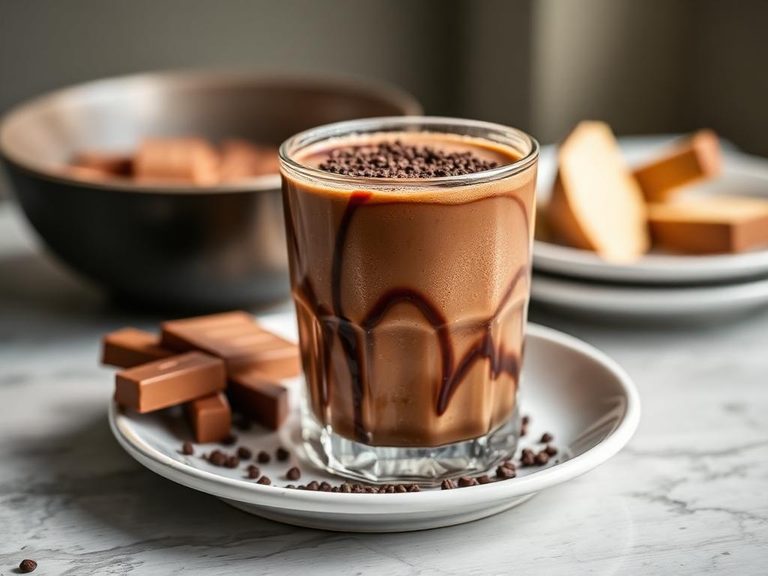
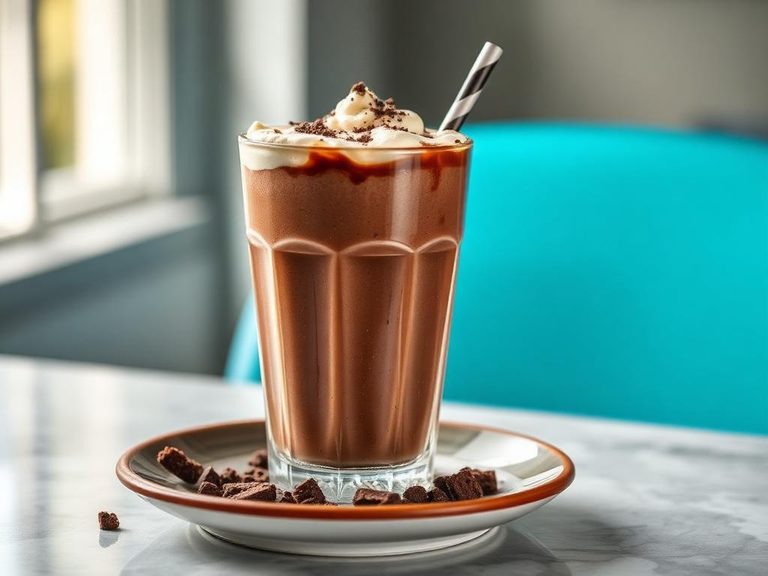
A classic fast-food chocolate milkshake is a thick, frosty blend of ice cream, milk, and chocolate syrup, delivering a rich, creamy texture and a sweet, indulgent cocoa flavor. Nutritionally, it's a significant source of quick energy from carbohydrates, particularly simple sugars, with a modest amount of protein and fat.
Calorie split: 9% protein · 52% carbs · 38% fat
↓ Full nutrition💚 Why it's loved
People love it for the immediate, satisfying combination of cold, creamy texture and deep chocolate sweetness, often evoking nostalgic feelings of diners and summer outings. Its versatility makes it a popular dessert or indulgent snack that pairs well with salty foods like fries.
⚠️ Watch-outs & how to enjoy it better
The high sugar content can lead to a rapid blood-sugar spike and subsequent crash, making it a poor choice for those managing diabetes or seeking sustained energy. To counteract this, pair it with a source of protein or healthy fat (like nuts) to slow sugar absorption, and practice strict portion control by sharing or choosing a small size.
Key benefits
- Provides quick energy from carbohydrates
- Contains some calcium and protein from dairy
- Can be a comforting treat and mood booster
- Offers a convenient, ready-to-drink format
🍽️ Popular dishes


🌍 Where it's eaten
💡 Did you know?
The milkshake in its modern, drinkable form was popularized in the 1920s after the invention of the electric blender, which allowed ice cream to be smoothly incorporated with milk and flavorings.
Full nutrition (USDA data · scales with serving)
| Water | 68.3 g |
| Energy | 150 kcal |
| Protein | 3.7 g |
| Total lipid (fat) | 6.7 g |
| Carbohydrate, by difference | 20.4 g |
| Fiber, total dietary | 1.6 g |
| Total Sugars | 13.4 g |
| Calcium, Ca | 115 mg |
| Iron, Fe | 0.73 mg |
| Magnesium, Mg | 23.0 mg |
| Phosphorus, P | 111 mg |
| Potassium, K | 193 mg |
| Sodium, Na | 80.0 mg |
| Zinc, Zn | 0.70 mg |
| Copper, Cu | 0.18 mg |
| Selenium, Se | 3.4 ug |
| Vitamin C, total ascorbic acid | 0.00 mg |
| Thiamin | 0.03 mg |
| Riboflavin | 0.65 mg |
| Niacin | 0.25 mg |
| Vitamin B-6 | 0.06 mg |
| Folate, total | 1.0 ug |
| Folic acid | 0.00 ug |
| Folate, food | 1.0 ug |
| Folate, DFE | 1.0 ug |
| Choline, total | 27.0 mg |
| Vitamin B-12 | 0.22 ug |
| Vitamin B-12, added | 0.00 ug |
| Vitamin A, RAE | 89.0 ug |
| Retinol | 89.0 ug |
| Carotene, beta | 0.00 ug |
| Carotene, alpha | 0.00 ug |
| Cryptoxanthin, beta | 0.00 ug |
| Lycopene | 0.00 ug |
| Lutein + zeaxanthin | 1.0 ug |
| Vitamin E (alpha-tocopherol) | 0.25 mg |
| Vitamin E, added | 0.00 mg |
| Vitamin D (D2 + D3) | 0.00 ug |
| Vitamin K (phylloquinone) | 0.40 ug |
| Alcohol, ethyl | 0.00 g |
| Caffeine | 5.0 mg |
| Theobromine | 41.0 mg |
Fat & fatty acid profile (per 100g)
| Fatty acids, total saturated | 4.0 g |
| SFA 4:0 | 0.19 g |
| SFA 6:0 | 0.15 g |
| SFA 8:0 | 0.07 g |
| SFA 10:0 | 0.15 g |
| SFA 12:0 | 0.17 g |
| SFA 14:0 | 0.58 g |
| SFA 16:0 | 1.8 g |
| SFA 18:0 | 0.86 g |
| Fatty acids, total monounsaturated | 1.8 g |
| MUFA 16:1 | 0.11 g |
| MUFA 18:1 | 1.7 g |
| MUFA 20:1 | 0.00 g |
| MUFA 22:1 | 0.00 g |
| Fatty acids, total polyunsaturated | 0.32 g |
| PUFA 18:2 | 0.27 g |
| PUFA 18:3 | 0.03 g |
| PUFA 18:4 | 0.01 g |
| PUFA 20:4 | 0.01 g |
| PUFA 20:5 n-3 (EPA) | 0.00 g |
| PUFA 22:5 n-3 (DPA) | 0.00 g |
| PUFA 22:6 n-3 (DHA) | 0.00 g |
| Cholesterol | 23.0 mg |
Amino acid profile (per 100g)
Estimated from Milk shakes, thick chocolate — USDA does not publish this profile for Milk shake.
| Tryptophan | 0.04 g |
| Threonine | 0.14 g |
| Isoleucine | 0.18 g |
| Leucine | 0.30 g |
| Lysine | 0.24 g |
| Methionine | 0.08 g |
| Cystine | 0.03 g |
| Phenylalanine | 0.15 g |
| Tyrosine | 0.15 g |
| Valine | 0.20 g |
| Arginine | 0.11 g |
| Histidine | 0.08 g |
| Alanine | 0.10 g |
| Aspartic acid | 0.23 g |
| Glutamic acid | 0.64 g |
| Glycine | 0.07 g |
| Proline | 0.29 g |
| Serine | 0.17 g |
FAQ
Is a chocolate milkshake a good source of calcium?
Yes, because its primary ingredients are milk and ice cream, it provides a notable amount of calcium, which is essential for bone health. However, the high sugar and fat content mean it's not the most nutrient-efficient source.
Can I make a healthier version at home?
Absolutely. You can blend frozen bananas with a small amount of milk, a scoop of chocolate protein powder, and a tablespoon of cocoa powder for a version with less added sugar and more protein and fiber.
Why does a fast-food milkshake sometimes taste different than homemade?
Fast-food versions often use pre-made mixes, stabilizers, and emulsifiers to ensure consistent texture, thickness, and flavor across locations, which can create a distinct mouthfeel compared to a simple homemade blend of ice cream and milk.
Nutrient density (calculated · NRF9.3)
Nutrient Rich Foods index: beneficial nutrients (protein, fiber, vitamins, minerals) minus saturated fat, added sugar & sodium, per 100 kcal.
NRF9.3 index — Fulgoni, Keast & Drewnowski, 2009. Computed from USDA nutrients.
Weight-loss friendliness (composite index)
Energy density 1.50 kcal/g · 10% calories from protein · 1.6 g fiber · 13.4 g sugar per 100 g.
Composite of energy density (Rolls et al., 1999), protein & fiber satiety, minus sugar. A calculated heuristic — ranks satiety-per-calorie, not a clinical measure.
Dietary load (calculated from USDA values)
Potential renal acid load. Positive = acid-forming, negative = alkaline-forming.
Sodium-to-potassium ratio: 0.41 (lower is better — aim for ≤ 1)
Sodium:potassium per WHO potassium guidance. Computed from USDA nutrients.