

Beverages, shake, fast food, strawberry
Whole food · Beverages

Photo: Wikipedia
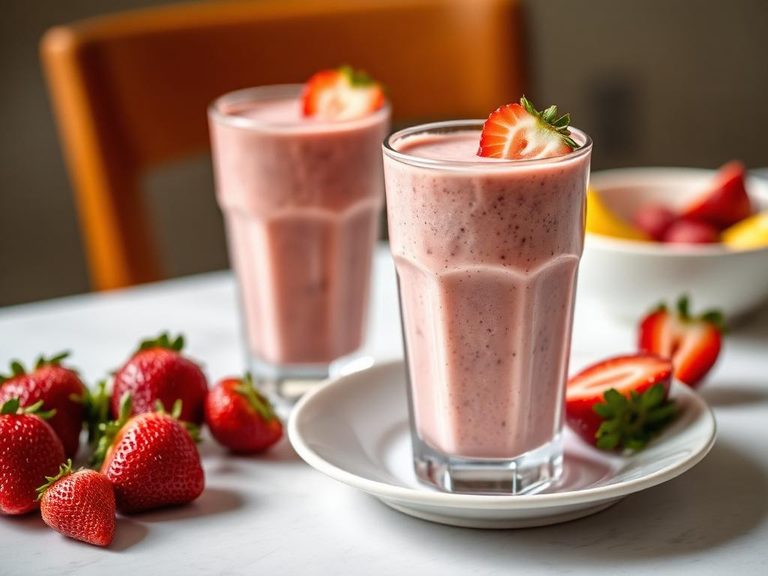
This is a classic, creamy strawberry shake, a staple of fast-food menus, offering a sweet, nostalgic flavor with a smooth, thick texture. Nutritionally, it provides a moderate calorie boost with a significant carbohydrate content, primarily from added sugars and milk. Its simple profile makes it a quick, indulgent treat rather than a nutrient-dense beverage.
Calorie split: 12% protein · 66% carbs · 22% fat
↓ Full nutrition💚 Why it's loved
People love it for its sweet, creamy, and refreshing strawberry flavor, which evokes a sense of nostalgia and comfort. It's a versatile treat that pairs well with savory fast-food meals, offering a cool contrast to salty items like fries or burgers.
⚠️ Watch-outs & how to enjoy it better
The high sugar and carbohydrate content can lead to rapid blood-sugar spikes, making it less suitable for individuals managing diabetes or insulin resistance. To counteract this, consider pairing it with a high-protein, low-carb meal (like grilled chicken) and opting for a smaller portion size to moderate the glycemic impact.
Key benefits
- Quick source of energy from carbohydrates
- Provides a small amount of protein from milk base
- Offers calcium and vitamin D if made with dairy milk
- Convenient and widely available fast-food option
- Can be a palatable way to consume milk for some individuals
🍽️ Popular dishes

🌍 Where it's eaten
💡 Did you know?
The strawberry milkshake is believed to have been invented in the early 1900s, with the first electric blender specifically designed for milkshakes appearing in 1911, revolutionizing its smooth texture.
Full nutrition (USDA data · scales with serving)
| Water | 74.1 g |
| Energy | 113 kcal |
| Energy | 473 kj |
| Protein | 3.4 g |
| Total lipid (fat) | 2.8 g |
| Ash | 0.90 g |
| Carbohydrate, by difference | 18.9 g |
| Fiber, total dietary | 0.40 g |
| Calcium, Ca | 113 mg |
| Iron, Fe | 0.11 mg |
| Magnesium, Mg | 13.0 mg |
| Phosphorus, P | 100 mg |
| Potassium, K | 182 mg |
| Sodium, Na | 83.0 mg |
| Zinc, Zn | 0.36 mg |
| Copper, Cu | 0.02 mg |
| Manganese, Mn | 0.01 mg |
| Selenium, Se | 2.1 ug |
| Vitamin C, total ascorbic acid | 0.80 mg |
| Thiamin | 0.04 mg |
| Riboflavin | 0.20 mg |
| Niacin | 0.17 mg |
| Pantothenic acid | 0.49 mg |
| Vitamin B-6 | 0.04 mg |
| Folate, total | 3.0 ug |
| Folic acid | 0.00 ug |
| Folate, food | 3.0 ug |
| Folate, DFE | 3.0 ug |
| Vitamin B-12 | 0.31 ug |
| Vitamin A, RAE | 26.0 ug |
| Retinol | 26.0 ug |
| Vitamin A, IU | 120 iu |
| Vitamin D (D2 + D3), International Units | 0.00 iu |
| Vitamin D (D2 + D3) | 0.00 ug |
Fat & fatty acid profile (per 100g)
| Fatty acids, total saturated | 1.7 g |
| Fatty acids, total trans | 0.00 g |
| Cholesterol | 11.0 mg |
Amino acid profile (per 100g)
| Tryptophan | 0.05 g |
| Threonine | 0.15 g |
| Isoleucine | 0.20 g |
| Leucine | 0.33 g |
| Lysine | 0.27 g |
| Methionine | 0.08 g |
| Cystine | 0.03 g |
| Phenylalanine | 0.16 g |
| Tyrosine | 0.16 g |
| Valine | 0.23 g |
| Arginine | 0.12 g |
| Histidine | 0.09 g |
| Alanine | 0.12 g |
| Aspartic acid | 0.25 g |
| Glutamic acid | 0.70 g |
| Glycine | 0.07 g |
| Proline | 0.33 g |
| Serine | 0.18 g |
FAQ
Is a strawberry shake a good source of protein?
No, it provides only a modest amount of protein (around 3.4g per 100g), which is insufficient for a significant protein boost. It's primarily a source of carbohydrates and calories.
Can I make a healthier version at home?
Yes, you can blend fresh or frozen strawberries with Greek yogurt, a small amount of milk, and a natural sweetener like honey to increase protein and reduce added sugars.
How does it compare to a strawberry smoothie?
A shake is typically made with ice cream or milk and sugar, while a smoothie often uses fresh fruit, yogurt, or juice, making it generally lower in sugar and higher in fiber and nutrients.
Nutrient density (calculated · NRF9.3)
Nutrient Rich Foods index: beneficial nutrients (protein, fiber, vitamins, minerals) minus saturated fat, added sugar & sodium, per 100 kcal.
NRF9.3 index — Fulgoni, Keast & Drewnowski, 2009. Computed from USDA nutrients.
Weight-loss friendliness (composite index)
Energy density 1.13 kcal/g · 12% calories from protein · 0.4 g fiber · 0.0 g sugar per 100 g.
Composite of energy density (Rolls et al., 1999), protein & fiber satiety, minus sugar. A calculated heuristic — ranks satiety-per-calorie, not a clinical measure.
Dietary load (calculated from USDA values)
Potential renal acid load. Positive = acid-forming, negative = alkaline-forming.
Sodium-to-potassium ratio: 0.46 (lower is better — aim for ≤ 1)
Sodium:potassium per WHO potassium guidance. Computed from USDA nutrients.