

Lamb, variety meats and by-products, brain, cooked, braised
Whole food · Lamb, Veal, and Game Products

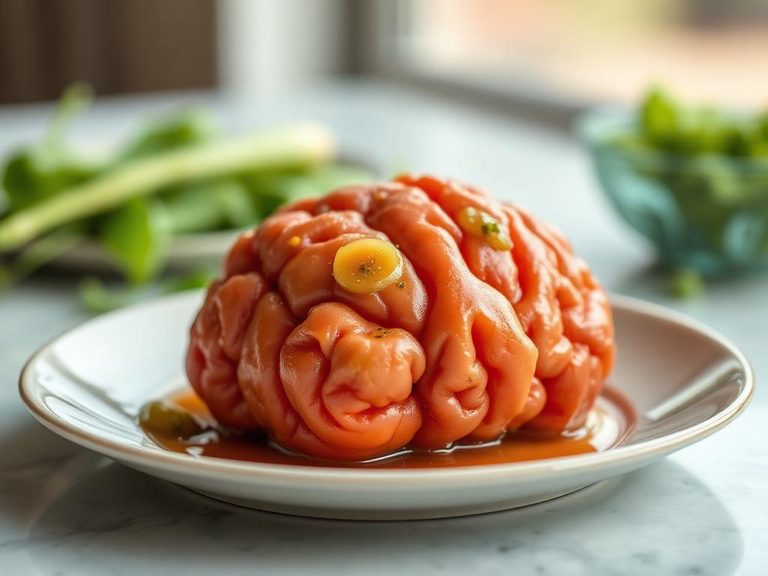
Photo: Wikipedia
Braised lamb brain is a rich, delicate offal prized for its exceptionally tender, creamy texture that melts on the tongue. With a mild, slightly mineral flavor, it absorbs sauces and spices beautifully, often compared to a savory custard. Nutritionally, it is a lean source of high-quality protein and healthy fats, providing 12.55g protein and 10.17g fat per 100g with zero carbohydrates.
Calorie split: 35% protein · 0% carbs · 65% fat
↓ Full nutrition💚 Why it's loved
People love it for its unique, buttery mouthfeel and ability to take on complex flavors from braising liquids and spices. It is a cultural delicacy in many cuisines, often associated with traditional celebrations and nose-to-tail eating.
⚠️ Watch-outs & how to enjoy it better
The texture can be off-putting to those unfamiliar with it, and its high cholesterol content may concern some individuals. To mitigate, consume in moderate portions and pair with fiber-rich vegetables; ensure thorough cooking to avoid any potential food safety risks.
Key benefits
- Excellent source of complete protein for muscle maintenance
- Rich in healthy fats, including omega-3 fatty acids
- Provides essential vitamins like B12 and riboflavin
- Contains minerals such as phosphorus and selenium
- Low in carbohydrates, suitable for ketogenic diets
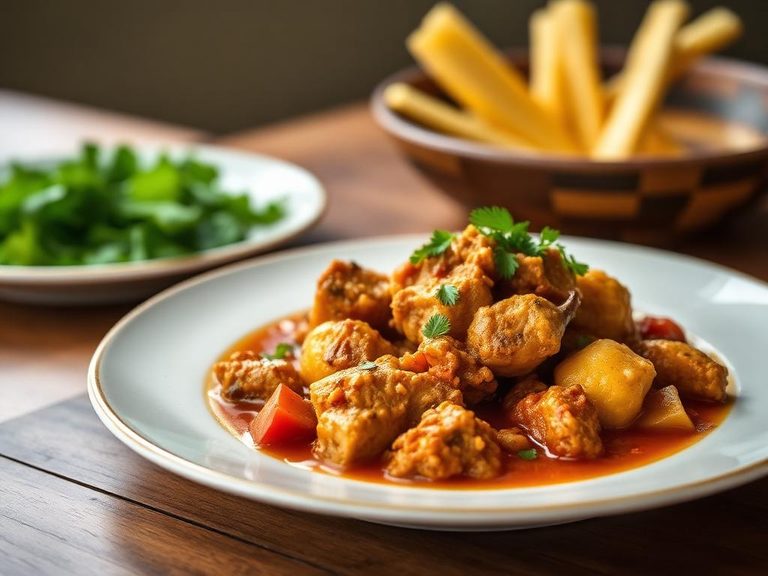
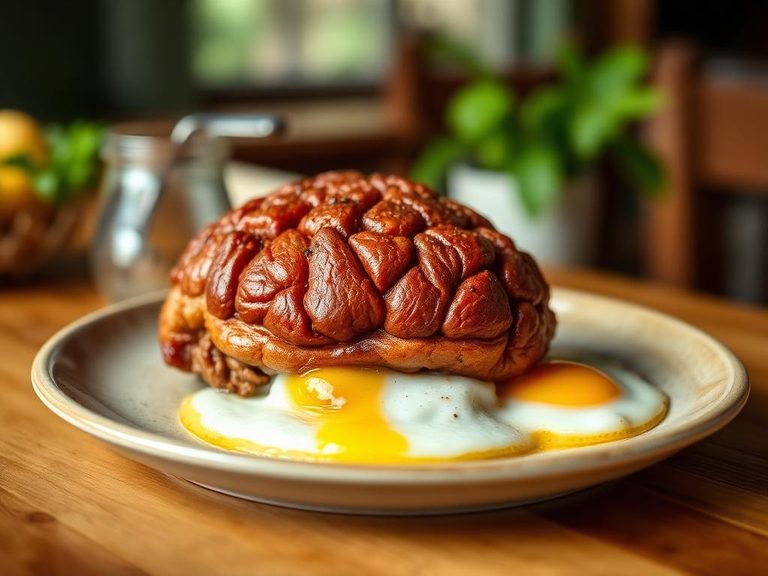
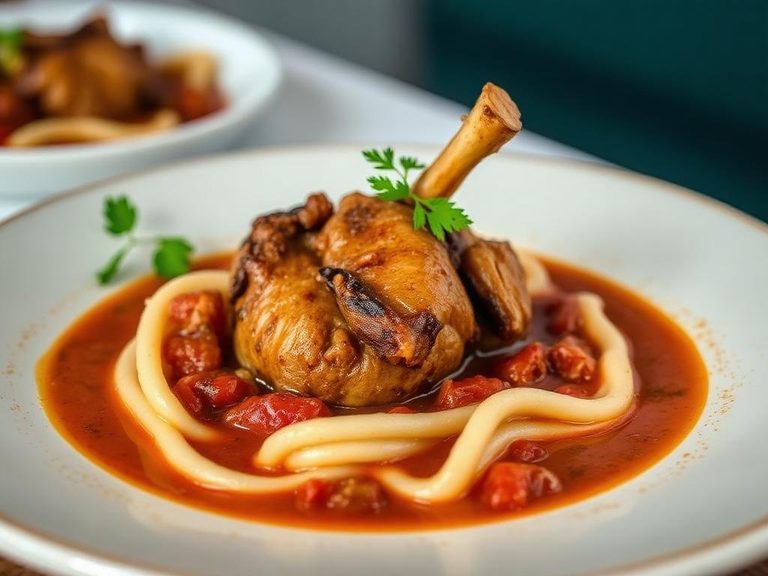
🍽️ Popular dishes
🌍 Where it's eaten
💡 Did you know?
Lamb brain is one of the richest natural sources of the omega-3 fatty acid DHA, which is crucial for brain health, and it contains a higher concentration of this nutrient than many fish.
Full nutrition (USDA data · scales with serving)
| Water | 75.7 g |
| Energy | 145 kcal |
| Energy | 607 kj |
| Protein | 12.6 g |
| Total lipid (fat) | 10.2 g |
| Ash | 1.4 g |
| Carbohydrate, by difference | 0.00 g |
| Fiber, total dietary | 0.00 g |
| Calcium, Ca | 12.0 mg |
| Iron, Fe | 1.7 mg |
| Magnesium, Mg | 14.0 mg |
| Phosphorus, P | 337 mg |
| Potassium, K | 205 mg |
| Sodium, Na | 134 mg |
| Zinc, Zn | 1.4 mg |
| Copper, Cu | 0.21 mg |
| Manganese, Mn | 0.06 mg |
| Selenium, Se | 12.0 ug |
| Vitamin C, total ascorbic acid | 12.0 mg |
| Thiamin | 0.11 mg |
| Riboflavin | 0.24 mg |
| Niacin | 2.5 mg |
| Pantothenic acid | 0.99 mg |
| Vitamin B-6 | 0.11 mg |
| Folate, total | 5.0 ug |
| Folic acid | 0.00 ug |
| Folate, food | 5.0 ug |
| Folate, DFE | 5.0 ug |
| Vitamin B-12 | 9.3 ug |
| Vitamin A, RAE | 0.00 ug |
| Retinol | 0.00 ug |
| Vitamin A, IU | 0.00 iu |
| Alcohol, ethyl | 0.00 g |
Fat & fatty acid profile (per 100g)
| Fatty acids, total saturated | 2.6 g |
| SFA 4:0 | 0.00 g |
| SFA 6:0 | 0.00 g |
| SFA 8:0 | 0.00 g |
| SFA 10:0 | 0.00 g |
| SFA 12:0 | 0.00 g |
| SFA 14:0 | 0.04 g |
| SFA 16:0 | 1.3 g |
| SFA 18:0 | 1.3 g |
| Fatty acids, total monounsaturated | 1.8 g |
| MUFA 16:1 | 0.06 g |
| MUFA 18:1 | 1.5 g |
| MUFA 20:1 | 0.15 g |
| MUFA 22:1 | 0.00 g |
| Fatty acids, total polyunsaturated | 1.0 g |
| PUFA 18:2 | 0.03 g |
| PUFA 18:3 | 0.00 g |
| PUFA 18:4 | 0.00 g |
| PUFA 20:4 | 0.27 g |
| PUFA 20:5 n-3 (EPA) | 0.00 g |
| PUFA 22:5 n-3 (DPA) | 0.15 g |
| PUFA 22:6 n-3 (DHA) | 0.59 g |
| Cholesterol | 2043 mg |
Amino acid profile (per 100g)
| Tryptophan | 0.13 g |
| Threonine | 0.56 g |
| Isoleucine | 0.50 g |
| Leucine | 0.98 g |
| Lysine | 0.81 g |
| Methionine | 0.25 g |
| Cystine | 0.13 g |
| Phenylalanine | 0.60 g |
| Tyrosine | 0.46 g |
| Valine | 0.60 g |
| Arginine | 0.85 g |
| Histidine | 0.33 g |
| Alanine | 0.71 g |
| Aspartic acid | 1.0 g |
| Glutamic acid | 1.5 g |
| Glycine | 0.59 g |
| Proline | 0.54 g |
| Serine | 0.65 g |
FAQ
How is lamb brain typically prepared?
Lamb brain is usually cleaned, then braised, fried, or scrambled. It's often cooked with spices, onions, and tomatoes to enhance its mild flavor.
Is lamb brain safe to eat?
Yes, when properly sourced and cooked to an internal temperature of at least 165°F (74°C) to eliminate any potential pathogens. It should be fresh and handled hygienically.
What does lamb brain taste like?
It has a mild, slightly sweet and mineral flavor with a soft, creamy, and custard-like texture, often compared to a delicate tofu or soft cheese.
Nutrient density (calculated · NRF9.3)
Nutrient Rich Foods index: beneficial nutrients (protein, fiber, vitamins, minerals) minus saturated fat, added sugar & sodium, per 100 kcal.
NRF9.3 index — Fulgoni, Keast & Drewnowski, 2009. Computed from USDA nutrients.
Weight-loss friendliness (composite index)
Energy density 1.45 kcal/g · 35% calories from protein · 0.0 g fiber · 0.0 g sugar per 100 g.
Composite of energy density (Rolls et al., 1999), protein & fiber satiety, minus sugar. A calculated heuristic — ranks satiety-per-calorie, not a clinical measure.
Dietary load (calculated from USDA values)
Potential renal acid load. Positive = acid-forming, negative = alkaline-forming.
Sodium-to-potassium ratio: 0.65 (lower is better — aim for ≤ 1)
Sodium:potassium per WHO potassium guidance. Computed from USDA nutrients.