

Ice cream cone, NFS
Common food
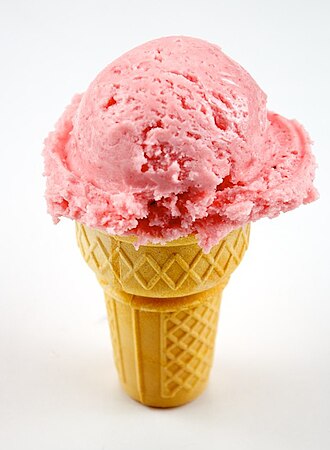
Photo: Wikipedia
An ice cream cone is a crisp, edible wafer or sugar cone holding a scoop of frozen dairy dessert. The cone provides a satisfying crunch that contrasts with the smooth, creamy, and cold ice cream. Nutritionally, it's a treat high in simple sugars and fats, with a modest amount of protein from the dairy.
Calorie split: 7% protein · 50% carbs · 44% fat
↓ Full nutrition💚 Why it's loved
People love it for the perfect marriage of textures—the crisp, sometimes sweet cone against the soft, melting ice cream. It's a nostalgic, portable symbol of summer, celebration, and simple indulgence.
⚠️ Watch-outs & how to enjoy it better
The high sugar and refined carb content can lead to rapid blood-sugar spikes, and the saturated fat may concern those monitoring heart health. To counteract, enjoy it occasionally as a planned treat, pair it with a protein-rich meal, or opt for a smaller scoop to manage portions.
Key benefits
- Provides a quick source of energy from carbohydrates.
- Contains calcium and some protein from the dairy ice cream.
- Offers a convenient, handheld serving format.
- Can be a source of enjoyment and psychological comfort.
🍽️ Popular dishes
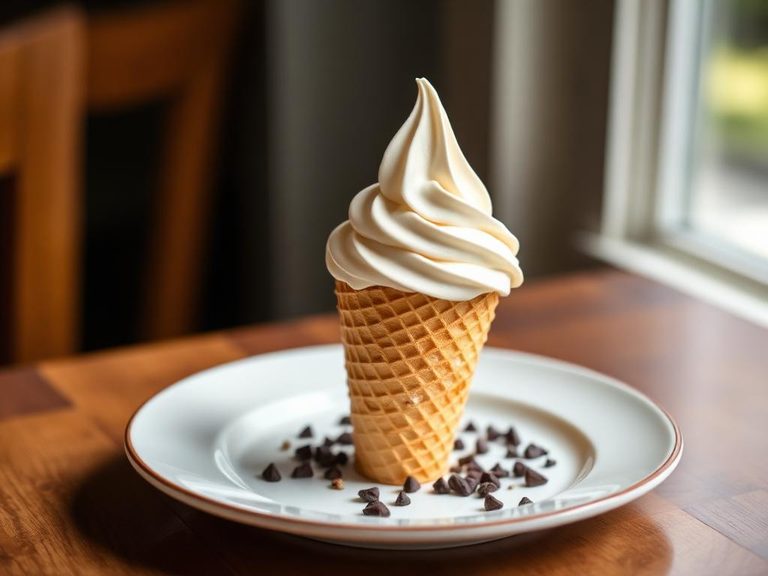
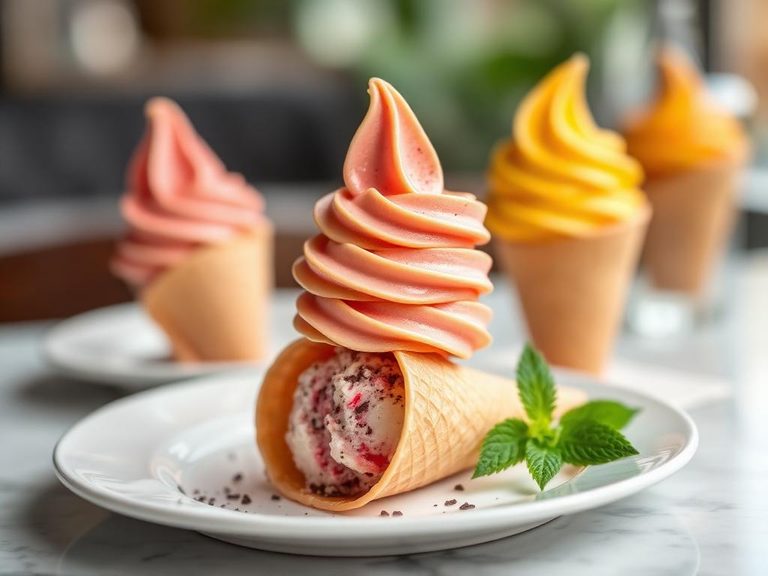


🌍 Where it's eaten
💡 Did you know?
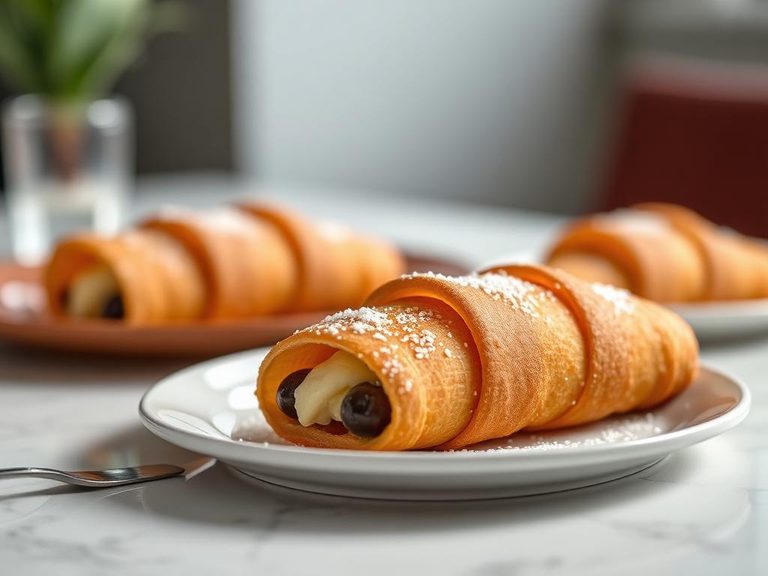
The first known ice cream cone was not a cone at all, but a waffle rolled into a cylinder; it was popularized at the 1904 St. Louis World's Fair, though its exact invention is still debated.
Full nutrition (USDA data · scales with serving)
| Water | 55.7 g |
| Energy | 229 kcal |
| Protein | 3.8 g |
| Total lipid (fat) | 11.1 g |
| Carbohydrate, by difference | 28.5 g |
| Fiber, total dietary | 0.90 g |
| Total Sugars | 22.2 g |
| Calcium, Ca | 120 mg |
| Iron, Fe | 0.43 mg |
| Magnesium, Mg | 16.0 mg |
| Phosphorus, P | 105 mg |
| Potassium, K | 199 mg |
| Sodium, Na | 97.0 mg |
| Zinc, Zn | 0.72 mg |
| Copper, Cu | 0.05 mg |
| Selenium, Se | 2.0 ug |
| Vitamin C, total ascorbic acid | 0.60 mg |
| Thiamin | 0.05 mg |
| Riboflavin | 0.24 mg |
| Niacin | 0.33 mg |
| Vitamin B-6 | 0.04 mg |
| Folate, total | 12.0 ug |
| Folic acid | 7.0 ug |
| Folate, food | 5.0 ug |
| Folate, DFE | 18.0 ug |
| Choline, total | 24.7 mg |
| Vitamin B-12 | 0.36 ug |
| Vitamin B-12, added | 0.00 ug |
| Vitamin A, RAE | 108 ug |
| Retinol | 106 ug |
| Carotene, beta | 17.0 ug |
| Carotene, alpha | 0.00 ug |
| Cryptoxanthin, beta | 0.00 ug |
| Lycopene | 0.00 ug |
| Lutein + zeaxanthin | 1.0 ug |
| Vitamin E (alpha-tocopherol) | 0.40 mg |
| Vitamin E, added | 0.00 mg |
| Vitamin D (D2 + D3) | 0.20 ug |
| Vitamin K (phylloquinone) | 0.80 ug |
| Alcohol, ethyl | 0.00 g |
| Caffeine | 1.0 mg |
| Theobromine | 12.0 mg |
Fat & fatty acid profile (per 100g)
| Fatty acids, total saturated | 6.6 g |
| SFA 4:0 | 0.34 g |
| SFA 6:0 | 0.19 g |
| SFA 8:0 | 0.11 g |
| SFA 10:0 | 0.26 g |
| SFA 12:0 | 0.29 g |
| SFA 14:0 | 1.0 g |
| SFA 16:0 | 3.0 g |
| SFA 18:0 | 1.4 g |
| Fatty acids, total monounsaturated | 3.1 g |
| MUFA 16:1 | 0.19 g |
| MUFA 18:1 | 2.9 g |
| MUFA 20:1 | 0.00 g |
| MUFA 22:1 | 0.00 g |
| Fatty acids, total polyunsaturated | 0.61 g |
| PUFA 18:2 | 0.44 g |
| PUFA 18:3 | 0.17 g |
| PUFA 18:4 | 0.00 g |
| PUFA 20:4 | 0.00 g |
| PUFA 20:5 n-3 (EPA) | 0.00 g |
| PUFA 22:5 n-3 (DPA) | 0.00 g |
| PUFA 22:6 n-3 (DHA) | 0.00 g |
| Cholesterol | 40.0 mg |
Amino acid profile (per 100g)
Estimated from Ice creams, vanilla, rich — USDA does not publish this profile for Ice cream cone.
| Tryptophan | 0.04 g |
| Threonine | 0.14 g |
| Isoleucine | 0.18 g |
| Leucine | 0.30 g |
| Lysine | 0.25 g |
| Methionine | 0.08 g |
| Cystine | 0.03 g |
| Phenylalanine | 0.15 g |
| Tyrosine | 0.14 g |
| Valine | 0.20 g |
| Arginine | 0.14 g |
| Histidine | 0.08 g |
| Alanine | 0.14 g |
| Glutamic acid | 0.65 g |
| Glycine | 0.15 g |
| Proline | 0.34 g |
| Serine | 0.17 g |
FAQ
Is an ice cream cone gluten-free?
Traditional sugar and wafer cones are made with wheat flour and contain gluten. However, gluten-free cones made from rice flour, corn, or other alternative flours are widely available.
Why does the bottom of the cone sometimes get soggy?
Moisture from the melting ice cream migrates into the porous cone structure. To slow this, some cones have a chocolate or candy lining inside, or you can eat it quickly!
What's the difference between a sugar cone and a cake cone?
A sugar cone is denser, sweeter, and has a pointed bottom. A cake cone (or wafer cone) is lighter, less sweet, has a flat bottom, and a more open, grid-like texture.
Nutrient density (calculated · NRF9.3)
Nutrient Rich Foods index: beneficial nutrients (protein, fiber, vitamins, minerals) minus saturated fat, added sugar & sodium, per 100 kcal.
NRF9.3 index — Fulgoni, Keast & Drewnowski, 2009. Computed from USDA nutrients.
Weight-loss friendliness (composite index)
Energy density 2.29 kcal/g · 7% calories from protein · 0.9 g fiber · 22.2 g sugar per 100 g.
Composite of energy density (Rolls et al., 1999), protein & fiber satiety, minus sugar. A calculated heuristic — ranks satiety-per-calorie, not a clinical measure.
Dietary load (calculated from USDA values)
Potential renal acid load. Positive = acid-forming, negative = alkaline-forming.
Sodium-to-potassium ratio: 0.49 (lower is better — aim for ≤ 1)
Sodium:potassium per WHO potassium guidance. Computed from USDA nutrients.