

Ham sandwich on wheat
Common food
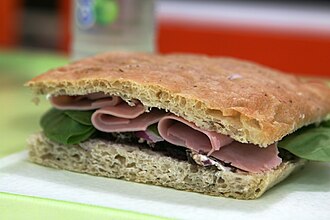
Photo: Wikipedia
A classic ham sandwich on wheat bread offers a satisfying balance of savory, salty ham against the nutty, slightly chewy texture of whole-wheat bread. It's a protein-packed, moderately caloric meal that provides quick energy from its carbohydrate content while the fiber in the wheat helps promote a feeling of fullness.
Calorie split: 30% protein · 51% carbs · 19% fat
↓ Full nutrition💚 Why it's loved
People love its reliable, comforting simplicity—the familiar salty-savory flavor of ham paired with the earthy taste of wheat bread. It's a versatile staple that can be dressed up with mustard, cheese, and greens or enjoyed plain, making it a go-to for quick lunches, picnics, and packed meals.
⚠️ Watch-outs & how to enjoy it better
Processed ham is often high in sodium, which can be a concern for those monitoring blood pressure. The wheat bread, while containing fiber, can still cause a moderate blood-sugar spike for some individuals. To counteract this, pair the sandwich with a source of healthy fat (like avocado or a handful of nuts) and a side of non-starchy vegetables (like a leafy green salad) to slow digestion and blunt the glycemic response. Choosing low-sodium ham and whole-grain bread with at least 3g of fiber per slice is also beneficial.
Key benefits
- Good source of protein for muscle maintenance and satiety
- Whole-wheat bread provides dietary fiber for digestive health
- Convenient, portable, and requires no cooking
- Balanced macronutrient profile for a quick meal
- Can be easily customized with vegetables for added nutrients
🍽️ Popular dishes




🌍 Where it's eaten
💡 Did you know?
The ham sandwich is so iconic in the United States that it was the subject of a famous 1976 Supreme Court case (United States v. 11 1/4 Dozen Packages of Articles Labeled in Part 'Peter Pan Peanut Butter'), where the Court ruled that a sandwich must consist of two slices of bread, effectively defining it for regulatory purposes.
Full nutrition (USDA data · scales with serving)
| Water | 55.7 g |
| Energy | 185 kcal |
| Protein | 14.0 g |
| Total lipid (fat) | 3.9 g |
| Carbohydrate, by difference | 23.6 g |
| Fiber, total dietary | 2.8 g |
| Total Sugars | 2.7 g |
| Calcium, Ca | 86.0 mg |
| Iron, Fe | 1.9 mg |
| Magnesium, Mg | 38.0 mg |
| Phosphorus, P | 212 mg |
| Potassium, K | 303 mg |
| Sodium, Na | 657 mg |
| Zinc, Zn | 1.4 mg |
| Copper, Cu | 0.12 mg |
| Selenium, Se | 29.5 ug |
| Vitamin C, total ascorbic acid | 0.10 mg |
| Thiamin | 0.37 mg |
| Riboflavin | 0.24 mg |
| Niacin | 5.3 mg |
| Vitamin B-6 | 0.27 mg |
| Folate, total | 37.0 ug |
| Folic acid | 7.0 ug |
| Folate, food | 30.0 ug |
| Folate, DFE | 43.0 ug |
| Choline, total | 41.1 mg |
| Vitamin B-12 | 0.17 ug |
| Vitamin B-12, added | 0.00 ug |
| Vitamin A, RAE | 0.00 ug |
| Retinol | 0.00 ug |
| Carotene, beta | 1.0 ug |
| Carotene, alpha | 0.00 ug |
| Cryptoxanthin, beta | 0.00 ug |
| Lycopene | 0.00 ug |
| Lutein + zeaxanthin | 33.0 ug |
| Vitamin E (alpha-tocopherol) | 0.32 mg |
| Vitamin E, added | 0.00 mg |
| Vitamin D (D2 + D3) | 0.30 ug |
| Vitamin K (phylloquinone) | 2.9 ug |
| Alcohol, ethyl | 0.00 g |
| Caffeine | 0.00 mg |
| Theobromine | 0.00 mg |
Fat & fatty acid profile (per 100g)
| Fatty acids, total saturated | 0.91 g |
| SFA 4:0 | 0.00 g |
| SFA 6:0 | 0.00 g |
| SFA 8:0 | 0.00 g |
| SFA 10:0 | 0.00 g |
| SFA 12:0 | 0.01 g |
| SFA 14:0 | 0.02 g |
| SFA 16:0 | 0.57 g |
| SFA 18:0 | 0.29 g |
| Fatty acids, total monounsaturated | 1.0 g |
| MUFA 16:1 | 0.05 g |
| MUFA 18:1 | 0.98 g |
| MUFA 20:1 | 0.02 g |
| MUFA 22:1 | 0.00 g |
| Fatty acids, total polyunsaturated | 1.1 g |
| PUFA 18:2 | 0.94 g |
| PUFA 18:3 | 0.08 g |
| PUFA 18:4 | 0.00 g |
| PUFA 20:4 | 0.03 g |
| PUFA 20:5 n-3 (EPA) | 0.00 g |
| PUFA 22:5 n-3 (DPA) | 0.00 g |
| PUFA 22:6 n-3 (DHA) | 0.00 g |
| Cholesterol | 20.0 mg |
Amino acid profile (per 100g)
Estimated from HOT POCKETS Ham 'N Cheese Stuffed Sandwich, frozen — USDA does not publish this profile for Ham sandwich on wheat.
| Tryptophan | 0.13 g |
| Threonine | 0.35 g |
| Isoleucine | 0.39 g |
| Leucine | 0.73 g |
| Lysine | 0.54 g |
| Methionine | 0.19 g |
| Cystine | 0.13 g |
| Phenylalanine | 0.41 g |
| Tyrosine | 0.26 g |
| Valine | 0.45 g |
| Arginine | 0.47 g |
| Histidine | 0.28 g |
| Alanine | 0.40 g |
| Aspartic acid | 0.65 g |
| Glutamic acid | 2.1 g |
| Glycine | 0.39 g |
| Proline | 0.76 g |
| Serine | 0.42 g |
FAQ
Is a ham sandwich on wheat bread healthy?
It can be a reasonably healthy option, especially compared to sandwiches on white bread or with fatty meats. The whole-wheat bread offers more fiber and nutrients, and ham provides protein. Its healthiness largely depends on the specific ingredients: choosing low-sodium, minimally processed ham and bread with high fiber content, and loading it with vegetables, makes it a balanced meal.
How can I make a ham sandwich on wheat more nutritious?
Boost its nutritional value by adding plenty of fresh vegetables like spinach, tomatoes, cucumbers, and bell peppers. Use a flavorful spread like hummus or mashed avocado instead of mayonnaise for healthy fats. Opt for high-quality, low-sodium deli ham and 100% whole-wheat bread with at least 3 grams of fiber per slice.
What's the best way to store a ham sandwich?
If not eating immediately, wrap it tightly in plastic wrap or place it in an airtight container. Refrigerate it promptly and consume within 24 hours for the best quality and food safety. For a crispier texture, you can store the bread and fillings separately and assemble just before eating.
Nutrient density (calculated · NRF9.3)
Nutrient Rich Foods index: beneficial nutrients (protein, fiber, vitamins, minerals) minus saturated fat, added sugar & sodium, per 100 kcal.
NRF9.3 index — Fulgoni, Keast & Drewnowski, 2009. Computed from USDA nutrients.
Weight-loss friendliness (composite index)
Energy density 1.85 kcal/g · 30% calories from protein · 2.8 g fiber · 2.7 g sugar per 100 g.
Composite of energy density (Rolls et al., 1999), protein & fiber satiety, minus sugar. A calculated heuristic — ranks satiety-per-calorie, not a clinical measure.
Dietary load (calculated from USDA values)
Potential renal acid load. Positive = acid-forming, negative = alkaline-forming.
Sodium-to-potassium ratio: 2.17 (lower is better — aim for ≤ 1)
Sodium:potassium per WHO potassium guidance. Computed from USDA nutrients.