

Fish, pike, walleye, raw
Whole food · Finfish and Shellfish Products

Photo: Wikipedia
Walleye, a prized freshwater pike, offers a mild, sweet flavor with a delicate, flaky white flesh that melts in the mouth. It's an exceptionally lean protein source, packing over 19 grams of protein per 100 grams with virtually no fat or carbohydrates, making it a staple for clean-eating diets. Its clean taste and firm texture make it a versatile canvas for various cooking methods, from pan-searing to baking.
Calorie split: 87% protein · 0% carbs · 13% fat
↓ Full nutrition💚 Why it's loved
People adore walleye for its sweet, mild flavor that lacks the 'fishy' taste many dislike, paired with a tender, flaky texture that holds up well in cooking. Its versatility allows it to shine in simple preparations like pan-frying with butter or in more complex dishes like fish tacos, making it a favorite in North American lakeside and home cooking cultures.
⚠️ Watch-outs & how to enjoy it better
While generally safe, walleye, like other freshwater fish, can accumulate environmental contaminants such as mercury or PCBs, so it's advisable to consume it in moderation, especially for pregnant women or young children. To mitigate any potential risks, choose fish from reputable sources, vary your seafood intake, and consider cooking methods like baking or broiling that don't add extra fat.
Key benefits
- Exceptionally high in lean protein (19.14g per 100g)
- Very low in fat (1.22g per 100g) and calories (93 kcal per 100g)
- Zero carbohydrates, sugars, or fiber
- Rich in essential nutrients like selenium and B vitamins
- Supports muscle maintenance and weight management goals
🍽️ Popular dishes




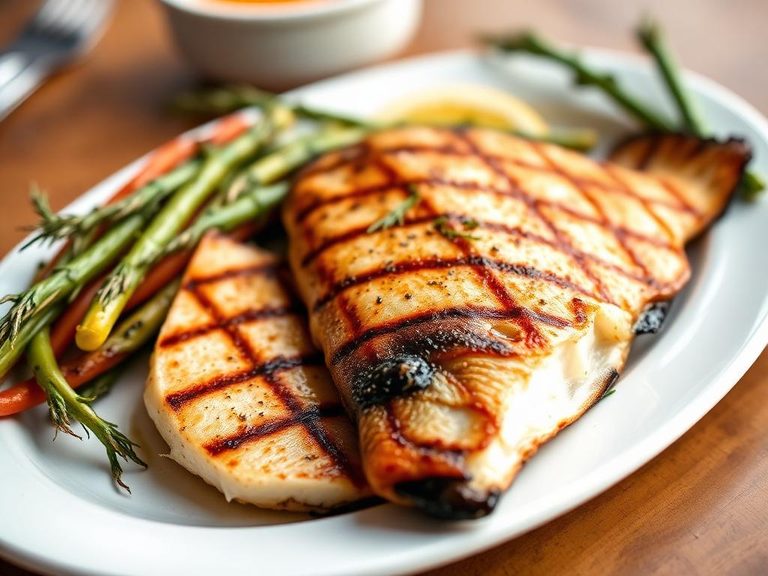
🌍 Where it's eaten
💡 Did you know?
Walleye get their name from their large, light-reflecting eyes that help them see in murky water, giving them a distinctive, somewhat eerie appearance.
Full nutrition (USDA data · scales with serving)
| Water | 79.3 g |
| Energy | 93.0 kcal |
| Energy | 389 kj |
| Protein | 19.1 g |
| Total lipid (fat) | 1.2 g |
| Ash | 1.2 g |
| Carbohydrate, by difference | 0.00 g |
| Fiber, total dietary | 0.00 g |
| Calcium, Ca | 110 mg |
| Iron, Fe | 1.3 mg |
| Magnesium, Mg | 30.0 mg |
| Phosphorus, P | 210 mg |
| Potassium, K | 389 mg |
| Sodium, Na | 51.0 mg |
| Zinc, Zn | 0.62 mg |
| Copper, Cu | 0.18 mg |
| Manganese, Mn | 0.80 mg |
| Selenium, Se | 12.6 ug |
| Vitamin C, total ascorbic acid | 0.00 mg |
| Thiamin | 0.27 mg |
| Riboflavin | 0.16 mg |
| Niacin | 2.3 mg |
| Pantothenic acid | 0.75 mg |
| Vitamin B-6 | 0.12 mg |
| Folate, total | 15.0 ug |
| Folic acid | 0.00 ug |
| Folate, food | 15.0 ug |
| Folate, DFE | 15.0 ug |
| Vitamin B-12 | 2.0 ug |
| Vitamin A, RAE | 21.0 ug |
| Retinol | 21.0 ug |
| Vitamin A, IU | 70.0 iu |
| Alcohol, ethyl | 0.00 g |
Fat & fatty acid profile (per 100g)
| Fatty acids, total saturated | 0.25 g |
| SFA 4:0 | 0.00 g |
| SFA 6:0 | 0.00 g |
| SFA 8:0 | 0.00 g |
| SFA 10:0 | 0.00 g |
| SFA 12:0 | 0.00 g |
| SFA 14:0 | 0.02 g |
| SFA 16:0 | 0.20 g |
| SFA 18:0 | 0.03 g |
| Fatty acids, total monounsaturated | 0.29 g |
| MUFA 16:1 | 0.10 g |
| MUFA 18:1 | 0.20 g |
| MUFA 20:1 | 0.00 g |
| MUFA 22:1 | 0.00 g |
| Fatty acids, total polyunsaturated | 0.45 g |
| PUFA 18:2 | 0.03 g |
| PUFA 18:3 | 0.01 g |
| PUFA 18:4 | 0.00 g |
| PUFA 20:4 | 0.06 g |
| PUFA 20:5 n-3 (EPA) | 0.09 g |
| PUFA 22:5 n-3 (DPA) | 0.04 g |
| PUFA 22:6 n-3 (DHA) | 0.23 g |
| Cholesterol | 86.0 mg |
Amino acid profile (per 100g)
| Tryptophan | 0.21 g |
| Threonine | 0.84 g |
| Isoleucine | 0.88 g |
| Leucine | 1.6 g |
| Lysine | 1.8 g |
| Methionine | 0.57 g |
| Cystine | 0.20 g |
| Phenylalanine | 0.75 g |
| Tyrosine | 0.65 g |
| Valine | 0.99 g |
| Arginine | 1.1 g |
| Histidine | 0.56 g |
| Alanine | 1.2 g |
| Aspartic acid | 2.0 g |
| Glutamic acid | 2.9 g |
| Glycine | 0.92 g |
| Proline | 0.68 g |
| Serine | 0.78 g |
FAQ
Is walleye a healthy fish to eat?
Yes, walleye is very healthy. It's low in calories and fat, high in protein, and provides important nutrients like selenium and B vitamins. It's a great choice for a balanced diet.
How should I cook walleye?
Walleye is versatile. It's excellent pan-fried with a light coating, baked with herbs, or grilled. Its mild flavor pairs well with lemon, butter, and simple seasonings.
What does walleye taste like?
Walleye has a mild, sweet flavor with a delicate, flaky texture. It's less 'fishy' than many other fish, making it popular with people who prefer a subtle taste.
Nutrient density (calculated · NRF9.3)
Nutrient Rich Foods index: beneficial nutrients (protein, fiber, vitamins, minerals) minus saturated fat, added sugar & sodium, per 100 kcal.
NRF9.3 index — Fulgoni, Keast & Drewnowski, 2009. Computed from USDA nutrients.
Weight-loss friendliness (composite index)
Energy density 0.93 kcal/g · 82% calories from protein · 0.0 g fiber · 0.0 g sugar per 100 g.
Composite of energy density (Rolls et al., 1999), protein & fiber satiety, minus sugar. A calculated heuristic — ranks satiety-per-calorie, not a clinical measure.
Dietary load (calculated from USDA values)
Potential renal acid load. Positive = acid-forming, negative = alkaline-forming.
Sodium-to-potassium ratio: 0.13 (lower is better — aim for ≤ 1)
Sodium:potassium per WHO potassium guidance. Computed from USDA nutrients.