

Coconut, fresh
Common food
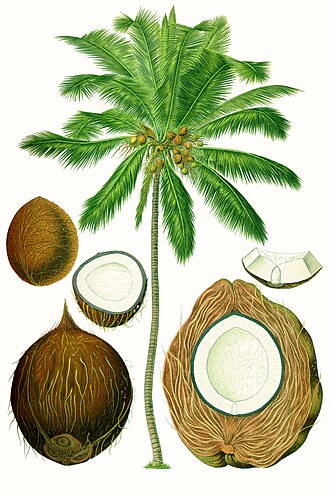
Photo: Wikipedia
Fresh coconut is the edible white flesh (endosperm) from the mature fruit, offering a rich, slightly sweet, and nutty flavor with a firm, fibrous, and chewy texture. It is a calorie-dense food primarily composed of healthy fats, providing a substantial source of dietary fiber and manganese.
Calorie split: 4% protein · 16% carbs · 80% fat
↓ Full nutrition💚 Why it's loved
People adore fresh coconut for its uniquely tropical, aromatic flavor and satisfyingly chewy texture that elevates both desserts and main dishes. Its cultural significance in coastal cuisines worldwide, from curries to candies, makes it a beloved and nostalgic ingredient.
⚠️ Watch-outs & how to enjoy it better
Its high saturated fat and calorie content can be a concern for those monitoring heart health or calorie intake. The high fiber content may cause digestive discomfort like bloating in sensitive individuals if consumed in large amounts. Tip: Enjoy in moderation as part of a balanced diet, and pair it with protein or other fiber sources to mitigate any blood sugar impact.
Key benefits
- Excellent source of dietary fiber, supporting digestive health.
- Rich in medium-chain triglycerides (MCTs), which are metabolized differently for quick energy.
- Provides essential minerals like manganese and copper.
- Contains antioxidants that help combat oxidative stress.
- A versatile ingredient in both sweet and savory cooking.
🍽️ Popular dishes



🌍 Where it's eaten
💡 Did you know?
The water inside a young coconut is naturally sterile and was historically used as an emergency intravenous fluid in some remote medical situations.
Full nutrition (USDA data · scales with serving)
| Water | 47.0 g |
| Energy | 354 kcal |
| Protein | 3.3 g |
| Total lipid (fat) | 33.5 g |
| Carbohydrate, by difference | 15.2 g |
| Fiber, total dietary | 9.0 g |
| Total Sugars | 6.2 g |
| Calcium, Ca | 14.0 mg |
| Iron, Fe | 2.4 mg |
| Magnesium, Mg | 32.0 mg |
| Phosphorus, P | 113 mg |
| Potassium, K | 356 mg |
| Sodium, Na | 20.0 mg |
| Zinc, Zn | 1.1 mg |
| Copper, Cu | 0.43 mg |
| Selenium, Se | 10.1 ug |
| Vitamin C, total ascorbic acid | 3.3 mg |
| Thiamin | 0.07 mg |
| Riboflavin | 0.02 mg |
| Niacin | 0.54 mg |
| Vitamin B-6 | 0.05 mg |
| Folate, total | 26.0 ug |
| Folic acid | 0.00 ug |
| Folate, food | 26.0 ug |
| Folate, DFE | 26.0 ug |
| Choline, total | 12.1 mg |
| Vitamin B-12 | 0.00 ug |
| Vitamin B-12, added | 0.00 ug |
| Vitamin A, RAE | 0.00 ug |
| Retinol | 0.00 ug |
| Carotene, beta | 0.00 ug |
| Carotene, alpha | 0.00 ug |
| Cryptoxanthin, beta | 0.00 ug |
| Lycopene | 0.00 ug |
| Lutein + zeaxanthin | 0.00 ug |
| Vitamin E (alpha-tocopherol) | 0.24 mg |
| Vitamin E, added | 0.00 mg |
| Vitamin D (D2 + D3) | 0.00 ug |
| Vitamin K (phylloquinone) | 0.20 ug |
| Alcohol, ethyl | 0.00 g |
| Caffeine | 0.00 mg |
| Theobromine | 0.00 mg |
Fat & fatty acid profile (per 100g)
| Fatty acids, total saturated | 29.7 g |
| SFA 4:0 | 0.00 g |
| SFA 6:0 | 0.19 g |
| SFA 8:0 | 2.3 g |
| SFA 10:0 | 1.9 g |
| SFA 12:0 | 14.9 g |
| SFA 14:0 | 5.9 g |
| SFA 16:0 | 2.8 g |
| SFA 18:0 | 1.7 g |
| Fatty acids, total monounsaturated | 1.4 g |
| MUFA 16:1 | 0.00 g |
| MUFA 18:1 | 1.4 g |
| MUFA 20:1 | 0.00 g |
| MUFA 22:1 | 0.00 g |
| Fatty acids, total polyunsaturated | 0.37 g |
| PUFA 18:2 | 0.37 g |
| PUFA 18:3 | 0.00 g |
| PUFA 18:4 | 0.00 g |
| PUFA 20:4 | 0.00 g |
| PUFA 20:5 n-3 (EPA) | 0.00 g |
| PUFA 22:5 n-3 (DPA) | 0.00 g |
| PUFA 22:6 n-3 (DHA) | 0.00 g |
| Cholesterol | 0.00 mg |
Amino acid profile (per 100g)
Estimated from Nuts, coconut meat, dried (desiccated), sweetened, shredded — USDA does not publish this profile for Coconut.
| Tryptophan | 0.03 g |
| Threonine | 0.10 g |
| Isoleucine | 0.11 g |
| Leucine | 0.21 g |
| Lysine | 0.13 g |
| Methionine | 0.05 g |
| Cystine | 0.06 g |
| Phenylalanine | 0.15 g |
| Tyrosine | 0.09 g |
| Valine | 0.17 g |
| Arginine | 0.47 g |
| Histidine | 0.07 g |
| Alanine | 0.15 g |
| Aspartic acid | 0.28 g |
| Glutamic acid | 0.66 g |
| Glycine | 0.14 g |
| Proline | 0.12 g |
| Serine | 0.15 g |
FAQ
What's the difference between fresh coconut and dried or desiccated coconut?
Fresh coconut is moist and perishable, while dried or desiccated coconut has had most of its water removed, making it shelf-stable with a more concentrated flavor and chewier texture.
Is the brown skin on the coconut flesh edible?
Yes, the thin brown skin (testa) attached to the white flesh is edible and contains fiber and nutrients, though it adds a slightly more fibrous texture.
How do you store fresh coconut meat?
Once opened, wrap the fresh meat tightly in plastic wrap or an airtight container and refrigerate for up to a week, or freeze it for several months.
Nutrient density (calculated · NRF9.3)
Nutrient Rich Foods index: beneficial nutrients (protein, fiber, vitamins, minerals) minus saturated fat, added sugar & sodium, per 100 kcal.
NRF9.3 index — Fulgoni, Keast & Drewnowski, 2009. Computed from USDA nutrients.
Weight-loss friendliness (composite index)
Energy density 3.54 kcal/g · 4% calories from protein · 9.0 g fiber · 6.2 g sugar per 100 g.
Composite of energy density (Rolls et al., 1999), protein & fiber satiety, minus sugar. A calculated heuristic — ranks satiety-per-calorie, not a clinical measure.
Dietary load (calculated from USDA values)
Potential renal acid load. Positive = acid-forming, negative = alkaline-forming.
Sodium-to-potassium ratio: 0.06 (lower is better — aim for ≤ 1)
Sodium:potassium per WHO potassium guidance. Computed from USDA nutrients.