

Chocolate milk, fat free (skim)
Common food
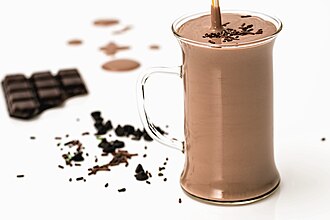
Photo: Wikipedia
Chocolate milk, fat-free (skim) is a smooth, sweetened dairy beverage made by blending cocoa or chocolate syrup with skim milk. It delivers a rich, chocolatey flavor and a thin, drinkable texture without any fat. A 100g serving provides 67 kcal, 3.39g of high-quality protein, and 13.46g of carbohydrates, primarily from lactose and added sugar.
Calorie split: 20% protein · 80% carbs · 0% fat
↓ Full nutrition💚 Why it's loved
People love it for its comforting, nostalgic taste that combines the indulgence of chocolate with the familiarity of milk. It's a versatile drink enjoyed cold as a treat, a quick breakfast, or a recovery beverage after exercise.
⚠️ Watch-outs & how to enjoy it better
The primary downside is its high added sugar content (8.39g per 100g), which can contribute to blood sugar spikes and excess calories. Those monitoring sugar intake or with diabetes should practice portion control or pair it with a source of fiber or protein (like nuts or a piece of fruit) to slow absorption. It is also a common dairy allergen.
Key benefits
- Excellent source of high-quality protein for muscle repair and satiety.
- Rich in calcium and vitamin D for bone health.
- Provides a convenient post-workout recovery drink with carbs and protein.
- Naturally free of fat and cholesterol.
- A palatable way to increase daily dairy intake, especially for children.
🍽️ Popular dishes

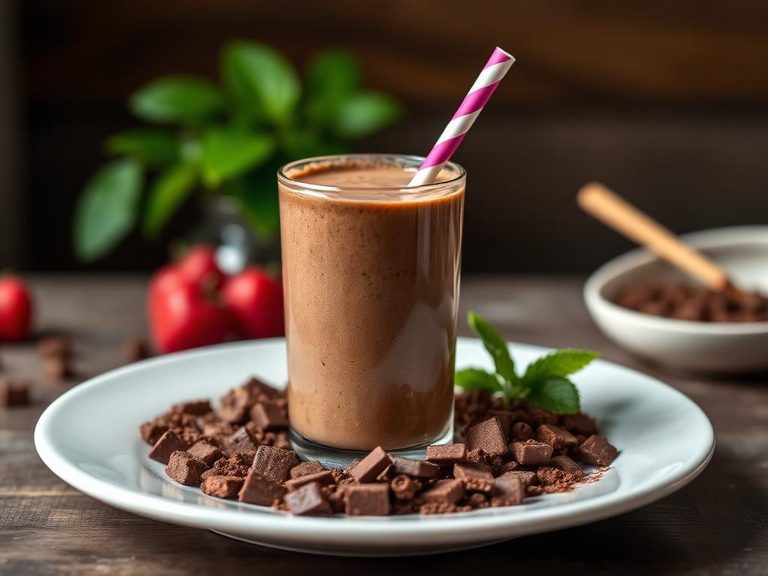

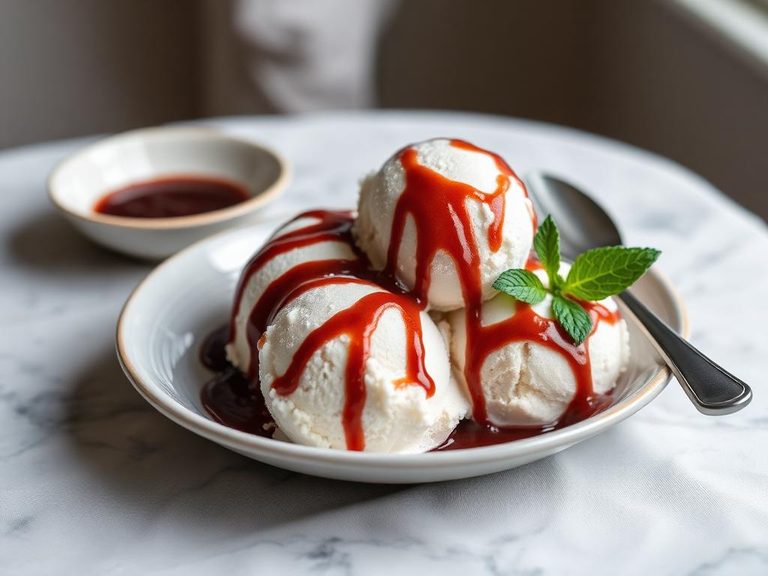
🌍 Where it's eaten
💡 Did you know?
Research in sports nutrition has shown that low-fat chocolate milk can be as effective as many commercial sports drinks for muscle recovery after endurance exercise, due to its ideal carbohydrate-to-protein ratio.
Full nutrition (USDA data · scales with serving)
| Water | 82.3 g |
| Energy | 67.0 kcal |
| Protein | 3.4 g |
| Total lipid (fat) | 0.00 g |
| Carbohydrate, by difference | 13.5 g |
| Fiber, total dietary | 0.00 g |
| Total Sugars | 8.4 g |
| Calcium, Ca | 127 mg |
| Iron, Fe | 0.27 mg |
| Magnesium, Mg | 13.0 mg |
| Phosphorus, P | 101 mg |
| Potassium, K | 182 mg |
| Sodium, Na | 79.0 mg |
| Zinc, Zn | 0.41 mg |
| Copper, Cu | 0.07 mg |
| Selenium, Se | 1.9 ug |
| Vitamin C, total ascorbic acid | 1.0 mg |
| Thiamin | 0.04 mg |
| Riboflavin | 0.17 mg |
| Niacin | 0.16 mg |
| Vitamin B-6 | 0.02 mg |
| Folate, total | 2.0 ug |
| Folic acid | 0.00 ug |
| Folate, food | 2.0 ug |
| Folate, DFE | 2.0 ug |
| Choline, total | 15.6 mg |
| Vitamin B-12 | 0.32 ug |
| Vitamin B-12, added | 0.00 ug |
| Vitamin A, RAE | 64.0 ug |
| Retinol | 63.0 ug |
| Carotene, beta | 11.0 ug |
| Carotene, alpha | 0.00 ug |
| Cryptoxanthin, beta | 0.00 ug |
| Lycopene | 0.00 ug |
| Lutein + zeaxanthin | 0.00 ug |
| Vitamin E (alpha-tocopherol) | 0.04 mg |
| Vitamin E, added | 0.00 mg |
| Vitamin D (D2 + D3) | 1.1 ug |
| Vitamin K (phylloquinone) | 0.20 ug |
| Alcohol, ethyl | 0.00 g |
| Caffeine | 1.0 mg |
| Theobromine | 22.0 mg |
Fat & fatty acid profile (per 100g)
| Fatty acids, total saturated | 0.00 g |
| SFA 4:0 | 0.00 g |
| SFA 6:0 | 0.00 g |
| SFA 8:0 | 0.00 g |
| SFA 10:0 | 0.00 g |
| SFA 12:0 | 0.00 g |
| SFA 14:0 | 0.00 g |
| SFA 16:0 | 0.00 g |
| SFA 18:0 | 0.00 g |
| Fatty acids, total monounsaturated | 0.00 g |
| MUFA 16:1 | 0.00 g |
| MUFA 18:1 | 0.00 g |
| MUFA 20:1 | 0.00 g |
| MUFA 22:1 | 0.00 g |
| Fatty acids, total polyunsaturated | 0.00 g |
| PUFA 18:2 | 0.00 g |
| PUFA 18:3 | 0.00 g |
| PUFA 18:4 | 0.00 g |
| PUFA 20:4 | 0.00 g |
| PUFA 20:5 n-3 (EPA) | 0.00 g |
| PUFA 22:5 n-3 (DPA) | 0.00 g |
| PUFA 22:6 n-3 (DHA) | 0.00 g |
| Cholesterol | 2.0 mg |
Amino acid profile (per 100g)
Estimated from Snacks, granola bars, soft, coated, milk chocolate coating, chocolate chip — USDA does not publish this profile for Chocolate milk.
| Tryptophan | 0.07 g |
| Threonine | 0.23 g |
| Isoleucine | 0.27 g |
| Leucine | 0.47 g |
| Lysine | 0.29 g |
| Methionine | 0.11 g |
| Cystine | 0.06 g |
| Phenylalanine | 0.29 g |
| Tyrosine | 0.24 g |
| Valine | 0.34 g |
| Arginine | 0.24 g |
| Histidine | 0.10 g |
| Alanine | 0.22 g |
| Aspartic acid | 0.48 g |
| Glutamic acid | 1.1 g |
| Glycine | 0.18 g |
| Proline | 0.39 g |
| Serine | 0.25 g |
FAQ
Is fat-free chocolate milk healthy?
It can be a nutritious part of a balanced diet, offering protein, calcium, and vitamins. However, its high added sugar content means it should be consumed in moderation, especially by those watching their sugar or calorie intake.
Can I use it in cooking?
Yes! It's excellent for making creamy sauces, moistening cakes, or as a base for puddings and smoothies. Its flavor adds depth to both sweet and some savory dishes.
How does it differ from regular chocolate milk?
The key difference is the fat content. Fat-free (skim) chocolate milk contains no milkfat, making it lower in calories and saturated fat compared to reduced-fat or whole milk versions, while providing the same protein and calcium.
Nutrient density (calculated · NRF9.3)
Nutrient Rich Foods index: beneficial nutrients (protein, fiber, vitamins, minerals) minus saturated fat, added sugar & sodium, per 100 kcal.
NRF9.3 index — Fulgoni, Keast & Drewnowski, 2009. Computed from USDA nutrients.
Weight-loss friendliness (composite index)
Energy density 0.67 kcal/g · 20% calories from protein · 0.0 g fiber · 8.4 g sugar per 100 g.
Composite of energy density (Rolls et al., 1999), protein & fiber satiety, minus sugar. A calculated heuristic — ranks satiety-per-calorie, not a clinical measure.
Dietary load (calculated from USDA values)
Potential renal acid load. Positive = acid-forming, negative = alkaline-forming.
Sodium-to-potassium ratio: 0.43 (lower is better — aim for ≤ 1)
Sodium:potassium per WHO potassium guidance. Computed from USDA nutrients.