

Cereal, corn squares
Common food

Photo: Wikipedia
Cereal, corn squares are a crunchy, golden breakfast staple made from cornmeal, often shaped into small, bite-sized squares or pillows. They offer a satisfying, slightly sweet corn flavor with a light, airy texture that crisps up in milk. Nutritionally, they are a high-carbohydrate, low-fat energy source, providing a quick fuel boost to start the day.
Calorie split: 9% protein · 85% carbs · 6% fat
↓ Full nutrition💚 Why it's loved
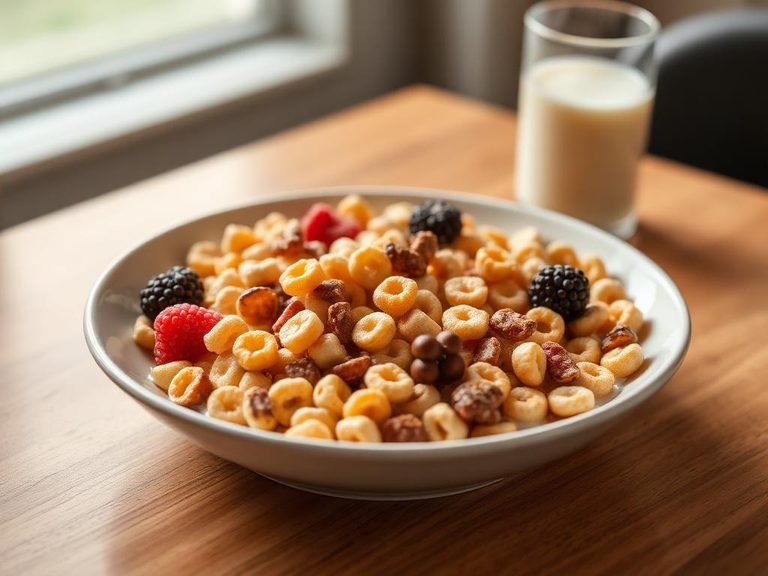
People love corn squares for their nostalgic, comforting corn flavor and the satisfying crunch that softens perfectly in milk. Their mild sweetness and versatility make them a beloved canvas for fresh fruit, nuts, or a simple bowl with cold milk.
⚠️ Watch-outs & how to enjoy it better
The high carbohydrate content and added sugars can lead to rapid blood sugar spikes, making it less ideal for those managing diabetes or seeking sustained energy. To counteract this, pair it with a source of protein (like Greek yogurt or milk) and healthy fats (like nuts or seeds) to slow digestion and stabilize blood sugar. Portion control is also key.
Key benefits
- Provides quick-release energy from complex carbohydrates
- Low in fat, making it a light breakfast option
- Contains dietary fiber to support digestive regularity
- Often fortified with essential vitamins and minerals like iron and B vitamins
- Convenient and requires no cooking
🍽️ Popular dishes

🌍 Where it's eaten
💡 Did you know?
The square shape of many corn cereals was originally patented in the 1930s as a way to prevent the cereal from becoming soggy too quickly in milk.
Full nutrition (USDA data · scales with serving)
| Water | 9.7 g |
| Energy | 369 kcal |
| Protein | 7.9 g |
| Total lipid (fat) | 2.6 g |
| Carbohydrate, by difference | 77.1 g |
| Fiber, total dietary | 5.4 g |
| Total Sugars | 10.4 g |
| Calcium, Ca | 330 mg |
| Iron, Fe | 28.5 mg |
| Magnesium, Mg | 28.0 mg |
| Phosphorus, P | 101 mg |
| Potassium, K | 124 mg |
| Sodium, Na | 729 mg |
| Zinc, Zn | 0.65 mg |
| Copper, Cu | 0.10 mg |
| Selenium, Se | 9.1 ug |
| Vitamin C, total ascorbic acid | 23.2 mg |
| Thiamin | 0.58 mg |
| Riboflavin | 0.54 mg |
| Niacin | 6.9 mg |
| Vitamin B-6 | 0.80 mg |
| Folate, total | 150 ug |
| Folic acid | 121 ug |
| Folate, food | 29.0 ug |
| Folate, DFE | 235 ug |
| Choline, total | 11.2 mg |
| Vitamin B-12 | 0.91 ug |
| Vitamin B-12, added | 0.91 ug |
| Vitamin A, RAE | 9.0 ug |
| Retinol | 0.00 ug |
| Carotene, beta | 83.0 ug |
| Carotene, alpha | 54.0 ug |
| Cryptoxanthin, beta | 0.00 ug |
| Lycopene | 0.00 ug |
| Lutein + zeaxanthin | 1396 ug |
| Vitamin E (alpha-tocopherol) | 0.28 mg |
| Vitamin E, added | 0.00 mg |
| Vitamin D (D2 + D3) | 5.0 ug |
| Vitamin K (phylloquinone) | 0.70 ug |
| Alcohol, ethyl | 0.00 g |
| Caffeine | 0.00 mg |
| Theobromine | 0.00 mg |
Fat & fatty acid profile (per 100g)
| Fatty acids, total saturated | 0.26 g |
| SFA 4:0 | 0.00 g |
| SFA 6:0 | 0.00 g |
| SFA 8:0 | 0.00 g |
| SFA 10:0 | 0.00 g |
| SFA 12:0 | 0.00 g |
| SFA 14:0 | 0.00 g |
| SFA 16:0 | 0.20 g |
| SFA 18:0 | 0.05 g |
| Fatty acids, total monounsaturated | 0.98 g |
| MUFA 16:1 | 0.01 g |
| MUFA 18:1 | 0.95 g |
| MUFA 20:1 | 0.02 g |
| MUFA 22:1 | 0.00 g |
| Fatty acids, total polyunsaturated | 1.00 g |
| PUFA 18:2 | 0.90 g |
| PUFA 18:3 | 0.10 g |
| PUFA 18:4 | 0.00 g |
| PUFA 20:4 | 0.00 g |
| PUFA 20:5 n-3 (EPA) | 0.00 g |
| PUFA 22:5 n-3 (DPA) | 0.00 g |
| PUFA 22:6 n-3 (DHA) | 0.00 g |
| Cholesterol | 0.00 mg |
Amino acid profile (per 100g)
Estimated from Cereals ready-to-eat, POST, HONEY BUNCHES OF OATS, honey roasted — USDA does not publish this profile for Cereal.
| Tryptophan | 0.09 g |
| Threonine | 0.24 g |
| Isoleucine | 0.26 g |
| Leucine | 0.80 g |
| Lysine | 0.12 g |
| Methionine | 0.10 g |
| Cystine | 0.11 g |
| Phenylalanine | 0.39 g |
| Tyrosine | 0.21 g |
| Valine | 0.34 g |
| Arginine | 0.24 g |
| Histidine | 0.18 g |
| Alanine | 0.46 g |
| Aspartic acid | 0.48 g |
| Glutamic acid | 1.9 g |
| Glycine | 0.27 g |
| Proline | 0.49 g |
| Serine | 0.38 g |
FAQ
Is corn cereal a good source of fiber?
It contains some fiber (about 5.4g per 100g), which is beneficial, but it's often lower in fiber than whole-grain or bran-based cereals. Check the nutrition label for specific fiber content.
Can I eat corn cereal on a gluten-free diet?
Many corn-based cereals are naturally gluten-free, but cross-contamination is possible. Always look for a certified gluten-free label if you have celiac disease or severe sensitivity.
Why does my corn cereal get soggy so fast?
The high surface area and porous structure of the squares allow milk to be absorbed quickly. To maintain crunch, add milk just before eating or try a two-stage pour.
Nutrient density (calculated · NRF9.3)
Nutrient Rich Foods index: beneficial nutrients (protein, fiber, vitamins, minerals) minus saturated fat, added sugar & sodium, per 100 kcal.
NRF9.3 index — Fulgoni, Keast & Drewnowski, 2009. Computed from USDA nutrients.
Weight-loss friendliness (composite index)
Energy density 3.69 kcal/g · 9% calories from protein · 5.4 g fiber · 10.4 g sugar per 100 g.
Composite of energy density (Rolls et al., 1999), protein & fiber satiety, minus sugar. A calculated heuristic — ranks satiety-per-calorie, not a clinical measure.
Dietary load (calculated from USDA values)
Potential renal acid load. Positive = acid-forming, negative = alkaline-forming.
Sodium-to-potassium ratio: 5.88 (lower is better — aim for ≤ 1)
Sodium:potassium per WHO potassium guidance. Computed from USDA nutrients.