

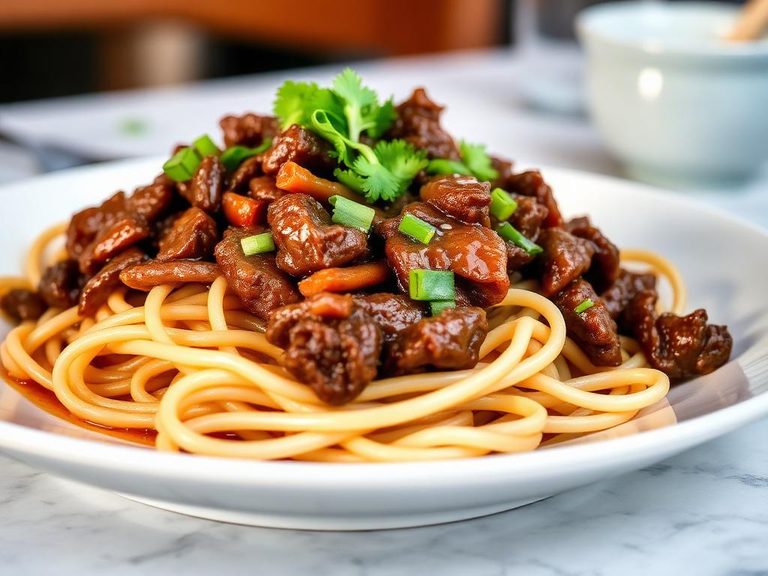
Beef, noodles, and vegetables including carrots, broccoli, and/or dark-green leafy; mushroom sauce
Common food

Photo: Wikipedia
This is a savory, comforting bowl of tender beef and slurpy noodles tossed with crisp carrots, earthy broccoli, and vibrant dark greens, all coated in a rich, umami-packed mushroom sauce. The texture is a delightful mix of soft noodles, chewy beef, and crunchy vegetables, while the sauce adds a deep, savory flavor. Nutritionally, it's a balanced meal with a good protein-to-calorie ratio and a moderate amount of carbohydrates for energy.
Calorie split: 21% protein · 43% carbs · 36% fat
↓ Full nutrition💚 Why it's loved
People love this dish for its perfect harmony of savory, umami flavors and satisfying, hearty textures that make it a quintessential comfort food. It's also incredibly versatile, allowing for endless variations in noodles, vegetables, and sauce intensity to suit personal tastes.
⚠️ Watch-outs & how to enjoy it better
The dish can be high in sodium from the sauce and seasoning, which may be a concern for those monitoring blood pressure. The mushrooms in the sauce contain oxalates, which can be an issue for individuals prone to kidney stones. To counteract sodium, use low-sodium broth and season with herbs and spices; for oxalates, ensure mushrooms are cooked thoroughly and pair the meal with a calcium-rich food like a glass of milk.
Key benefits
- Provides a complete protein source from beef for muscle maintenance.
- Contains beta-carotene from carrots for eye health.
- Offers iron and B-vitamins from beef and dark leafy greens.
- The mushroom sauce adds umami without excessive calories.
- A balanced mix of macronutrients for sustained energy.
🍽️ Popular dishes
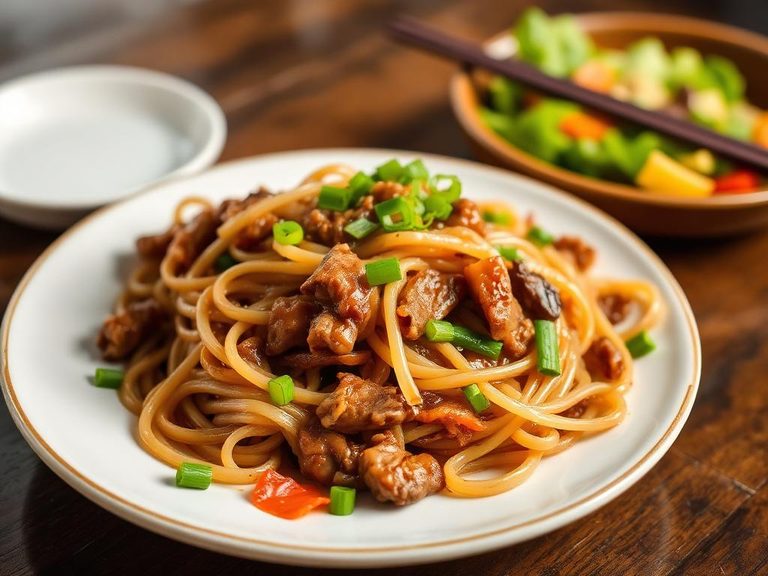
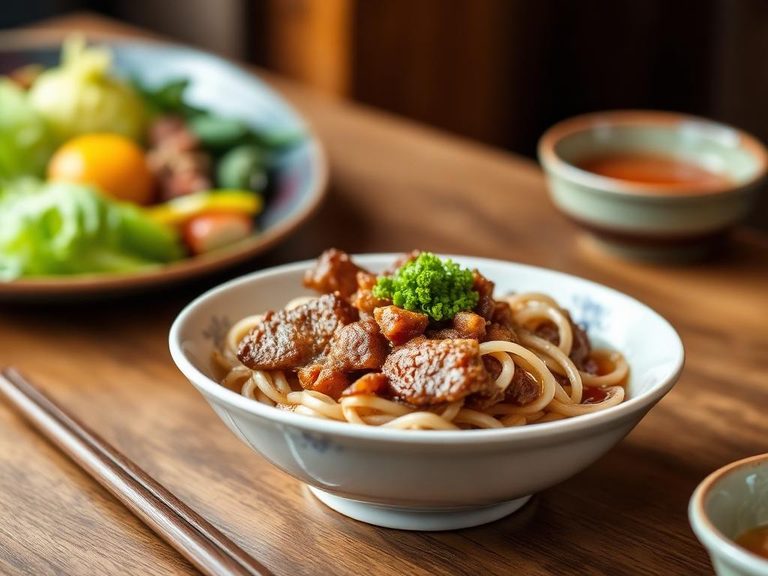
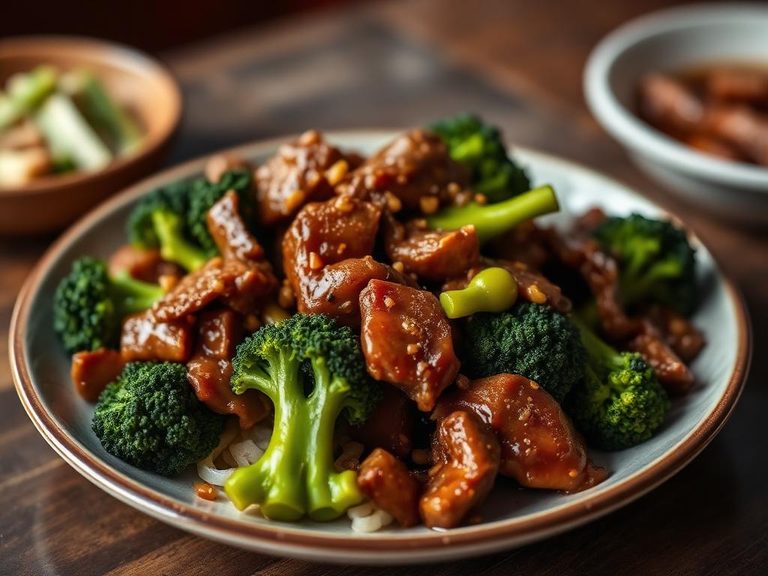
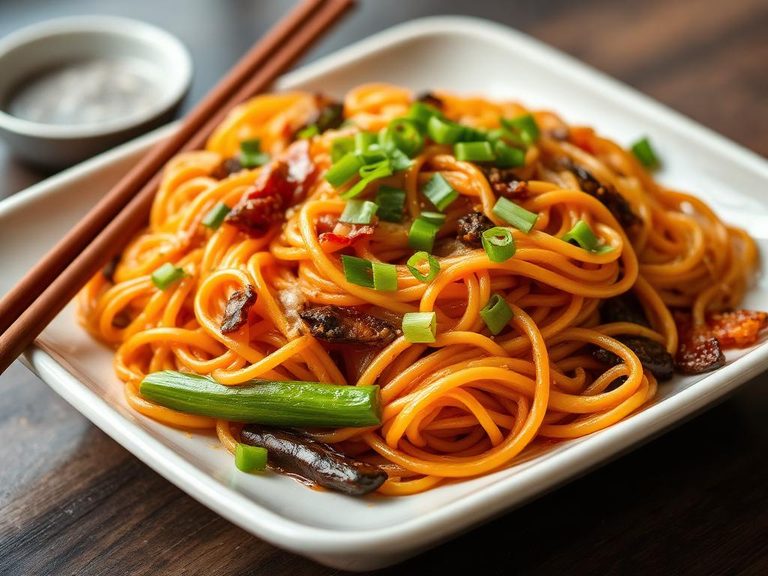
🌍 Where it's eaten
💡 Did you know?
The mushroom sauce in many Asian beef noodle dishes often uses shiitake mushrooms, which were first cultivated on logs in China over 1,000 years ago, long before the practice became common in the West.
Full nutrition (USDA data · scales with serving)
| Water | 73.5 g |
| Energy | 125 kcal |
| Protein | 6.6 g |
| Total lipid (fat) | 5.1 g |
| Carbohydrate, by difference | 13.6 g |
| Fiber, total dietary | 1.2 g |
| Total Sugars | 1.1 g |
| Calcium, Ca | 25.0 mg |
| Iron, Fe | 1.1 mg |
| Magnesium, Mg | 15.0 mg |
| Phosphorus, P | 76.0 mg |
| Potassium, K | 103 mg |
| Sodium, Na | 303 mg |
| Zinc, Zn | 1.0 mg |
| Copper, Cu | 0.07 mg |
| Selenium, Se | 14.8 ug |
| Vitamin C, total ascorbic acid | 3.5 mg |
| Thiamin | 0.14 mg |
| Riboflavin | 0.10 mg |
| Niacin | 1.7 mg |
| Vitamin B-6 | 0.10 mg |
| Folate, total | 42.0 ug |
| Folic acid | 32.0 ug |
| Folate, food | 10.0 ug |
| Folate, DFE | 64.0 ug |
| Choline, total | 31.1 mg |
| Vitamin B-12 | 0.30 ug |
| Vitamin B-12, added | 0.00 ug |
| Vitamin A, RAE | 82.0 ug |
| Retinol | 8.0 ug |
| Carotene, beta | 729 ug |
| Carotene, alpha | 309 ug |
| Cryptoxanthin, beta | 0.00 ug |
| Lycopene | 0.00 ug |
| Lutein + zeaxanthin | 163 ug |
| Vitamin E (alpha-tocopherol) | 0.73 mg |
| Vitamin E, added | 0.00 mg |
| Vitamin D (D2 + D3) | 0.20 ug |
| Vitamin K (phylloquinone) | 15.0 ug |
| Alcohol, ethyl | 0.00 g |
| Caffeine | 0.00 mg |
| Theobromine | 0.00 mg |
Fat & fatty acid profile (per 100g)
| Fatty acids, total saturated | 1.2 g |
| SFA 4:0 | 0.01 g |
| SFA 6:0 | 0.00 g |
| SFA 8:0 | 0.00 g |
| SFA 10:0 | 0.01 g |
| SFA 12:0 | 0.01 g |
| SFA 14:0 | 0.06 g |
| SFA 16:0 | 0.76 g |
| SFA 18:0 | 0.27 g |
| Fatty acids, total monounsaturated | 1.7 g |
| MUFA 16:1 | 0.08 g |
| MUFA 18:1 | 1.6 g |
| MUFA 20:1 | 0.02 g |
| MUFA 22:1 | 0.00 g |
| Fatty acids, total polyunsaturated | 1.6 g |
| PUFA 18:2 | 1.4 g |
| PUFA 18:3 | 0.18 g |
| PUFA 18:4 | 0.00 g |
| PUFA 20:4 | 0.00 g |
| PUFA 20:5 n-3 (EPA) | 0.00 g |
| PUFA 22:5 n-3 (DPA) | 0.00 g |
| PUFA 22:6 n-3 (DHA) | 0.00 g |
| Cholesterol | 24.0 mg |
Amino acid profile (per 100g)
Estimated from Beef, variety meats and by-products, mechanically separated beef, raw — USDA does not publish this profile for Beef.
| Tryptophan | 0.17 g |
| Threonine | 0.47 g |
| Isoleucine | 0.58 g |
| Leucine | 1.2 g |
| Lysine | 1.2 g |
| Methionine | 0.43 g |
| Cystine | 0.23 g |
| Phenylalanine | 0.64 g |
| Tyrosine | 0.38 g |
| Valine | 0.92 g |
| Arginine | 1.2 g |
| Histidine | 0.44 g |
| Alanine | 1.0 g |
| Aspartic acid | 1.3 g |
| Glutamic acid | 2.1 g |
| Glycine | 1.2 g |
| Proline | 0.92 g |
| Serine | 0.57 g |
FAQ
Is this dish gluten-free?
It depends entirely on the noodles used. Traditional wheat noodles contain gluten, but you can substitute them with rice noodles, sweet potato noodles, or other gluten-free alternatives to make it suitable for a gluten-free diet.
How can I reduce the fat content?
Choose a leaner cut of beef, such as sirloin or tenderloin, and trim any visible fat before cooking. You can also reduce the amount of oil used in the stir-fry and thicken the sauce with a cornstarch slurry instead of additional fat.
What's the best way to store leftovers?
Store the noodles, beef, and vegetables in an airtight container in the refrigerator for up to 3 days. For best results, keep the sauce separate if possible to prevent the noodles from becoming too soggy upon reheating.
Nutrient density (calculated · NRF9.3)
Nutrient Rich Foods index: beneficial nutrients (protein, fiber, vitamins, minerals) minus saturated fat, added sugar & sodium, per 100 kcal.
NRF9.3 index — Fulgoni, Keast & Drewnowski, 2009. Computed from USDA nutrients.
Weight-loss friendliness (composite index)
Energy density 1.25 kcal/g · 21% calories from protein · 1.2 g fiber · 1.1 g sugar per 100 g.
Composite of energy density (Rolls et al., 1999), protein & fiber satiety, minus sugar. A calculated heuristic — ranks satiety-per-calorie, not a clinical measure.
Dietary load (calculated from USDA values)
Potential renal acid load. Positive = acid-forming, negative = alkaline-forming.
Sodium-to-potassium ratio: 2.94 (lower is better — aim for ≤ 1)
Sodium:potassium per WHO potassium guidance. Computed from USDA nutrients.