

Beef, cured, luncheon meat, jellied
Whole food · Sausages and Luncheon Meats

Photo: Wikipedia
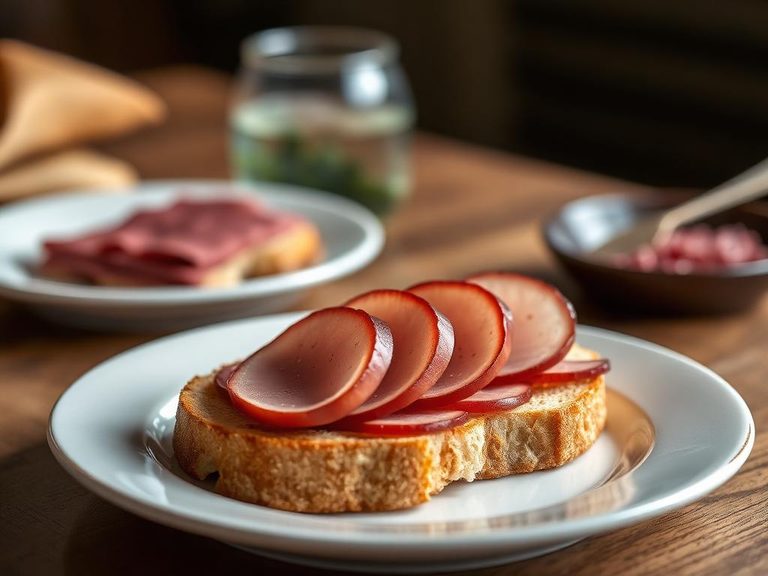
Jellied beef luncheon meat is a savory, pressed product where tender beef pieces are suspended in a clear, savory aspic. Its texture is uniquely smooth yet slightly chunky, with a mild, salty beef flavor that is both familiar and distinct. Nutritionally, it is a remarkably lean protein source, offering 19 grams of protein with virtually no carbohydrates or sugar.
Calorie split: 72% protein · 0% carbs · 28% fat
↓ Full nutrition💚 Why it's loved
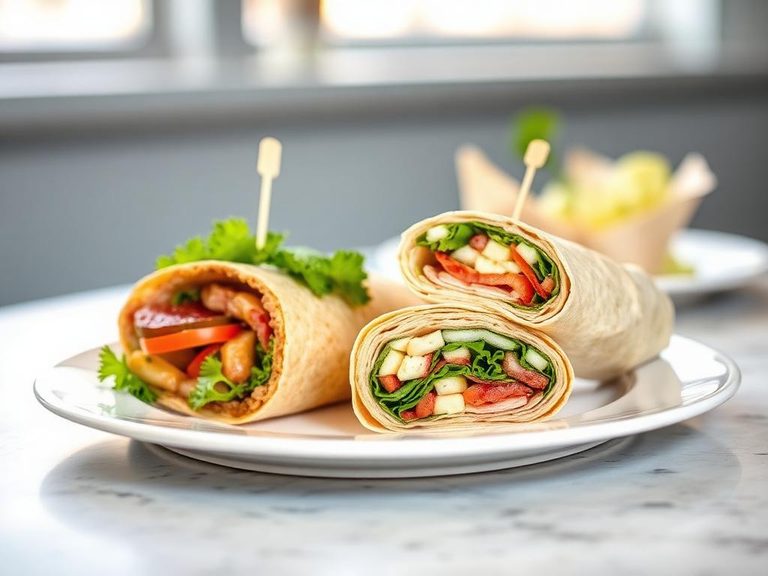
People love it for its satisfying, meaty texture and convenience, making it a quick addition to sandwiches, salads, or charcuterie boards. Its mild flavor and satisfying chew also make it a nostalgic comfort food in many households and a staple in various cuisines.
⚠️ Watch-outs & how to enjoy it better
The high sodium content, common in cured meats, can be a concern for those monitoring blood pressure, and the gelatinous texture may be off-putting to some. To counteract this, pair it with fresh, potassium-rich vegetables like cucumber or lettuce, and practice portion control by using it as a flavor accent rather than the main protein.
Key benefits
- Excellent source of high-quality protein
- Extremely low in carbohydrates and sugar
- Provides a convenient, ready-to-eat protein option
- Long shelf life when unopened
- Low in fat compared to many other cured meats
🍽️ Popular dishes


🌍 Where it's eaten
💡 Did you know?
The 'jelly' in jellied beef is typically natural gelatin rendered from the meat's collagen during the slow cooking process, which then sets into a firm aspic as it cools.
Full nutrition (USDA data · scales with serving)
| Water | 74.6 g |
| Energy | 111 kcal |
| Energy | 464 kj |
| Protein | 19.0 g |
| Total lipid (fat) | 3.3 g |
| Ash | 3.4 g |
| Carbohydrate, by difference | 0.00 g |
| Fiber, total dietary | 0.00 g |
| Calcium, Ca | 10.0 mg |
| Iron, Fe | 3.5 mg |
| Magnesium, Mg | 18.0 mg |
| Phosphorus, P | 139 mg |
| Potassium, K | 402 mg |
| Sodium, Na | 1322 mg |
| Zinc, Zn | 3.5 mg |
| Copper, Cu | 0.12 mg |
| Manganese, Mn | 0.05 mg |
| Selenium, Se | 16.4 ug |
| Vitamin C, total ascorbic acid | 0.00 mg |
| Thiamin | 0.14 mg |
| Riboflavin | 0.29 mg |
| Niacin | 4.8 mg |
| Pantothenic acid | 0.69 mg |
| Vitamin B-6 | 0.25 mg |
| Folate, total | 7.0 ug |
| Folic acid | 0.00 ug |
| Folate, food | 7.0 ug |
| Folate, DFE | 7.0 ug |
| Vitamin B-12 | 5.1 ug |
| Vitamin A, RAE | 0.00 ug |
| Retinol | 0.00 ug |
| Vitamin A, IU | 0.00 iu |
Fat & fatty acid profile (per 100g)
| Fatty acids, total saturated | 1.4 g |
| SFA 4:0 | 0.00 g |
| SFA 6:0 | 0.00 g |
| SFA 8:0 | 0.00 g |
| SFA 10:0 | 0.01 g |
| SFA 12:0 | 0.02 g |
| SFA 14:0 | 0.09 g |
| SFA 16:0 | 0.68 g |
| SFA 18:0 | 0.54 g |
| Fatty acids, total monounsaturated | 1.4 g |
| MUFA 16:1 | 0.22 g |
| MUFA 18:1 | 1.2 g |
| MUFA 20:1 | 0.00 g |
| MUFA 22:1 | 0.00 g |
| Fatty acids, total polyunsaturated | 0.17 g |
| PUFA 18:2 | 0.13 g |
| PUFA 18:3 | 0.04 g |
| PUFA 18:4 | 0.00 g |
| PUFA 20:4 | 0.00 g |
| PUFA 20:5 n-3 (EPA) | 0.00 g |
| PUFA 22:5 n-3 (DPA) | 0.00 g |
| PUFA 22:6 n-3 (DHA) | 0.00 g |
| Cholesterol | 34.0 mg |
| Phytosterols | 0.00 mg |
Amino acid profile (per 100g)
| Tryptophan | 0.14 g |
| Threonine | 0.74 g |
| Isoleucine | 0.71 g |
| Leucine | 1.3 g |
| Lysine | 1.5 g |
| Methionine | 0.42 g |
| Cystine | 0.20 g |
| Phenylalanine | 0.67 g |
| Tyrosine | 0.51 g |
| Valine | 0.82 g |
| Arginine | 1.3 g |
| Histidine | 0.50 g |
| Alanine | 1.3 g |
| Aspartic acid | 1.6 g |
| Glutamic acid | 2.6 g |
| Glycine | 1.8 g |
| Proline | 1.2 g |
| Serine | 0.76 g |
FAQ
What is the difference between jellied beef luncheon meat and regular canned corned beef?
Jellied beef is typically made from leaner cuts of beef, pressed and set in a clear aspic (gelatin), resulting in a firmer, sliceable texture. Regular canned corned beef is often fattier, shredded or ground, and packed in its own fat or broth, making it softer and more crumbly.
Is jellied beef luncheon meat a good source of protein?
Yes, it is an excellent source of protein, providing about 19 grams per 100 grams. It is a lean, low-carbohydrate option that can help meet daily protein needs.
How should I store and serve jellied beef?
Once opened, it should be refrigerated in an airtight container and consumed within 3-5 days. It is best served cold or at room temperature, sliced thinly for sandwiches, salads, or as part of an appetizer platter.
Nutrient density (calculated · NRF9.3)
Nutrient Rich Foods index: beneficial nutrients (protein, fiber, vitamins, minerals) minus saturated fat, added sugar & sodium, per 100 kcal.
NRF9.3 index — Fulgoni, Keast & Drewnowski, 2009. Computed from USDA nutrients.
Weight-loss friendliness (composite index)
Energy density 1.11 kcal/g · 68% calories from protein · 0.0 g fiber · 0.0 g sugar per 100 g.
Composite of energy density (Rolls et al., 1999), protein & fiber satiety, minus sugar. A calculated heuristic — ranks satiety-per-calorie, not a clinical measure.
Dietary load (calculated from USDA values)
Potential renal acid load. Positive = acid-forming, negative = alkaline-forming.
Sodium-to-potassium ratio: 3.29 (lower is better — aim for ≤ 1)
Sodium:potassium per WHO potassium guidance. Computed from USDA nutrients.