

Squash, winter, butternut, cooked, baked, with salt
Whole food · Vegetables and Vegetable Products
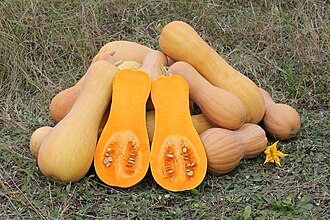
Photo: Wikipedia
Baked butternut squash is a velvety, golden-orange winter squash with a rich, nutty sweetness and a smooth, creamy texture. At just 40 calories per 100g, it's a nutrient-dense powerhouse, delivering over 3 grams of fiber and a wealth of beta-carotene for a mere calorie investment. Its natural caramelization during baking intensifies its flavor, making it a beloved staple for both savory and sweet preparations.
Calorie split: 8% protein · 90% carbs · 2% fat
↓ Full nutrition💚 Why it's loved
People adore its naturally sweet, almost caramel-like flavor and luxuriously smooth texture when baked, which makes it a versatile canvas for both sweet spices like cinnamon and savory herbs like sage. It's a comforting, nourishing food deeply embedded in autumnal and holiday cuisines, from American Thanksgiving tables to European winter soups.
⚠️ Watch-outs & how to enjoy it better
Its natural sugars can cause a quicker blood-sugar rise compared to non-starchy vegetables, so those monitoring glucose levels should be mindful of portions and pair it with protein or healthy fats (like nuts or cheese) to slow absorption. The added salt in this prepared version can be a concern for those on sodium-restricted diets; opting for no-salt-added baked squash and seasoning at the table allows for better control.
Key benefits
- Excellent source of beta-carotene, which the body converts to vitamin A.
- High in dietary fiber, supporting digestive health and satiety.
- Very low in calories and fat, making it ideal for weight management.
- Provides essential minerals like potassium and manganese.
- Contains antioxidants like lutein and zeaxanthin, beneficial for eye health.
🍽️ Popular dishes


🌍 Where it's eaten
💡 Did you know?
The butternut squash is a relatively modern cultivar, developed in the 1940s by American horticulturist Charles Leggett, who crossed a Gooseneck pumpkin with a tan-colored pumpkin to create its signature long, bell-like shape and sweet flesh.
Full nutrition (USDA data · scales with serving)
| Water | 87.8 g |
| Energy | 40.0 kcal |
| Energy | 167 kj |
| Protein | 0.90 g |
| Total lipid (fat) | 0.09 g |
| Ash | 0.72 g |
| Carbohydrate, by difference | 10.5 g |
| Fiber, total dietary | 3.2 g |
| Total Sugars | 2.0 g |
| Calcium, Ca | 41.0 mg |
| Iron, Fe | 0.60 mg |
| Magnesium, Mg | 29.0 mg |
| Phosphorus, P | 27.0 mg |
| Potassium, K | 284 mg |
| Sodium, Na | 240 mg |
| Zinc, Zn | 0.13 mg |
| Copper, Cu | 0.07 mg |
| Manganese, Mn | 0.17 mg |
| Selenium, Se | 0.50 ug |
| Vitamin C, total ascorbic acid | 15.1 mg |
| Thiamin | 0.07 mg |
| Riboflavin | 0.02 mg |
| Niacin | 0.97 mg |
| Pantothenic acid | 0.36 mg |
| Vitamin B-6 | 0.12 mg |
| Folate, total | 19.0 ug |
| Folic acid | 0.00 ug |
| Folate, food | 19.0 ug |
| Folate, DFE | 19.0 ug |
| Vitamin B-12 | 0.00 ug |
| Vitamin B-12, added | 0.00 ug |
| Vitamin A, RAE | 558 ug |
| Retinol | 0.00 ug |
| Carotene, beta | 4570 ug |
| Carotene, alpha | 1130 ug |
| Cryptoxanthin, beta | 3116 ug |
| Vitamin A, IU | 11155 iu |
| Lycopene | 0.00 ug |
| Lutein + zeaxanthin | 0.00 ug |
| Vitamin E (alpha-tocopherol) | 1.3 mg |
| Vitamin E, added | 0.00 mg |
| Vitamin D (D2 + D3), International Units | 0.00 iu |
| Vitamin D (D2 + D3) | 0.00 ug |
| Vitamin K (phylloquinone) | 1.0 ug |
| Alcohol, ethyl | 0.00 g |
| Caffeine | 0.00 mg |
| Theobromine | 0.00 mg |
Fat & fatty acid profile (per 100g)
| Fatty acids, total saturated | 0.02 g |
| SFA 12:0 | 0.00 g |
| SFA 14:0 | 0.00 g |
| SFA 16:0 | 0.02 g |
| SFA 18:0 | 0.00 g |
| Fatty acids, total monounsaturated | 0.01 g |
| MUFA 16:1 | 0.00 g |
| MUFA 18:1 | 0.01 g |
| Fatty acids, total polyunsaturated | 0.04 g |
| PUFA 18:2 | 0.01 g |
| PUFA 18:3 | 0.02 g |
| Fatty acids, total trans | 0.00 g |
| Cholesterol | 0.00 mg |
Amino acid profile (per 100g)
| Tryptophan | 0.01 g |
| Threonine | 0.03 g |
| Isoleucine | 0.04 g |
| Leucine | 0.05 g |
| Lysine | 0.03 g |
| Methionine | 0.01 g |
| Cystine | 0.01 g |
| Phenylalanine | 0.04 g |
| Tyrosine | 0.03 g |
| Valine | 0.04 g |
| Arginine | 0.05 g |
| Histidine | 0.02 g |
| Alanine | 0.04 g |
| Aspartic acid | 0.10 g |
| Glutamic acid | 0.16 g |
| Glycine | 0.03 g |
| Proline | 0.03 g |
| Serine | 0.04 g |
FAQ
Is baked butternut squash healthy?
Yes, it's very nutritious. It's low in calories, high in fiber, and an excellent source of vitamins A and C, potassium, and antioxidants. Baking it without excessive added fats or sugars preserves these benefits.
How do I prevent baked butternut squash from being watery?
To avoid a watery texture, cut the squash into evenly sized pieces, avoid overcrowding the baking pan, and ensure a high oven temperature (around 400°F / 200°C) to promote evaporation and caramelization rather than steaming.
Can I eat the skin of baked butternut squash?
While the skin of a butternut squash is technically edible and becomes tender when cooked, it is often tough and fibrous even after baking. Most recipes call for peeling the squash before cooking, but if baked until very soft, the skin can be scooped away from the flesh and eaten.
Nutrient density (calculated · NRF9.3)
Nutrient Rich Foods index: beneficial nutrients (protein, fiber, vitamins, minerals) minus saturated fat, added sugar & sodium, per 100 kcal.
NRF9.3 index — Fulgoni, Keast & Drewnowski, 2009. Computed from USDA nutrients.
Weight-loss friendliness (composite index)
Energy density 0.40 kcal/g · 9% calories from protein · 3.2 g fiber · 2.0 g sugar per 100 g.
Composite of energy density (Rolls et al., 1999), protein & fiber satiety, minus sugar. A calculated heuristic — ranks satiety-per-calorie, not a clinical measure.
Dietary load (calculated from USDA values)
Potential renal acid load. Positive = acid-forming, negative = alkaline-forming.
Sodium-to-potassium ratio: 0.85 (lower is better — aim for ≤ 1)
Sodium:potassium per WHO potassium guidance. Computed from USDA nutrients.