

Wheat germ
Common food

Photo: Wikipedia
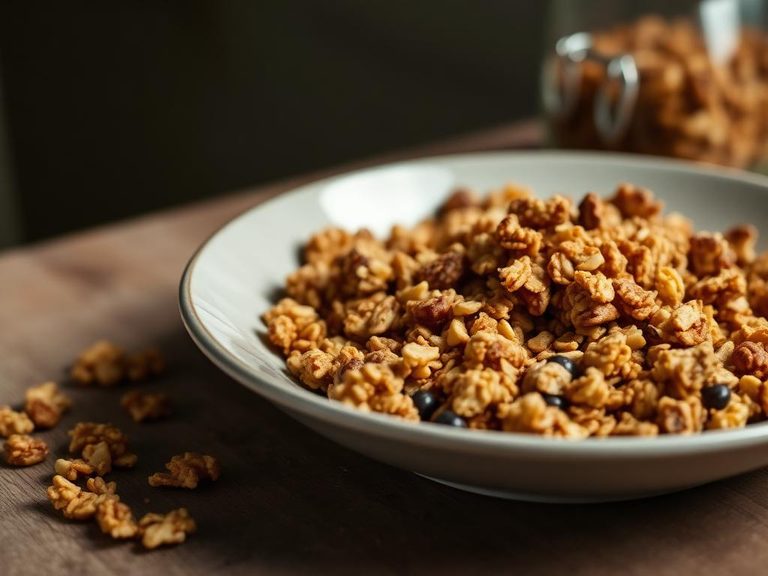
Wheat germ is the nutrient-dense embryo of the wheat kernel, milled off during white flour production. It has a chewy, granular texture and a nutty, slightly sweet, toasty flavor when cooked. Nutritionally, it's a powerhouse, packing nearly 30 grams of protein and over 15 grams of fiber per 100 grams.
Calorie split: 28% protein · 48% carbs · 23% fat
↓ Full nutrition💚 Why it's loved
People love wheat germ for its intense, toasty nuttiness that adds depth to baked goods and its incredible ability to boost the nutritional profile of simple foods like yogurt or oatmeal without overwhelming the flavor.
⚠️ Watch-outs & how to enjoy it better
The high fiber content can cause digestive discomfort (bloating, gas) if introduced too quickly, especially for those with sensitive guts or IBS. Its natural oils make it prone to rancidity; always store it in the refrigerator or freezer and use it promptly. For those monitoring carbohydrate intake, the 50g carbs per 100g should be accounted for.
Key benefits
- Excellent source of plant-based protein for muscle repair and satiety.
- Rich in dietary fiber to support digestive health and blood sugar regulation.
- High in essential minerals like magnesium, zinc, and iron.
- Contains B vitamins crucial for energy metabolism.
- Provides antioxidants like vitamin E and ferulic acid.
🍽️ Popular dishes




🌍 Where it's eaten
💡 Did you know?
Wheat germ is so rich in essential fatty acids and enzymes that it will go rancid at room temperature in just a few weeks, which is why it's almost always sold refrigerated or frozen.
Full nutrition (USDA data · scales with serving)
| Water | 5.6 g |
| Energy | 382 kcal |
| Protein | 29.1 g |
| Total lipid (fat) | 10.7 g |
| Carbohydrate, by difference | 49.6 g |
| Fiber, total dietary | 15.1 g |
| Total Sugars | 7.8 g |
| Calcium, Ca | 45.0 mg |
| Iron, Fe | 9.1 mg |
| Magnesium, Mg | 320 mg |
| Phosphorus, P | 1146 mg |
| Potassium, K | 947 mg |
| Sodium, Na | 4.0 mg |
| Zinc, Zn | 16.7 mg |
| Copper, Cu | 0.62 mg |
| Selenium, Se | 65.0 ug |
| Vitamin C, total ascorbic acid | 6.0 mg |
| Thiamin | 1.7 mg |
| Riboflavin | 0.82 mg |
| Niacin | 5.6 mg |
| Vitamin B-6 | 0.98 mg |
| Folate, total | 352 ug |
| Folic acid | 0.00 ug |
| Folate, food | 352 ug |
| Folate, DFE | 352 ug |
| Choline, total | 179 mg |
| Vitamin B-12 | 0.00 ug |
| Vitamin B-12, added | 0.00 ug |
| Vitamin A, RAE | 5.0 ug |
| Retinol | 0.00 ug |
| Carotene, beta | 62.0 ug |
| Carotene, alpha | 0.00 ug |
| Cryptoxanthin, beta | 0.00 ug |
| Lycopene | 0.00 ug |
| Lutein + zeaxanthin | 790 ug |
| Vitamin E (alpha-tocopherol) | 16.0 mg |
| Vitamin E, added | 0.00 mg |
| Vitamin D (D2 + D3) | 0.00 ug |
| Vitamin K (phylloquinone) | 4.0 ug |
| Alcohol, ethyl | 0.00 g |
| Caffeine | 0.00 mg |
| Theobromine | 0.00 mg |
Fat & fatty acid profile (per 100g)
| Fatty acids, total saturated | 1.8 g |
| SFA 4:0 | 0.00 g |
| SFA 6:0 | 0.00 g |
| SFA 8:0 | 0.00 g |
| SFA 10:0 | 0.00 g |
| SFA 12:0 | 0.00 g |
| SFA 14:0 | 0.01 g |
| SFA 16:0 | 1.8 g |
| SFA 18:0 | 0.06 g |
| Fatty acids, total monounsaturated | 1.5 g |
| MUFA 16:1 | 0.04 g |
| MUFA 18:1 | 1.5 g |
| MUFA 20:1 | 0.00 g |
| MUFA 22:1 | 0.00 g |
| Fatty acids, total polyunsaturated | 6.6 g |
| PUFA 18:2 | 5.8 g |
| PUFA 18:3 | 0.80 g |
| PUFA 18:4 | 0.00 g |
| PUFA 20:4 | 0.00 g |
| PUFA 20:5 n-3 (EPA) | 0.00 g |
| PUFA 22:5 n-3 (DPA) | 0.00 g |
| PUFA 22:6 n-3 (DHA) | 0.00 g |
| Cholesterol | 0.00 mg |
Amino acid profile (per 100g)
Estimated from Wheat germ, crude — USDA does not publish this profile for Wheat germ.
| Tryptophan | 0.32 g |
| Threonine | 0.97 g |
| Isoleucine | 0.85 g |
| Leucine | 1.6 g |
| Lysine | 1.5 g |
| Methionine | 0.46 g |
| Cystine | 0.46 g |
| Phenylalanine | 0.93 g |
| Tyrosine | 0.70 g |
| Valine | 1.2 g |
| Arginine | 1.9 g |
| Histidine | 0.64 g |
| Alanine | 1.5 g |
| Aspartic acid | 2.1 g |
| Glutamic acid | 4.0 g |
| Glycine | 1.4 g |
| Proline | 1.2 g |
| Serine | 1.1 g |
FAQ
How is wheat germ different from whole wheat flour?
Whole wheat flour includes the bran, germ, and endosperm. Wheat germ is just the separated, concentrated embryo, making it much higher in protein, fat, and micronutrients than the whole flour.
Can I eat raw wheat germ?
Yes, it's safe to eat raw, but toasting it lightly in a dry pan for a few minutes greatly enhances its nutty flavor and helps preserve it by reducing moisture.
What's a good substitute if I don't have wheat germ?
For nutrition, ground flaxseed or chia seeds offer similar fiber and omega-3s. For texture and nutty flavor in baking, finely chopped nuts like almonds or walnuts work well.
Nutrient density (calculated · NRF9.3)
Nutrient Rich Foods index: beneficial nutrients (protein, fiber, vitamins, minerals) minus saturated fat, added sugar & sodium, per 100 kcal.
NRF9.3 index — Fulgoni, Keast & Drewnowski, 2009. Computed from USDA nutrients.
Weight-loss friendliness (composite index)
Energy density 3.82 kcal/g · 30% calories from protein · 15.1 g fiber · 7.8 g sugar per 100 g.
Composite of energy density (Rolls et al., 1999), protein & fiber satiety, minus sugar. A calculated heuristic — ranks satiety-per-calorie, not a clinical measure.
Dietary load (calculated from USDA values)
Potential renal acid load. Positive = acid-forming, negative = alkaline-forming.
Sodium-to-potassium ratio: 0.00 (lower is better — aim for ≤ 1)
Sodium:potassium per WHO potassium guidance. Computed from USDA nutrients.