

Tomato juice, with added ingredients, from concentrate, shelf stable
Whole food · Vegetables and Vegetable Products

Photo: Wikipedia
This is a smooth, savory beverage made from concentrated tomato juice, often enhanced with salt, spices, and a touch of citric acid for brightness. It offers a clean, tangy tomato flavor with a thin, drinkable texture. Nutritionally, it's very low in calories and provides a small amount of protein and carbohydrates.
Calorie split: 15% protein · 74% carbs · 11% fat
↓ Full nutrition💚 Why it's loved
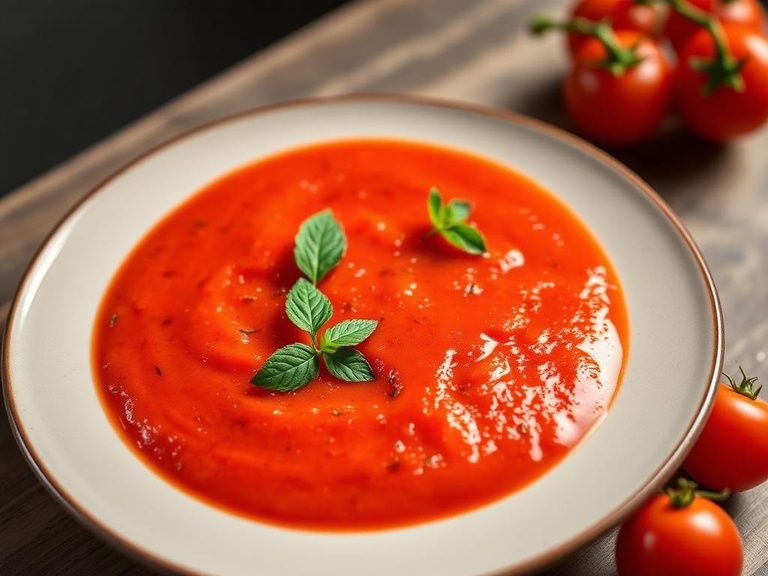
People love it for its concentrated, umami-rich tomato punch that serves as a refreshing drink or a versatile base for cocktails like the Bloody Mary. It's a staple in American brunch culture and a quick way to enjoy savory tomato flavor without cooking.
⚠️ Watch-outs & how to enjoy it better
The added salt content in many brands can be high, which may concern those monitoring sodium intake. To counteract this, look for low-sodium versions or dilute it with water or unsalted vegetable juice. The acidity can also be harsh on sensitive stomachs; pairing it with a bland food like crackers or toast can help.
Key benefits
- Very low calorie density (23 kcal/100g)
- Source of the antioxidant lycopene
- Provides small amounts of potassium and vitamin C
- Convenient, shelf-stable source of tomato flavor
- Hydrating base for savory drinks and cocktails
🍽️ Popular dishes


🌍 Where it's eaten
💡 Did you know?
The modern Bloody Mary cocktail is often credited to Fernand Petiot, a bartender at Harry's New York Bar in Paris in the 1920s, who claimed to have invented the vodka-and-tomato-juice mix.
Full nutrition (USDA data · scales with serving)
| Water | 93.6 g |
| Energy (Atwater General Factors) | 23.3 kcal |
| Energy (Atwater Specific Factors) | 19.9 kcal |
| Nitrogen | 0.14 g |
| Protein | 0.86 g |
| Total lipid (fat) | 0.29 g |
| Ash | 0.93 g |
| Carbohydrate, by difference | 4.3 g |
| Sugars, Total | 2.6 g |
| Sucrose | 0.00 g |
| Glucose | 1.2 g |
| Fructose | 1.4 g |
| Lactose | 0.00 g |
| Maltose | 0.00 g |
| Galactose | 0.00 g |
| Citric acid | 0.00 mg |
| Malic acid | 11.2 mg |
| Oxalic acid | 0.00 mg |
| Quinic acid | 0.00 mg |
| Calcium, Ca | 9.7 mg |
| Iron, Fe | 0.30 mg |
| Magnesium, Mg | 10.4 mg |
| Phosphorus, P | 18.5 mg |
| Potassium, K | 198 mg |
| Sodium, Na | 236 mg |
| Zinc, Zn | 0.10 mg |
| Copper, Cu | 0.06 mg |
| Manganese, Mn | 0.06 mg |
| Vitamin C, total ascorbic acid | 49.8 mg |
| Thiamin | 0.04 mg |
| Niacin | 0.09 mg |
| Vitamin B-6 | 0.08 mg |
| Folate, total | 18.9 ug |
Fat & fatty acid profile (per 100g)
Estimated from Tomatoes, red, ripe, canned, packed in tomato juice — USDA does not publish this profile for Tomato juice.
| Fatty acids, total saturated | 0.03 g |
| SFA 4:0 | 0.00 g |
| SFA 6:0 | 0.00 g |
| SFA 8:0 | 0.00 g |
| SFA 10:0 | 0.00 g |
| SFA 12:0 | 0.00 g |
| SFA 14:0 | 0.00 g |
| SFA 16:0 | 0.03 g |
| SFA 18:0 | 0.01 g |
| Fatty acids, total monounsaturated | 0.04 g |
| MUFA 16:1 | 0.00 g |
| MUFA 18:1 | 0.04 g |
| MUFA 20:1 | 0.00 g |
| MUFA 22:1 | 0.00 g |
| Fatty acids, total polyunsaturated | 0.10 g |
| PUFA 18:2 | 0.10 g |
| PUFA 18:3 | 0.00 g |
| PUFA 18:4 | 0.00 g |
| PUFA 20:4 | 0.00 g |
| PUFA 20:5 n-3 (EPA) | 0.00 g |
| PUFA 22:5 n-3 (DPA) | 0.00 g |
| PUFA 22:6 n-3 (DHA) | 0.00 g |
| Fatty acids, total trans | 0.00 g |
| Cholesterol | 0.00 mg |
Amino acid profile (per 100g)
Estimated from Tomatoes, red, ripe, canned, packed in tomato juice — USDA does not publish this profile for Tomato juice.
| Tryptophan | 0.01 g |
| Threonine | 0.04 g |
| Isoleucine | 0.02 g |
| Leucine | 0.03 g |
| Lysine | 0.03 g |
| Methionine | 0.01 g |
| Cystine | 0.01 g |
| Phenylalanine | 0.03 g |
| Tyrosine | 0.02 g |
| Valine | 0.02 g |
| Arginine | 0.02 g |
| Histidine | 0.01 g |
| Alanine | 0.03 g |
| Aspartic acid | 0.15 g |
| Glutamic acid | 0.45 g |
| Glycine | 0.02 g |
| Proline | 0.01 g |
| Serine | 0.02 g |
FAQ
What's the difference between tomato juice and tomato cocktail?
Tomato juice is typically just tomatoes (and maybe salt), while tomato cocktail often includes added ingredients like sugar, corn syrup, and other vegetable juices like carrot or celery, resulting in a sweeter, more complex flavor.
Is this a good source of vitamins?
It provides some vitamin C and potassium, but the amounts are modest. It's not considered a primary source of these nutrients compared to whole tomatoes or other fruits and vegetables.
Can I use this for cooking?
Absolutely. It's a convenient base for sauces, soups, stews, and marinades, adding depth and tomato flavor without the need to cook down fresh tomatoes.
Nutrient density (calculated · NRF9.3)
Nutrient Rich Foods index: beneficial nutrients (protein, fiber, vitamins, minerals) minus saturated fat, added sugar & sodium, per 100 kcal.
NRF9.3 index — Fulgoni, Keast & Drewnowski, 2009. Computed from USDA nutrients.
Weight-loss friendliness (composite index)
Energy density 0.23 kcal/g · 15% calories from protein · 0.0 g fiber · 0.0 g sugar per 100 g.
Composite of energy density (Rolls et al., 1999), protein & fiber satiety, minus sugar. A calculated heuristic — ranks satiety-per-calorie, not a clinical measure.
Dietary load (calculated from USDA values)
Potential renal acid load. Positive = acid-forming, negative = alkaline-forming.
Sodium-to-potassium ratio: 1.19 (lower is better — aim for ≤ 1)
Sodium:potassium per WHO potassium guidance. Computed from USDA nutrients.