

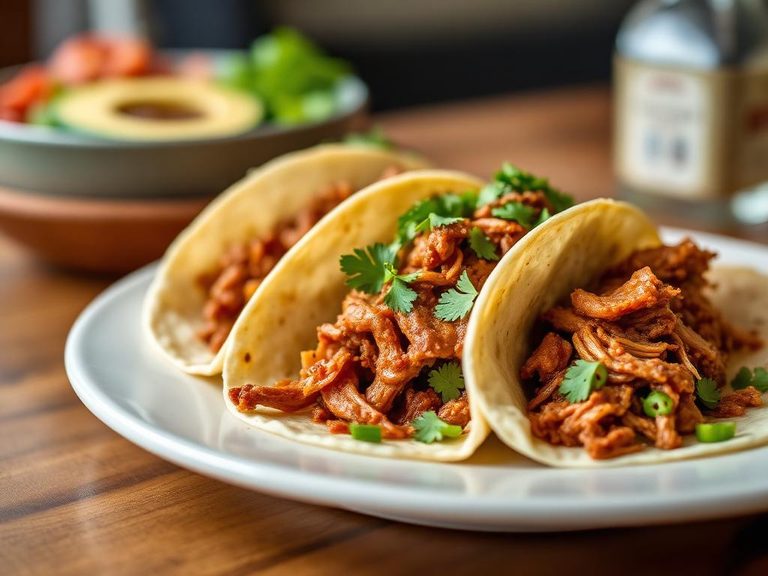
Taco, corn tortilla, pork, with beans, cheese
Common food

Photo: Wikipedia
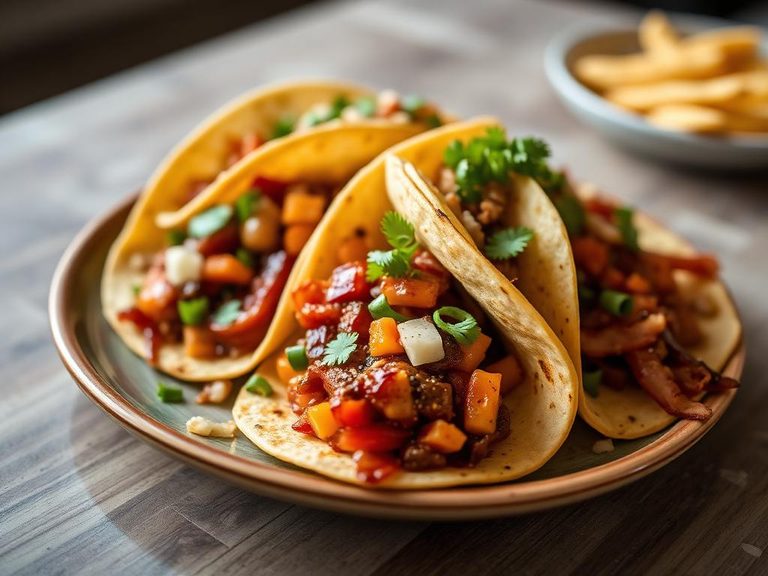
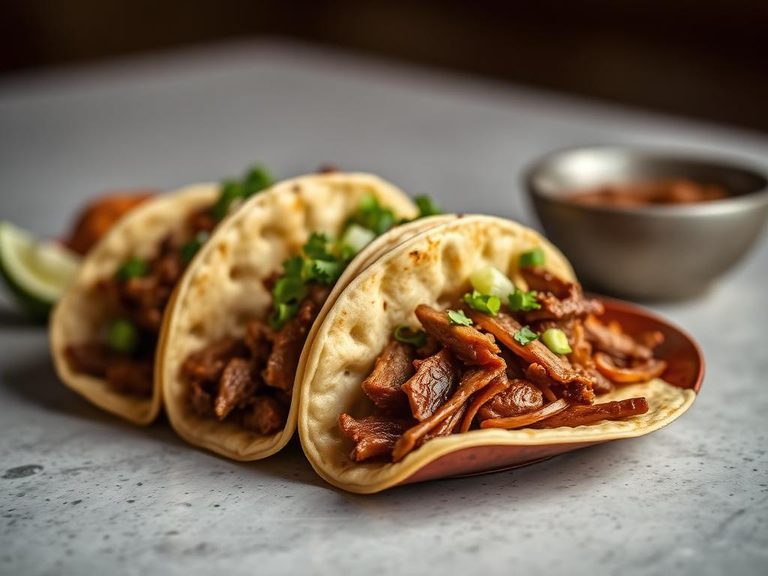
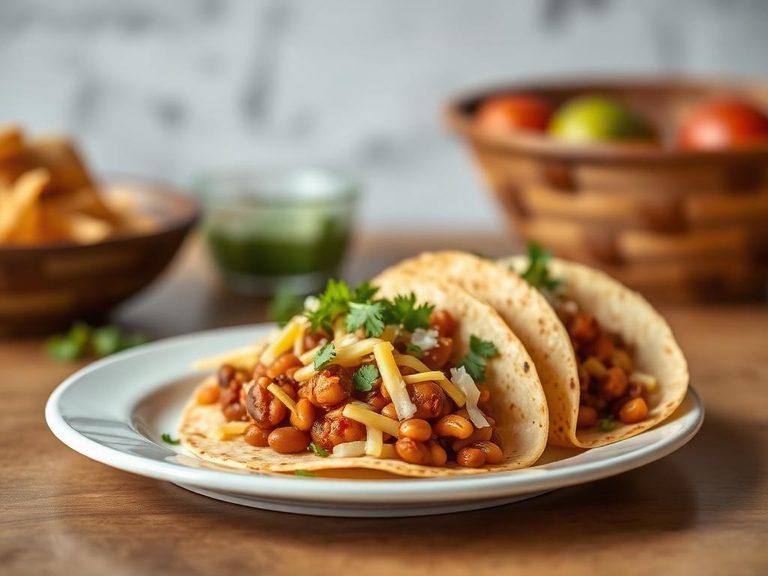
A pork taco on a corn tortilla, topped with beans and cheese, delivers a satisfying crunch from the tortilla, savory depth from the pork, and creamy, earthy notes from the beans and cheese. At about 214 calories per 100g, it offers a balanced mix of protein, carbs, and fats, making it a hearty and flavorful bite. The corn tortilla provides a distinct, slightly sweet base that complements the rich fillings.
Calorie split: 19% protein · 35% carbs · 45% fat
↓ Full nutrition💚 Why it's loved
People adore this taco for its harmonious blend of textures and flavors—the crisp tortilla, tender pork, creamy beans, and melted cheese create a deeply satisfying experience. It's a beloved staple in Mexican cuisine, celebrated for its versatility and cultural significance.
⚠️ Watch-outs & how to enjoy it better
The combination can be high in sodium and saturated fat, which may concern those monitoring heart health or blood pressure. To counteract, opt for low-sodium beans, lean pork cuts, and moderate cheese portions; pairing with a fresh salsa or salad adds fiber and nutrients.
Key benefits
- Good source of protein for muscle maintenance
- Provides dietary fiber from beans and corn tortilla
- Contains calcium from cheese for bone health
- Offers iron from pork and beans
- Balanced energy from carbs, protein, and fats
🍽️ Popular dishes
🌍 Where it's eaten
💡 Did you know?
The corn tortilla's masa dough is traditionally treated with lime (nixtamalization), which unlocks nutrients like niacin and gives it its characteristic flavor and texture.
Full nutrition (USDA data · scales with serving)
| Water | 57.4 g |
| Energy | 214 kcal |
| Protein | 10.3 g |
| Total lipid (fat) | 10.9 g |
| Carbohydrate, by difference | 19.1 g |
| Fiber, total dietary | 3.2 g |
| Total Sugars | 0.49 g |
| Calcium, Ca | 74.0 mg |
| Iron, Fe | 1.3 mg |
| Magnesium, Mg | 41.0 mg |
| Phosphorus, P | 203 mg |
| Potassium, K | 230 mg |
| Sodium, Na | 395 mg |
| Zinc, Zn | 1.9 mg |
| Copper, Cu | 0.12 mg |
| Selenium, Se | 14.7 ug |
| Vitamin C, total ascorbic acid | 0.20 mg |
| Thiamin | 0.17 mg |
| Riboflavin | 0.15 mg |
| Niacin | 1.5 mg |
| Vitamin B-6 | 0.21 mg |
| Folate, total | 10.0 ug |
| Folic acid | 0.00 ug |
| Folate, food | 10.0 ug |
| Folate, DFE | 10.0 ug |
| Choline, total | 35.9 mg |
| Vitamin B-12 | 0.28 ug |
| Vitamin B-12, added | 0.00 ug |
| Vitamin A, RAE | 11.0 ug |
| Retinol | 11.0 ug |
| Carotene, beta | 0.00 ug |
| Carotene, alpha | 0.00 ug |
| Cryptoxanthin, beta | 0.00 ug |
| Lycopene | 0.00 ug |
| Lutein + zeaxanthin | 1.0 ug |
| Vitamin E (alpha-tocopherol) | 0.89 mg |
| Vitamin E, added | 0.00 mg |
| Vitamin D (D2 + D3) | 0.30 ug |
| Vitamin K (phylloquinone) | 4.5 ug |
| Alcohol, ethyl | 0.00 g |
| Caffeine | 0.00 mg |
| Theobromine | 0.00 mg |
Fat & fatty acid profile (per 100g)
| Fatty acids, total saturated | 3.2 g |
| SFA 4:0 | 0.04 g |
| SFA 6:0 | 0.02 g |
| SFA 8:0 | 0.01 g |
| SFA 10:0 | 0.04 g |
| SFA 12:0 | 0.04 g |
| SFA 14:0 | 0.19 g |
| SFA 16:0 | 1.9 g |
| SFA 18:0 | 0.84 g |
| Fatty acids, total monounsaturated | 4.2 g |
| MUFA 16:1 | 0.15 g |
| MUFA 18:1 | 4.0 g |
| MUFA 20:1 | 0.06 g |
| MUFA 22:1 | 0.00 g |
| Fatty acids, total polyunsaturated | 2.6 g |
| PUFA 18:2 | 2.3 g |
| PUFA 18:3 | 0.25 g |
| PUFA 18:4 | 0.00 g |
| PUFA 20:4 | 0.03 g |
| PUFA 20:5 n-3 (EPA) | 0.00 g |
| PUFA 22:5 n-3 (DPA) | 0.00 g |
| PUFA 22:6 n-3 (DHA) | 0.00 g |
| Cholesterol | 27.0 mg |
Amino acid profile (per 100g)
Estimated from TACO BELL, Soft Taco with beef, cheese and lettuce — USDA does not publish this profile for Taco.
| Tryptophan | 0.10 g |
| Threonine | 0.37 g |
| Isoleucine | 0.38 g |
| Leucine | 0.72 g |
| Lysine | 0.62 g |
| Methionine | 0.20 g |
| Cystine | 0.12 g |
| Phenylalanine | 0.42 g |
| Tyrosine | 0.30 g |
| Valine | 0.45 g |
| Arginine | 0.49 g |
| Histidine | 0.26 g |
| Alanine | 0.46 g |
| Aspartic acid | 0.77 g |
| Glutamic acid | 2.1 g |
| Glycine | 0.52 g |
| Proline | 0.72 g |
| Serine | 0.45 g |
FAQ
Is this taco gluten-free?
Yes, if made with a traditional corn tortilla, it is naturally gluten-free. Always check for cross-contamination if celiac.
How can I make it healthier?
Use lean pork, reduce cheese, add extra beans or veggies like lettuce and tomato, and choose a whole-grain corn tortilla.
What's the best way to reheat leftovers?
Reheat in a dry skillet over medium heat to crisp the tortilla, or in the oven at 350°F (175°C) for 5-7 minutes to avoid sogginess.
Nutrient density (calculated · NRF9.3)
Nutrient Rich Foods index: beneficial nutrients (protein, fiber, vitamins, minerals) minus saturated fat, added sugar & sodium, per 100 kcal.
NRF9.3 index — Fulgoni, Keast & Drewnowski, 2009. Computed from USDA nutrients.
Weight-loss friendliness (composite index)
Energy density 2.14 kcal/g · 19% calories from protein · 3.2 g fiber · 0.5 g sugar per 100 g.
Composite of energy density (Rolls et al., 1999), protein & fiber satiety, minus sugar. A calculated heuristic — ranks satiety-per-calorie, not a clinical measure.
Dietary load (calculated from USDA values)
Potential renal acid load. Positive = acid-forming, negative = alkaline-forming.
Sodium-to-potassium ratio: 1.72 (lower is better — aim for ≤ 1)
Sodium:potassium per WHO potassium guidance. Computed from USDA nutrients.