

Squash, summer, casserole, with rice and tomato sauce
Common food
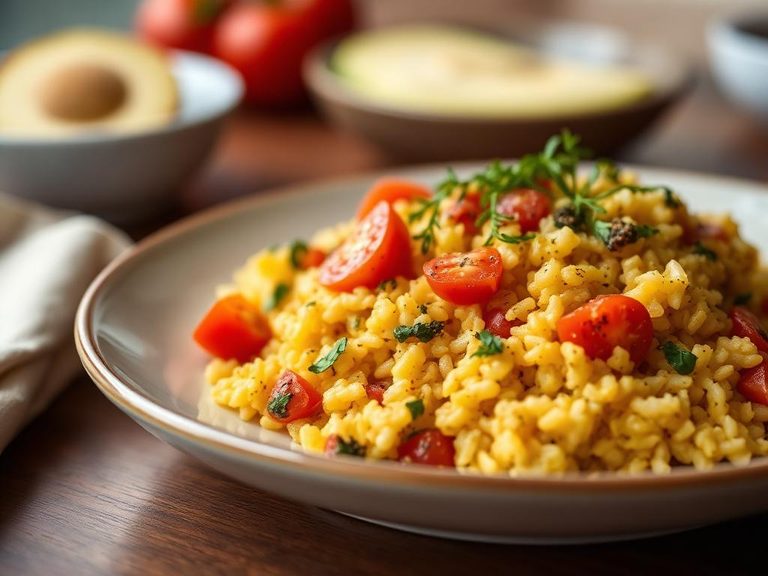
This is a comforting baked dish where tender summer squash is layered with fluffy rice and a savory tomato sauce, often bound with a light egg or cheese mixture. The texture is soft and cohesive, with the squash melting into the grains, creating a mild, slightly sweet flavor that absorbs the tangy tomato notes. Nutritionally, it's a low-calorie, high-volume side dish that provides modest fiber and protein.
Calorie split: 11% protein · 71% carbs · 18% fat
↓ Full nutrition💚 Why it's loved
People love it as a nostalgic, home-style comfort food that transforms humble summer squash into a satisfying, savory bake. Its mild flavor makes it a perfect canvas for herbs and spices, and it's a classic way to use up garden abundance.
⚠️ Watch-outs & how to enjoy it better
The dish can be high in sodium if using canned tomato sauce or salty broths, and the soft texture may not appeal to those who prefer crunchy vegetables. To counteract, use low-sodium sauce, add herbs for flavor, and pair with a crisp green salad. Those monitoring blood sugar should note the moderate carb content from rice; pairing with a lean protein can help balance the meal.
Key benefits
- Low in calories and fat
- Good source of hydration from squash
- Provides modest fiber for digestion
- Versatile base for added protein
- Uses seasonal summer produce
🍽️ Popular dishes
🌍 Where it's eaten
💡 Did you know?
The casserole format became a staple in American community cookbooks and potlucks in the mid-20th century, often as a way to stretch ingredients and feed crowds affordably.
Full nutrition (USDA data · scales with serving)
| Water | 80.2 g |
| Energy | 83.0 kcal |
| Protein | 2.3 g |
| Total lipid (fat) | 1.7 g |
| Carbohydrate, by difference | 14.9 g |
| Fiber, total dietary | 1.1 g |
| Total Sugars | 2.4 g |
| Calcium, Ca | 26.0 mg |
| Iron, Fe | 0.97 mg |
| Magnesium, Mg | 19.0 mg |
| Phosphorus, P | 46.0 mg |
| Potassium, K | 203 mg |
| Sodium, Na | 120 mg |
| Zinc, Zn | 0.43 mg |
| Copper, Cu | 0.09 mg |
| Selenium, Se | 3.7 ug |
| Vitamin C, total ascorbic acid | 10.4 mg |
| Thiamin | 0.13 mg |
| Riboflavin | 0.07 mg |
| Niacin | 1.2 mg |
| Vitamin B-6 | 0.12 mg |
| Folate, total | 35.0 ug |
| Folic acid | 21.0 ug |
| Folate, food | 14.0 ug |
| Folate, DFE | 50.0 ug |
| Choline, total | 7.8 mg |
| Vitamin B-12 | 0.02 ug |
| Vitamin B-12, added | 0.00 ug |
| Vitamin A, RAE | 18.0 ug |
| Retinol | 10.0 ug |
| Carotene, beta | 94.0 ug |
| Carotene, alpha | 0.00 ug |
| Cryptoxanthin, beta | 0.00 ug |
| Lycopene | 1696 ug |
| Lutein + zeaxanthin | 695 ug |
| Vitamin E (alpha-tocopherol) | 0.27 mg |
| Vitamin E, added | 0.00 mg |
| Vitamin D (D2 + D3) | 0.00 ug |
| Vitamin K (phylloquinone) | 3.0 ug |
| Alcohol, ethyl | 0.00 g |
| Caffeine | 0.00 mg |
| Theobromine | 0.00 mg |
Fat & fatty acid profile (per 100g)
| Fatty acids, total saturated | 0.75 g |
| SFA 4:0 | 0.03 g |
| SFA 6:0 | 0.02 g |
| SFA 8:0 | 0.01 g |
| SFA 10:0 | 0.03 g |
| SFA 12:0 | 0.03 g |
| SFA 14:0 | 0.10 g |
| SFA 16:0 | 0.38 g |
| SFA 18:0 | 0.13 g |
| Fatty acids, total monounsaturated | 0.32 g |
| MUFA 16:1 | 0.01 g |
| MUFA 18:1 | 0.29 g |
| MUFA 20:1 | 0.00 g |
| MUFA 22:1 | 0.00 g |
| Fatty acids, total polyunsaturated | 0.23 g |
| PUFA 18:2 | 0.18 g |
| PUFA 18:3 | 0.05 g |
| PUFA 18:4 | 0.00 g |
| PUFA 20:4 | 0.00 g |
| PUFA 20:5 n-3 (EPA) | 0.00 g |
| PUFA 22:5 n-3 (DPA) | 0.00 g |
| PUFA 22:6 n-3 (DHA) | 0.00 g |
| Cholesterol | 3.0 mg |
Amino acid profile (per 100g)
Estimated from Squash, summer, crookneck and straightneck, frozen, cooked, boiled, drained, with salt — USDA does not publish this profile for Squash.
| Tryptophan | 0.01 g |
| Threonine | 0.03 g |
| Isoleucine | 0.05 g |
| Leucine | 0.07 g |
| Lysine | 0.07 g |
| Methionine | 0.02 g |
| Cystine | 0.01 g |
| Phenylalanine | 0.04 g |
| Tyrosine | 0.03 g |
| Valine | 0.06 g |
| Arginine | 0.05 g |
| Histidine | 0.03 g |
| Alanine | 0.07 g |
| Aspartic acid | 0.16 g |
| Glutamic acid | 0.14 g |
| Glycine | 0.05 g |
| Proline | 0.04 g |
| Serine | 0.05 g |
FAQ
Can I make this dish ahead?
Yes, it's ideal for meal prep. Assemble, cover, and refrigerate for up to 2 days before baking, or freeze the baked casserole for up to 3 months.
What type of summer squash works best?
Yellow crookneck or zucchini are most common. Pattypan or a mix of summer squashes also work well, offering slightly different textures and flavors.
How can I add more protein?
Stir in cooked chicken, ground turkey, or white beans before baking. Topping with a sprinkle of parmesan or serving with a side of Greek yogurt also boosts protein.
Nutrient density (calculated · NRF9.3)
Nutrient Rich Foods index: beneficial nutrients (protein, fiber, vitamins, minerals) minus saturated fat, added sugar & sodium, per 100 kcal.
NRF9.3 index — Fulgoni, Keast & Drewnowski, 2009. Computed from USDA nutrients.
Weight-loss friendliness (composite index)
Energy density 0.83 kcal/g · 11% calories from protein · 1.1 g fiber · 2.4 g sugar per 100 g.
Composite of energy density (Rolls et al., 1999), protein & fiber satiety, minus sugar. A calculated heuristic — ranks satiety-per-calorie, not a clinical measure.
Dietary load (calculated from USDA values)
Potential renal acid load. Positive = acid-forming, negative = alkaline-forming.
Sodium-to-potassium ratio: 0.59 (lower is better — aim for ≤ 1)
Sodium:potassium per WHO potassium guidance. Computed from USDA nutrients.