

Soup, pepperpot
Common food
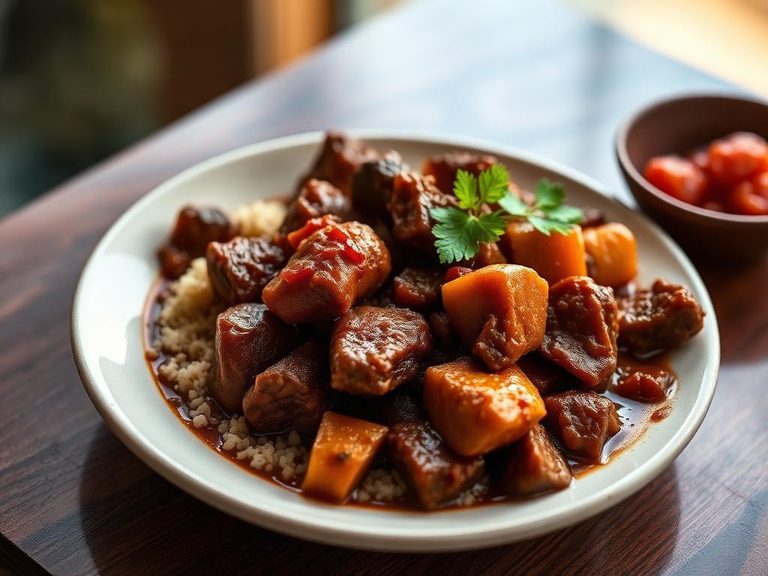
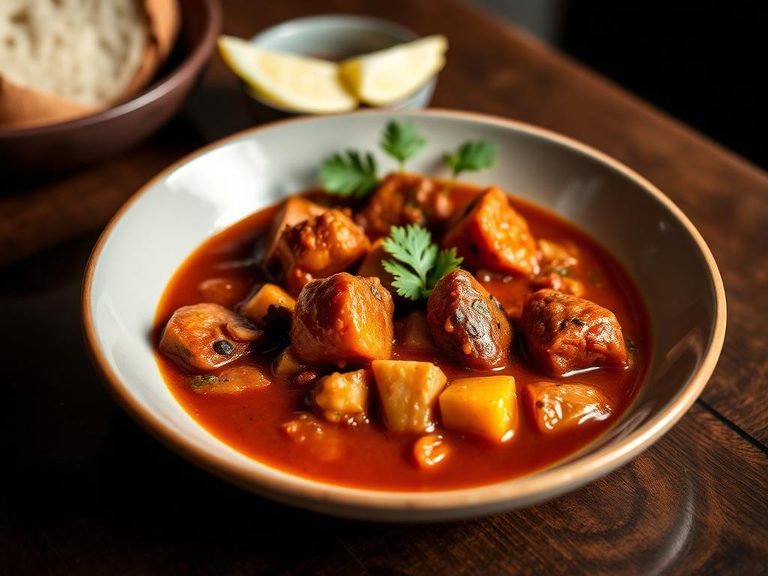
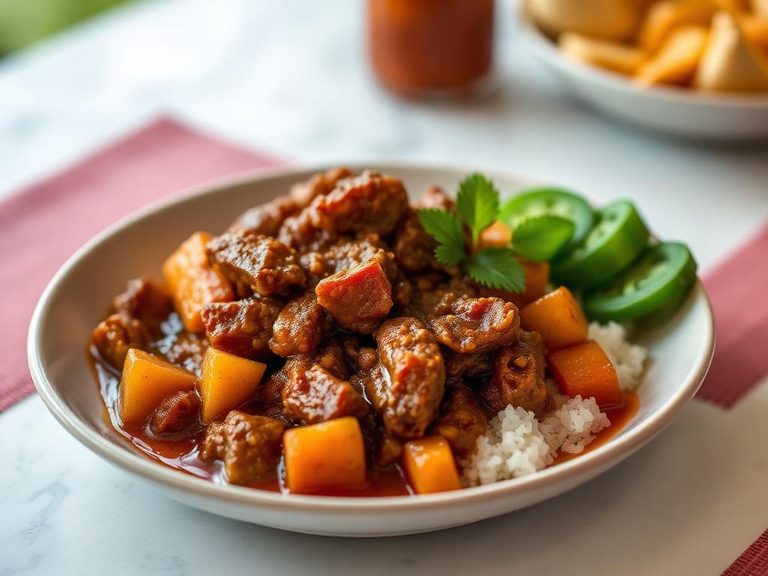
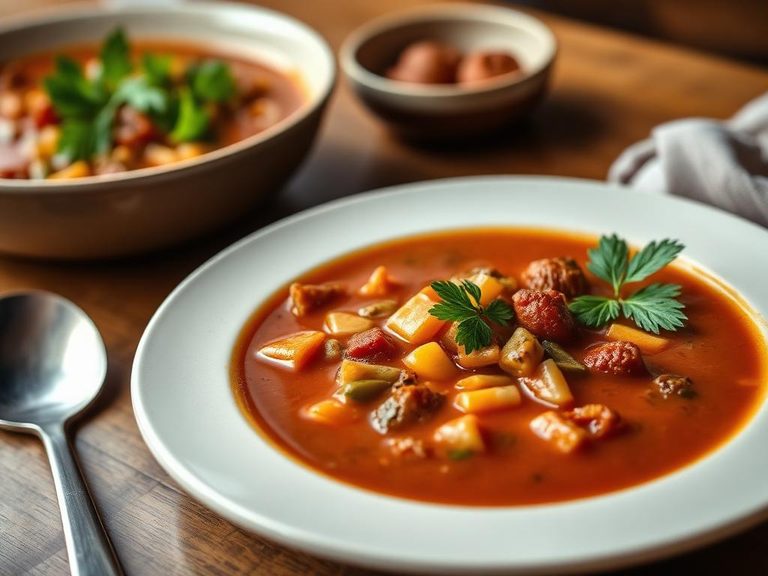
Pepperpot is a rich, hearty stew traditionally made with a variety of meats, vegetables, and a unique, slightly bitter flavoring agent called cassareep. The texture is thick and stew-like, with the meat becoming incredibly tender from slow cooking. Nutritionally, it's a moderate-calorie dish that provides a balanced mix of protein and fats for sustained energy.
Calorie split: 13% protein · 30% carbs · 57% fat
↓ Full nutrition💚 Why it's loved
People love Pepperpot for its deep, complex, and uniquely savory-sweet flavor profile that develops over time, especially when reheated. It's a beloved cultural staple, often served at festivals and holidays, symbolizing community and tradition.
⚠️ Watch-outs & how to enjoy it better
The dish can be high in sodium and saturated fat depending on the meats used. Those watching their sodium intake should be mindful of portion sizes and opt for leaner cuts of meat. To counteract, pair with a fresh, vinegar-based side salad and use low-sodium broth if preparing from scratch.
Key benefits
- Provides a balanced source of protein and fats for satiety.
- Contains a moderate amount of carbohydrates for energy.
- Cassareep, a key ingredient, has antioxidant properties.
- Often includes a variety of vegetables, adding micronutrients.
- A traditional, culturally significant comfort food.
🍽️ Popular dishes
🌍 Where it's eaten
💡 Did you know?
Authentic Pepperpot is often said to taste better the next day, as the flavors meld and deepen; some traditional pots are never fully emptied, with a portion of the old stew being used to start the next batch, creating a continuous 'perpetual stew' for years.
Full nutrition (USDA data · scales with serving)
| Water | 83.3 g |
| Energy | 91.0 kcal |
| Protein | 3.1 g |
| Total lipid (fat) | 5.8 g |
| Carbohydrate, by difference | 6.8 g |
| Fiber, total dietary | 0.90 g |
| Total Sugars | 1.5 g |
| Calcium, Ca | 22.0 mg |
| Iron, Fe | 0.43 mg |
| Magnesium, Mg | 12.0 mg |
| Phosphorus, P | 41.0 mg |
| Potassium, K | 155 mg |
| Sodium, Na | 251 mg |
| Zinc, Zn | 0.49 mg |
| Copper, Cu | 0.04 mg |
| Selenium, Se | 3.6 ug |
| Vitamin C, total ascorbic acid | 6.9 mg |
| Thiamin | 0.08 mg |
| Riboflavin | 0.08 mg |
| Niacin | 0.78 mg |
| Vitamin B-6 | 0.08 mg |
| Folate, total | 15.0 ug |
| Folic acid | 4.0 ug |
| Folate, food | 12.0 ug |
| Folate, DFE | 18.0 ug |
| Choline, total | 21.6 mg |
| Vitamin B-12 | 0.12 ug |
| Vitamin B-12, added | 0.00 ug |
| Vitamin A, RAE | 71.0 ug |
| Retinol | 39.0 ug |
| Carotene, beta | 339 ug |
| Carotene, alpha | 96.0 ug |
| Cryptoxanthin, beta | 4.0 ug |
| Lycopene | 227 ug |
| Lutein + zeaxanthin | 260 ug |
| Vitamin E (alpha-tocopherol) | 0.31 mg |
| Vitamin E, added | 0.00 mg |
| Vitamin D (D2 + D3) | 0.20 ug |
| Vitamin K (phylloquinone) | 13.6 ug |
| Alcohol, ethyl | 0.00 g |
| Caffeine | 0.00 mg |
| Theobromine | 0.00 mg |
Fat & fatty acid profile (per 100g)
| Fatty acids, total saturated | 2.9 g |
| SFA 4:0 | 0.09 g |
| SFA 6:0 | 0.07 g |
| SFA 8:0 | 0.05 g |
| SFA 10:0 | 0.11 g |
| SFA 12:0 | 0.13 g |
| SFA 14:0 | 0.42 g |
| SFA 16:0 | 1.4 g |
| SFA 18:0 | 0.53 g |
| Fatty acids, total monounsaturated | 1.5 g |
| MUFA 16:1 | 0.10 g |
| MUFA 18:1 | 1.5 g |
| MUFA 20:1 | 0.02 g |
| MUFA 22:1 | 0.00 g |
| Fatty acids, total polyunsaturated | 0.46 g |
| PUFA 18:2 | 0.33 g |
| PUFA 18:3 | 0.04 g |
| PUFA 18:4 | 0.00 g |
| PUFA 20:4 | 0.01 g |
| PUFA 20:5 n-3 (EPA) | 0.00 g |
| PUFA 22:5 n-3 (DPA) | 0.00 g |
| PUFA 22:6 n-3 (DHA) | 0.00 g |
| Cholesterol | 23.0 mg |
Amino acid profile (per 100g)
Estimated from Restaurant, Latino, black bean soup — USDA does not publish this profile for Soup.
| Tryptophan | 0.04 g |
| Threonine | 0.17 g |
| Isoleucine | 0.16 g |
| Leucine | 0.32 g |
| Lysine | 0.27 g |
| Methionine | 0.10 g |
| Cystine | 0.04 g |
| Phenylalanine | 0.16 g |
| Tyrosine | 0.13 g |
| Valine | 0.20 g |
| Arginine | 0.35 g |
| Histidine | 0.09 g |
| Alanine | 0.35 g |
| Aspartic acid | 0.38 g |
| Glutamic acid | 0.72 g |
| Glycine | 0.58 g |
| Proline | 0.36 g |
| Serine | 0.20 g |
FAQ
What gives Pepperpot its distinctive dark color and slightly bitter taste?
The key ingredient is cassareep, a thick, dark syrup made from boiled cassava juice. It acts as a preservative and provides the stew's signature flavor and color.
Is Pepperpot the same as a regular meat stew?
While similar, Pepperpot is distinguished by its use of cassareep and the traditional practice of keeping the stew going for days or even weeks, which develops a unique depth of flavor.
Can Pepperpot be made vegetarian?
Yes, modern versions can substitute the meat with hearty vegetables like mushrooms, jackfruit, or beans, and use vegetable broth with cassareep to mimic the traditional flavor profile.
Nutrient density (calculated · NRF9.3)
Nutrient Rich Foods index: beneficial nutrients (protein, fiber, vitamins, minerals) minus saturated fat, added sugar & sodium, per 100 kcal.
NRF9.3 index — Fulgoni, Keast & Drewnowski, 2009. Computed from USDA nutrients.
Weight-loss friendliness (composite index)
Energy density 0.91 kcal/g · 13% calories from protein · 0.9 g fiber · 1.5 g sugar per 100 g.
Composite of energy density (Rolls et al., 1999), protein & fiber satiety, minus sugar. A calculated heuristic — ranks satiety-per-calorie, not a clinical measure.
Dietary load (calculated from USDA values)
Potential renal acid load. Positive = acid-forming, negative = alkaline-forming.
Sodium-to-potassium ratio: 1.62 (lower is better — aim for ≤ 1)
Sodium:potassium per WHO potassium guidance. Computed from USDA nutrients.