

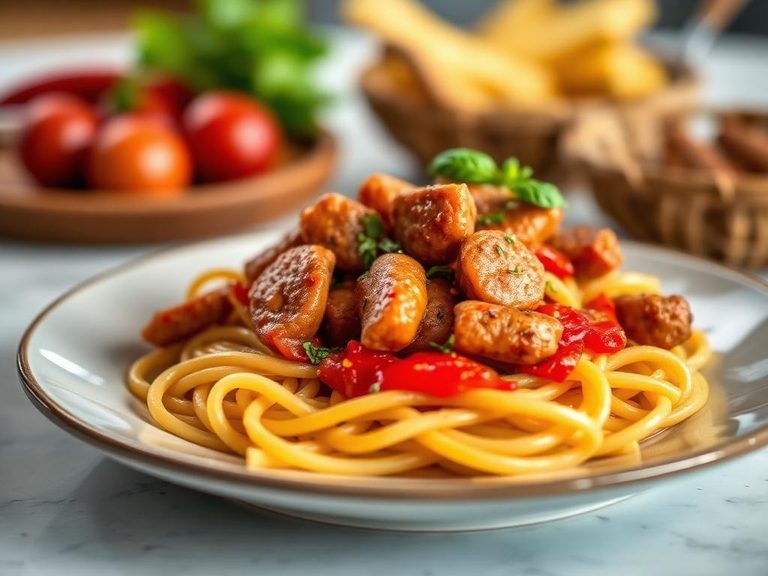
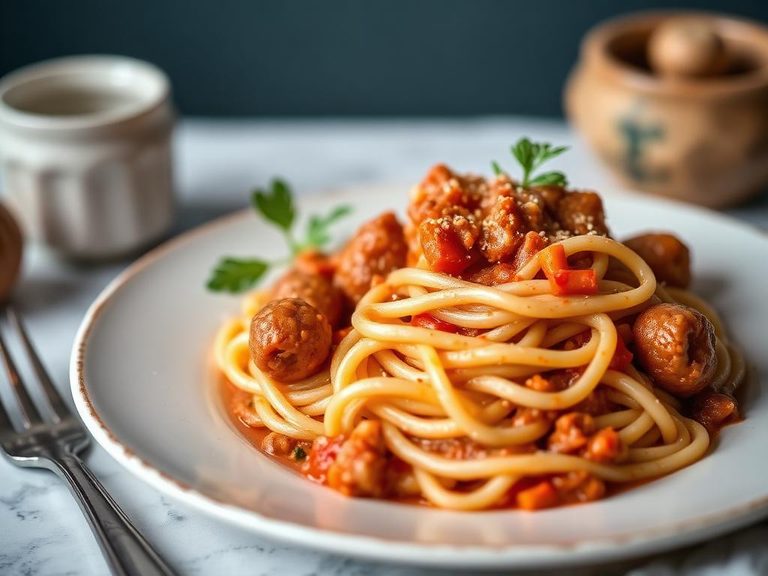
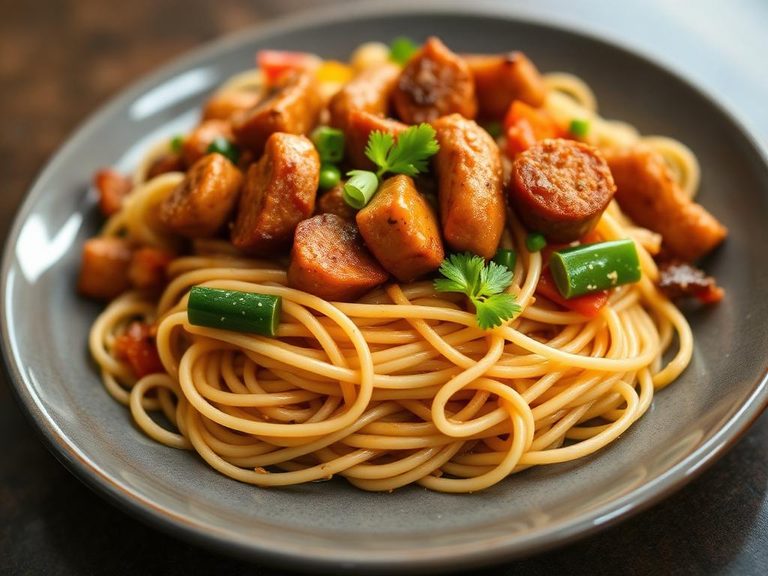
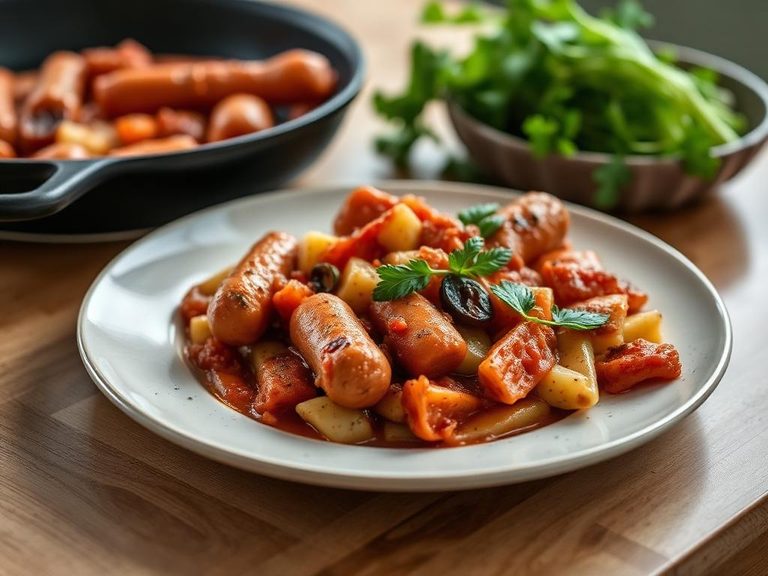
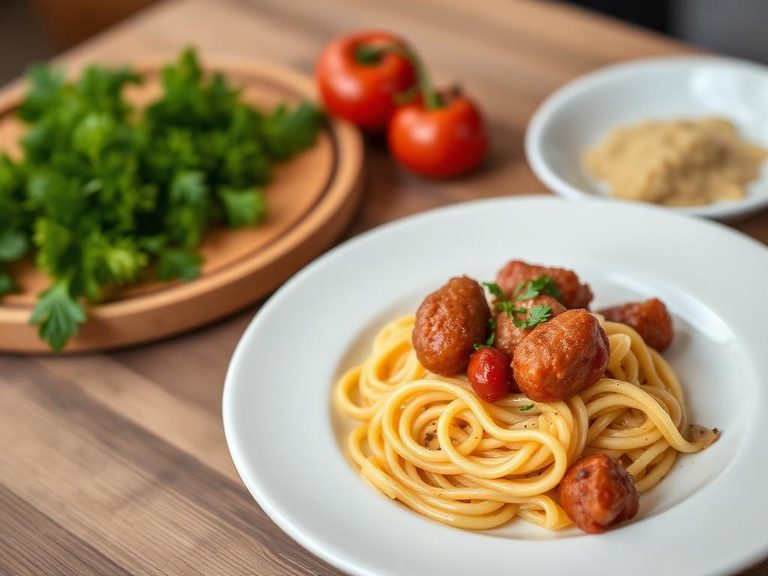
Sausage, noodles, and vegetables excluding carrots, broccoli, and dark-green leafy; tomato-based sauce
Common food
This is a hearty, comforting dish of savory sausage, soft noodles, and mixed vegetables (like peppers, onions, or zucchini) simmered in a tangy tomato sauce. It offers a satisfying texture contrast between the chewy noodles, tender vegetables, and meaty sausage, all coated in a rich, slightly sweet tomato base. Nutritionally, it provides a moderate calorie count with a balanced mix of protein, carbs, and fat, making it a filling yet relatively light meal option.
Calorie split: 16% protein · 46% carbs · 38% fat
↓ Full nutrition💚 Why it's loved
People love this dish for its comforting, home-cooked appeal and the way the savory sausage and tangy tomato sauce create a deeply satisfying flavor profile. Its versatility allows it to be adapted with different noodles or vegetables, making it a go-to for quick, hearty meals that feel both nourishing and indulgent.
⚠️ Watch-outs & how to enjoy it better
The dish can be high in sodium from the sausage and tomato sauce, which may concern those monitoring salt intake. To counteract this, choose low-sodium sausage, rinse canned tomatoes, and pair the dish with a potassium-rich side like a small salad or steamed greens to help balance sodium levels. Additionally, the noodles and sauce may cause blood-sugar spikes in sensitive individuals; pairing with extra protein or fat (like a dollop of Greek yogurt or a side of beans) can help stabilize blood sugar response.
Key benefits
- Provides a balanced mix of protein, carbs, and fat for sustained energy.
- Contains fiber from vegetables and noodles to support digestion.
- Rich in vitamins from the tomato-based sauce and mixed vegetables.
- Offers a convenient, one-pot meal that is easy to prepare and portion.
- Can be customized with various vegetables to increase nutrient diversity.
🍽️ Popular dishes
🌍 Where it's eaten
💡 Did you know?
The combination of sausage and noodles in tomato sauce is a staple in many cultures, but the Italian-American version often uses a specific type of spicy sausage called 'soppressata' to add a smoky, peppery kick that enhances the tomato sauce's sweetness.
Full nutrition (USDA data · scales with serving)
| Water | 72.1 g |
| Energy | 131 kcal |
| Protein | 5.3 g |
| Total lipid (fat) | 5.7 g |
| Carbohydrate, by difference | 15.3 g |
| Fiber, total dietary | 1.4 g |
| Total Sugars | 1.7 g |
| Calcium, Ca | 15.0 mg |
| Iron, Fe | 1.2 mg |
| Magnesium, Mg | 20.0 mg |
| Phosphorus, P | 72.0 mg |
| Potassium, K | 180 mg |
| Sodium, Na | 381 mg |
| Zinc, Zn | 0.76 mg |
| Copper, Cu | 0.10 mg |
| Selenium, Se | 13.9 ug |
| Vitamin C, total ascorbic acid | 2.6 mg |
| Thiamin | 0.18 mg |
| Riboflavin | 0.12 mg |
| Niacin | 2.2 mg |
| Vitamin B-6 | 0.09 mg |
| Folate, total | 46.0 ug |
| Folic acid | 35.0 ug |
| Folate, food | 11.0 ug |
| Folate, DFE | 70.0 ug |
| Choline, total | 26.0 mg |
| Vitamin B-12 | 0.17 ug |
| Vitamin B-12, added | 0.00 ug |
| Vitamin A, RAE | 15.0 ug |
| Retinol | 7.0 ug |
| Carotene, beta | 95.0 ug |
| Carotene, alpha | 7.0 ug |
| Cryptoxanthin, beta | 12.0 ug |
| Lycopene | 3770 ug |
| Lutein + zeaxanthin | 131 ug |
| Vitamin E (alpha-tocopherol) | 0.77 mg |
| Vitamin E, added | 0.00 mg |
| Vitamin D (D2 + D3) | 0.20 ug |
| Vitamin K (phylloquinone) | 5.1 ug |
| Alcohol, ethyl | 0.00 g |
| Caffeine | 0.00 mg |
| Theobromine | 0.00 mg |
Fat & fatty acid profile (per 100g)
| Fatty acids, total saturated | 1.5 g |
| SFA 4:0 | 0.00 g |
| SFA 6:0 | 0.00 g |
| SFA 8:0 | 0.00 g |
| SFA 10:0 | 0.00 g |
| SFA 12:0 | 0.00 g |
| SFA 14:0 | 0.05 g |
| SFA 16:0 | 1.0 g |
| SFA 18:0 | 0.44 g |
| Fatty acids, total monounsaturated | 2.2 g |
| MUFA 16:1 | 0.10 g |
| MUFA 18:1 | 2.1 g |
| MUFA 20:1 | 0.05 g |
| MUFA 22:1 | 0.00 g |
| Fatty acids, total polyunsaturated | 1.4 g |
| PUFA 18:2 | 1.2 g |
| PUFA 18:3 | 0.08 g |
| PUFA 18:4 | 0.00 g |
| PUFA 20:4 | 0.02 g |
| PUFA 20:5 n-3 (EPA) | 0.00 g |
| PUFA 22:5 n-3 (DPA) | 0.00 g |
| PUFA 22:6 n-3 (DHA) | 0.00 g |
| Cholesterol | 25.0 mg |
Amino acid profile (per 100g)
Estimated from Sausage, smoked link sausage, pork and beef (nonfat dry milk added) — USDA does not publish this profile for Sausage.
| Tryptophan | 0.14 g |
| Threonine | 0.55 g |
| Isoleucine | 0.60 g |
| Leucine | 1.0 g |
| Lysine | 1.0 g |
| Methionine | 0.34 g |
| Cystine | 0.15 g |
| Phenylalanine | 0.52 g |
| Tyrosine | 0.45 g |
| Valine | 0.66 g |
| Arginine | 0.81 g |
| Histidine | 0.41 g |
| Alanine | 0.83 g |
| Aspartic acid | 1.2 g |
| Glutamic acid | 2.1 g |
| Glycine | 0.89 g |
| Proline | 0.81 g |
| Serine | 0.57 g |
FAQ
Can I make this dish vegetarian?
Yes, you can substitute the sausage with plant-based sausage or add extra vegetables like mushrooms or lentils for a protein-rich, vegetarian version.
How can I reduce the sodium content?
Use low-sodium sausage, rinse canned tomatoes, and avoid adding extra salt. You can also use fresh tomatoes instead of canned to control sodium levels.
What noodles work best for this dish?
Penne, fusilli, or spaghetti are classic choices, but you can also use whole-grain noodles for added fiber or gluten-free options like rice noodles.
Nutrient density (calculated · NRF9.3)
Nutrient Rich Foods index: beneficial nutrients (protein, fiber, vitamins, minerals) minus saturated fat, added sugar & sodium, per 100 kcal.
NRF9.3 index — Fulgoni, Keast & Drewnowski, 2009. Computed from USDA nutrients.
Weight-loss friendliness (composite index)
Energy density 1.31 kcal/g · 16% calories from protein · 1.4 g fiber · 1.7 g sugar per 100 g.
Composite of energy density (Rolls et al., 1999), protein & fiber satiety, minus sugar. A calculated heuristic — ranks satiety-per-calorie, not a clinical measure.
Dietary load (calculated from USDA values)
Potential renal acid load. Positive = acid-forming, negative = alkaline-forming.
Sodium-to-potassium ratio: 2.12 (lower is better — aim for ≤ 1)
Sodium:potassium per WHO potassium guidance. Computed from USDA nutrients.