

Potato salad, German style
Common food

Photo: Wikipedia
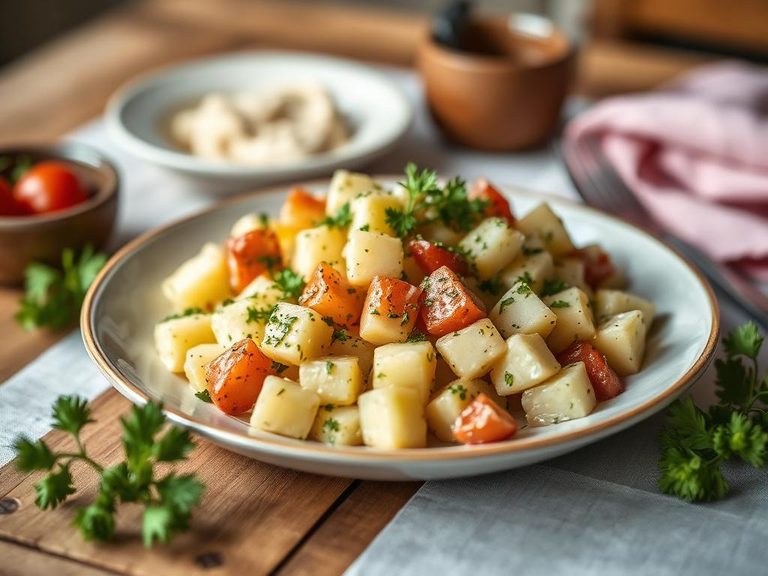
German-style potato salad is a warm or room-temperature salad featuring tender, sliced potatoes tossed in a tangy, savory vinaigrette of vinegar, oil, and often bacon drippings. Unlike its creamy American cousin, it has a bright, slightly sweet-and-sour flavor profile with a soft, yielding texture from the potatoes and a subtle crunch from onions or celery seed. Nutritionally, it's a lighter, lower-fat option, providing satisfying complex carbs and a modest amount of fiber per serving.
Calorie split: 11% protein · 63% carbs · 27% fat
↓ Full nutrition💚 Why it's loved
People love it for its distinctive sweet-and-sour tang from the vinegar dressing, which cuts through the richness of the potatoes. It's a beloved staple at German-American picnics and barbecues, valued for its ability to be served at room temperature without spoiling quickly.
⚠️ Watch-outs & how to enjoy it better
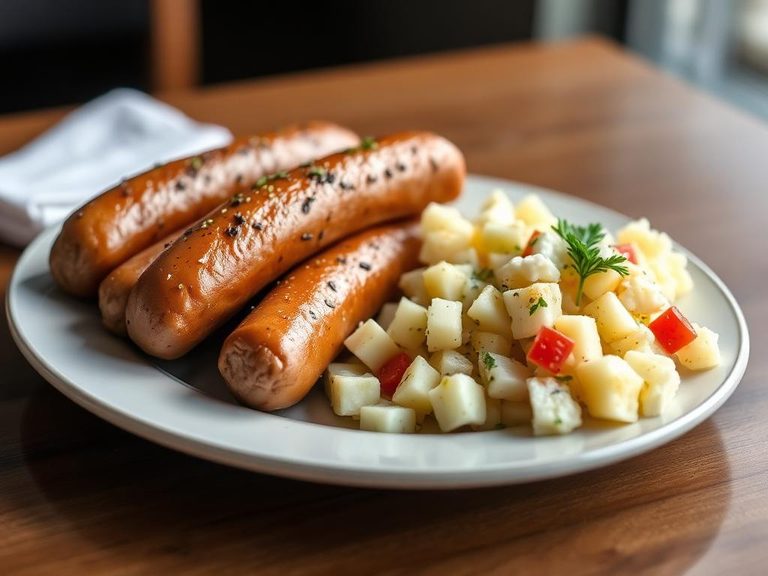
The vinegar and sugar content can be a concern for those monitoring blood sugar spikes or following a low-acid diet. To counteract this, pair it with a protein-rich main like grilled bratwurst or chicken, and practice portion control. Those sensitive to FODMAPs might react to the onion; using the green tops of scallions can be a gentler alternative.
Key benefits
- Good source of energy from complex carbohydrates
- Lower in fat and calories than mayonnaise-based versions
- Contains fiber for digestive health
- Can be served warm, making it versatile for different seasons
- Simple, whole-food ingredients
🍽️ Popular dishes
🌍 Where it's eaten
💡 Did you know?
In many German regions, particularly in the south, potato salad is traditionally made with a hot broth and vinegar dressing poured over the sliced potatoes, which allows them to absorb the flavors without needing mayonnaise.
Full nutrition (USDA data · scales with serving)
| Water | 74.8 g |
| Energy | 108 kcal |
| Protein | 2.9 g |
| Total lipid (fat) | 3.2 g |
| Carbohydrate, by difference | 17.2 g |
| Fiber, total dietary | 1.9 g |
| Total Sugars | 1.5 g |
| Calcium, Ca | 17.0 mg |
| Iron, Fe | 0.89 mg |
| Magnesium, Mg | 24.0 mg |
| Phosphorus, P | 67.0 mg |
| Potassium, K | 446 mg |
| Sodium, Na | 181 mg |
| Zinc, Zn | 0.38 mg |
| Copper, Cu | 0.10 mg |
| Selenium, Se | 1.7 ug |
| Vitamin C, total ascorbic acid | 7.8 mg |
| Thiamin | 0.07 mg |
| Riboflavin | 0.05 mg |
| Niacin | 1.4 mg |
| Vitamin B-6 | 0.26 mg |
| Folate, total | 23.0 ug |
| Folic acid | 0.00 ug |
| Folate, food | 23.0 ug |
| Folate, DFE | 23.0 ug |
| Choline, total | 15.3 mg |
| Vitamin B-12 | 0.03 ug |
| Vitamin B-12, added | 0.00 ug |
| Vitamin A, RAE | 2.0 ug |
| Retinol | 0.00 ug |
| Carotene, beta | 18.0 ug |
| Carotene, alpha | 0.00 ug |
| Cryptoxanthin, beta | 2.0 ug |
| Lycopene | 0.00 ug |
| Lutein + zeaxanthin | 40.0 ug |
| Vitamin E (alpha-tocopherol) | 0.07 mg |
| Vitamin E, added | 0.00 mg |
| Vitamin D (D2 + D3) | 0.10 ug |
| Vitamin K (phylloquinone) | 2.8 ug |
| Alcohol, ethyl | 0.00 g |
| Caffeine | 0.00 mg |
| Theobromine | 0.00 mg |
Fat & fatty acid profile (per 100g)
| Fatty acids, total saturated | 1.2 g |
| SFA 4:0 | 0.00 g |
| SFA 6:0 | 0.00 g |
| SFA 8:0 | 0.00 g |
| SFA 10:0 | 0.00 g |
| SFA 12:0 | 0.01 g |
| SFA 14:0 | 0.04 g |
| SFA 16:0 | 0.74 g |
| SFA 18:0 | 0.39 g |
| Fatty acids, total monounsaturated | 1.4 g |
| MUFA 16:1 | 0.08 g |
| MUFA 18:1 | 1.3 g |
| MUFA 20:1 | 0.03 g |
| MUFA 22:1 | 0.00 g |
| Fatty acids, total polyunsaturated | 0.46 g |
| PUFA 18:2 | 0.40 g |
| PUFA 18:3 | 0.04 g |
| PUFA 18:4 | 0.00 g |
| PUFA 20:4 | 0.01 g |
| PUFA 20:5 n-3 (EPA) | 0.00 g |
| PUFA 22:5 n-3 (DPA) | 0.00 g |
| PUFA 22:6 n-3 (DHA) | 0.00 g |
| Cholesterol | 5.0 mg |
Amino acid profile (per 100g)
Estimated from Potato salad, home-prepared — USDA does not publish this profile for Potato salad.
| Tryptophan | 0.04 g |
| Threonine | 0.12 g |
| Isoleucine | 0.14 g |
| Leucine | 0.20 g |
| Lysine | 0.17 g |
| Methionine | 0.07 g |
| Cystine | 0.05 g |
| Phenylalanine | 0.14 g |
| Tyrosine | 0.10 g |
| Valine | 0.17 g |
| Arginine | 0.15 g |
| Histidine | 0.06 g |
| Alanine | 0.12 g |
| Aspartic acid | 0.42 g |
| Glutamic acid | 0.39 g |
| Glycine | 0.09 g |
| Proline | 0.10 g |
| Serine | 0.16 g |
FAQ
What makes German potato salad different from American potato salad?
German potato salad is typically dressed with a warm vinaigrette of vinegar, oil, and bacon drippings, while American potato salad is usually bound with mayonnaise and often includes hard-boiled eggs and celery.
Can German potato salad be served cold?
Yes, it's often served at room temperature or chilled, which allows the flavors to meld. The vinegar-based dressing also helps it keep better at outdoor events than mayo-based salads.
Is it always made with bacon?
While traditional recipes use bacon drippings in the dressing and often include bacon bits, vegetarian versions are common, using vegetable oil and omitting the meat.
Nutrient density (calculated · NRF9.3)
Nutrient Rich Foods index: beneficial nutrients (protein, fiber, vitamins, minerals) minus saturated fat, added sugar & sodium, per 100 kcal.
NRF9.3 index — Fulgoni, Keast & Drewnowski, 2009. Computed from USDA nutrients.
Weight-loss friendliness (composite index)
Energy density 1.08 kcal/g · 11% calories from protein · 1.9 g fiber · 1.5 g sugar per 100 g.
Composite of energy density (Rolls et al., 1999), protein & fiber satiety, minus sugar. A calculated heuristic — ranks satiety-per-calorie, not a clinical measure.
Dietary load (calculated from USDA values)
Potential renal acid load. Positive = acid-forming, negative = alkaline-forming.
Sodium-to-potassium ratio: 0.41 (lower is better — aim for ≤ 1)
Sodium:potassium per WHO potassium guidance. Computed from USDA nutrients.