

Potato salad, from restaurant
Common food
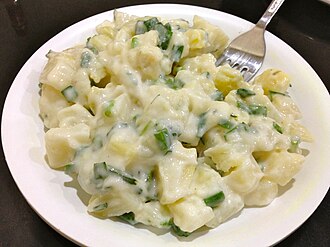
Photo: Wikipedia
A creamy, chilled side dish of tender potato chunks bound in a mayonnaise-based dressing, often with crunchy celery and tangy pickles. Its rich, savory flavor and satisfying texture make it a picnic staple. Nutritionally, it's a moderate-calorie, high-fat comfort food.
Calorie split: 4% protein · 39% carbs · 57% fat
↓ Full nutrition💚 Why it's loved
People adore it for its creamy, comforting texture and the way it balances savory, tangy, and subtly sweet flavors. It's a nostalgic, crowd-pleasing staple at barbecues and potlucks, easily customized with herbs or spices.
⚠️ Watch-outs & how to enjoy it better
The high fat and calorie density from mayonnaise can be a concern, and the refined carbs may cause blood sugar spikes. To counteract this, pair a smaller portion with a lean protein like grilled chicken or a large, vinegar-dressed green salad to add fiber and slow digestion.
Key benefits
- Provides quick energy from carbohydrates
- Contains potassium from potatoes
- Offers some dietary fiber
- A versatile side for grilled meats
- A source of fat for satiety
🍽️ Popular dishes
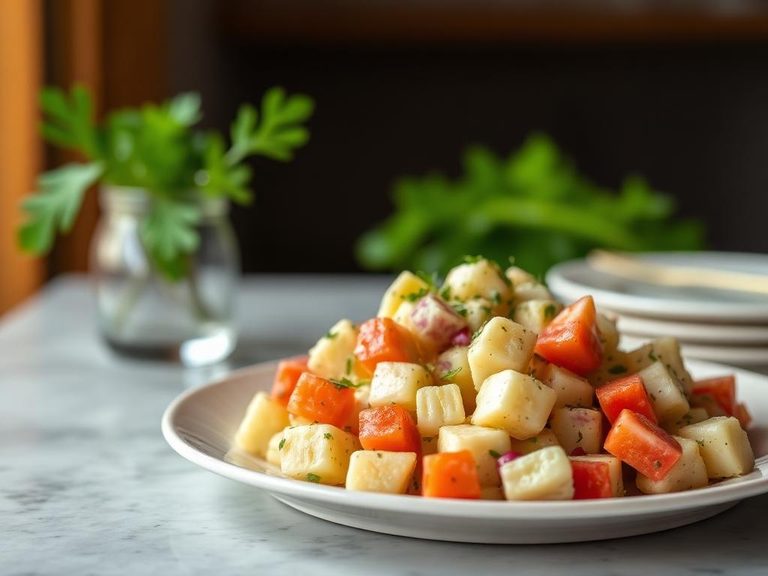
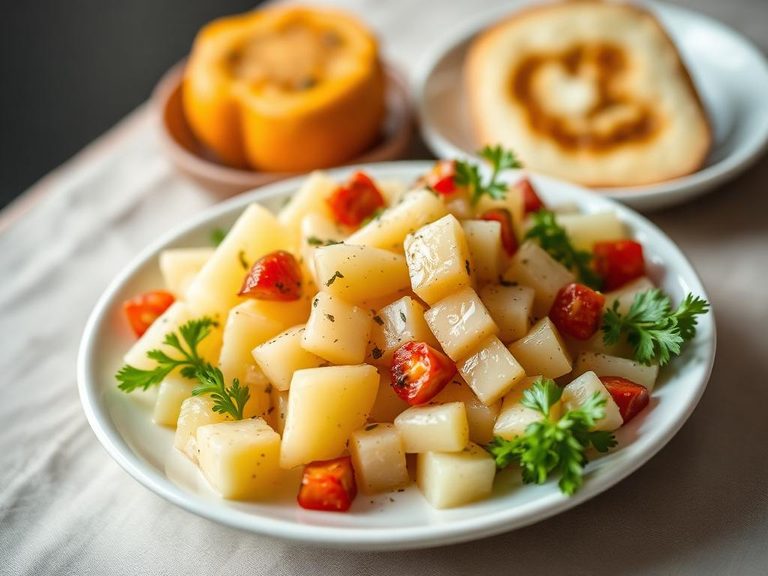
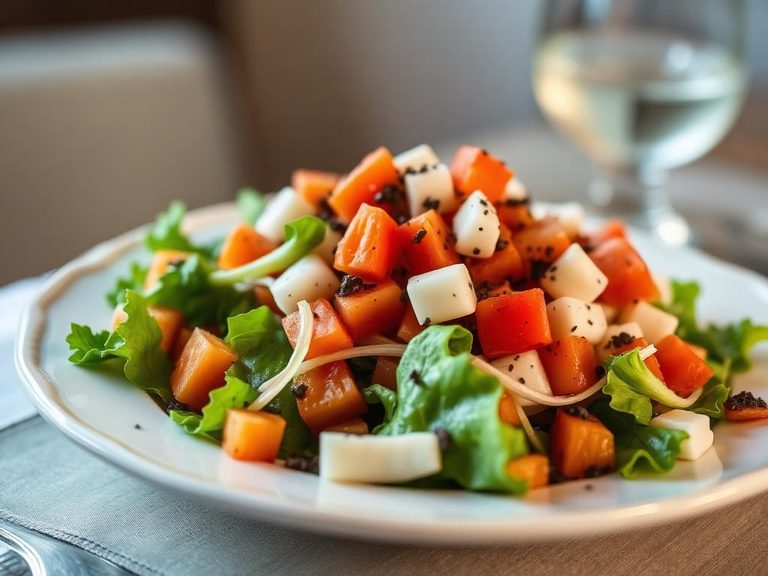
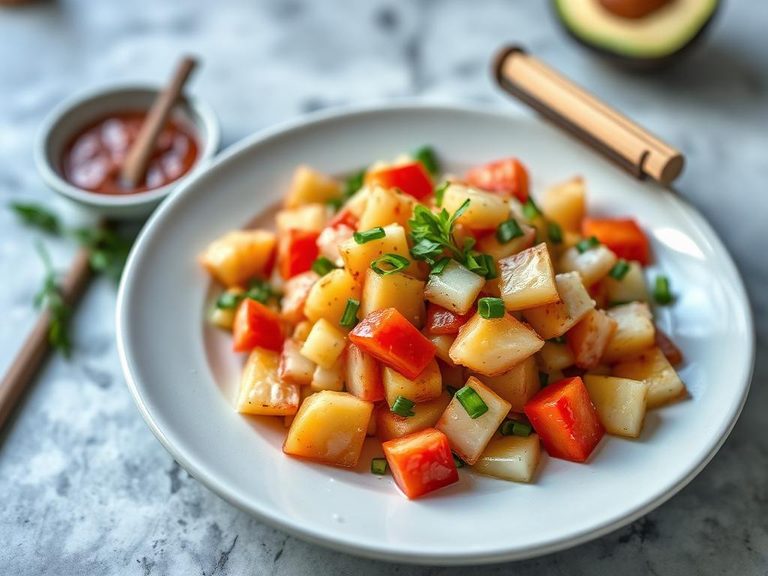
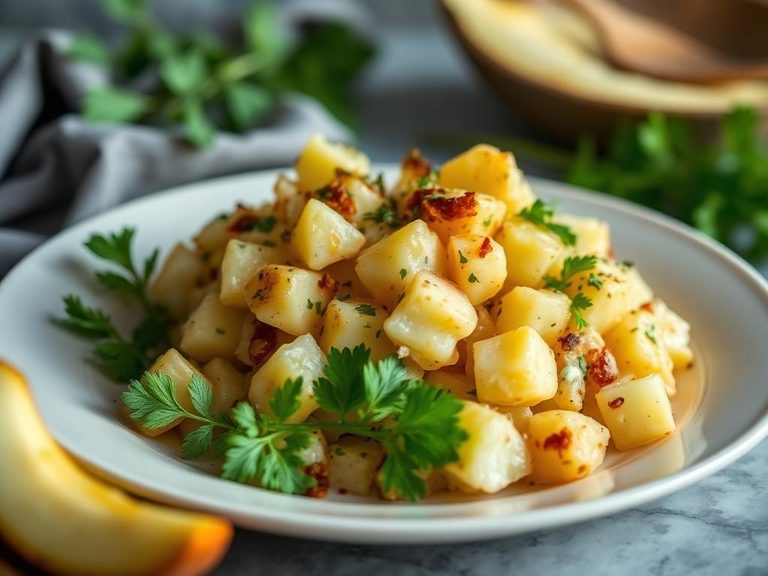
🌍 Where it's eaten
💡 Did you know?
The mayonnaise-based potato salad we know today became popular in the U.S. after WWII, when commercial mayonnaise production boomed and it became an affordable, shelf-stable ingredient for picnics.
Full nutrition (USDA data · scales with serving)
| Water | 67.6 g |
| Energy | 178 kcal |
| Protein | 1.7 g |
| Total lipid (fat) | 11.4 g |
| Carbohydrate, by difference | 17.3 g |
| Fiber, total dietary | 1.3 g |
| Total Sugars | 1.9 g |
| Calcium, Ca | 7.0 mg |
| Iron, Fe | 0.34 mg |
| Magnesium, Mg | 20.0 mg |
| Phosphorus, P | 44.0 mg |
| Potassium, K | 308 mg |
| Sodium, Na | 361 mg |
| Zinc, Zn | 0.26 mg |
| Copper, Cu | 0.17 mg |
| Selenium, Se | 1.1 ug |
| Vitamin C, total ascorbic acid | 10.0 mg |
| Thiamin | 0.09 mg |
| Riboflavin | 0.02 mg |
| Niacin | 1.1 mg |
| Vitamin B-6 | 0.23 mg |
| Folate, total | 8.0 ug |
| Folic acid | 0.00 ug |
| Folate, food | 8.0 ug |
| Folate, DFE | 8.0 ug |
| Choline, total | 16.8 mg |
| Vitamin B-12 | 0.02 ug |
| Vitamin B-12, added | 0.00 ug |
| Vitamin A, RAE | 3.0 ug |
| Retinol | 2.0 ug |
| Carotene, beta | 10.0 ug |
| Carotene, alpha | 2.0 ug |
| Cryptoxanthin, beta | 5.0 ug |
| Lycopene | 0.00 ug |
| Lutein + zeaxanthin | 8.0 ug |
| Vitamin E (alpha-tocopherol) | 0.54 mg |
| Vitamin E, added | 0.00 mg |
| Vitamin D (D2 + D3) | 0.00 ug |
| Vitamin K (phylloquinone) | 26.2 ug |
| Alcohol, ethyl | 0.00 g |
| Caffeine | 0.00 mg |
| Theobromine | 0.00 mg |
Fat & fatty acid profile (per 100g)
| Fatty acids, total saturated | 1.8 g |
| SFA 4:0 | 0.00 g |
| SFA 6:0 | 0.00 g |
| SFA 8:0 | 0.00 g |
| SFA 10:0 | 0.00 g |
| SFA 12:0 | 0.00 g |
| SFA 14:0 | 0.01 g |
| SFA 16:0 | 1.2 g |
| SFA 18:0 | 0.47 g |
| Fatty acids, total monounsaturated | 2.6 g |
| MUFA 16:1 | 0.01 g |
| MUFA 18:1 | 2.5 g |
| MUFA 20:1 | 0.04 g |
| MUFA 22:1 | 0.02 g |
| Fatty acids, total polyunsaturated | 6.8 g |
| PUFA 18:2 | 5.9 g |
| PUFA 18:3 | 0.84 g |
| PUFA 18:4 | 0.00 g |
| PUFA 20:4 | 0.01 g |
| PUFA 20:5 n-3 (EPA) | 0.00 g |
| PUFA 22:5 n-3 (DPA) | 0.00 g |
| PUFA 22:6 n-3 (DHA) | 0.00 g |
| Cholesterol | 6.0 mg |
Amino acid profile (per 100g)
Estimated from Potato salad, home-prepared — USDA does not publish this profile for Potato salad.
| Tryptophan | 0.04 g |
| Threonine | 0.12 g |
| Isoleucine | 0.14 g |
| Leucine | 0.20 g |
| Lysine | 0.17 g |
| Methionine | 0.07 g |
| Cystine | 0.05 g |
| Phenylalanine | 0.14 g |
| Tyrosine | 0.10 g |
| Valine | 0.17 g |
| Arginine | 0.15 g |
| Histidine | 0.06 g |
| Alanine | 0.12 g |
| Aspartic acid | 0.42 g |
| Glutamic acid | 0.39 g |
| Glycine | 0.09 g |
| Proline | 0.10 g |
| Serine | 0.16 g |
FAQ
Is potato salad a healthy choice?
It can be part of a balanced diet in moderation. Its main drawbacks are high calories and fat from mayonnaise. Opting for a vinegar-based version or using less dressing improves its nutritional profile.
Why does potato salad sometimes cause food poisoning?
The combination of cooked potatoes and mayonnaise (which contains eggs) creates a moist environment ideal for bacterial growth if left at room temperature. It must be refrigerated promptly and kept cold.
What's the difference between German and American potato salad?
German potato salad is often served warm with a vinegar, bacon, and oil-based dressing, while the classic American version is cold and mayonnaise-based.
Nutrient density (calculated · NRF9.3)
Nutrient Rich Foods index: beneficial nutrients (protein, fiber, vitamins, minerals) minus saturated fat, added sugar & sodium, per 100 kcal.
NRF9.3 index — Fulgoni, Keast & Drewnowski, 2009. Computed from USDA nutrients.
Weight-loss friendliness (composite index)
Energy density 1.78 kcal/g · 4% calories from protein · 1.3 g fiber · 1.9 g sugar per 100 g.
Composite of energy density (Rolls et al., 1999), protein & fiber satiety, minus sugar. A calculated heuristic — ranks satiety-per-calorie, not a clinical measure.
Dietary load (calculated from USDA values)
Potential renal acid load. Positive = acid-forming, negative = alkaline-forming.
Sodium-to-potassium ratio: 1.17 (lower is better — aim for ≤ 1)
Sodium:potassium per WHO potassium guidance. Computed from USDA nutrients.