

Popcorn, ready-to-eat, plain
Common food

Photo: Wikipedia
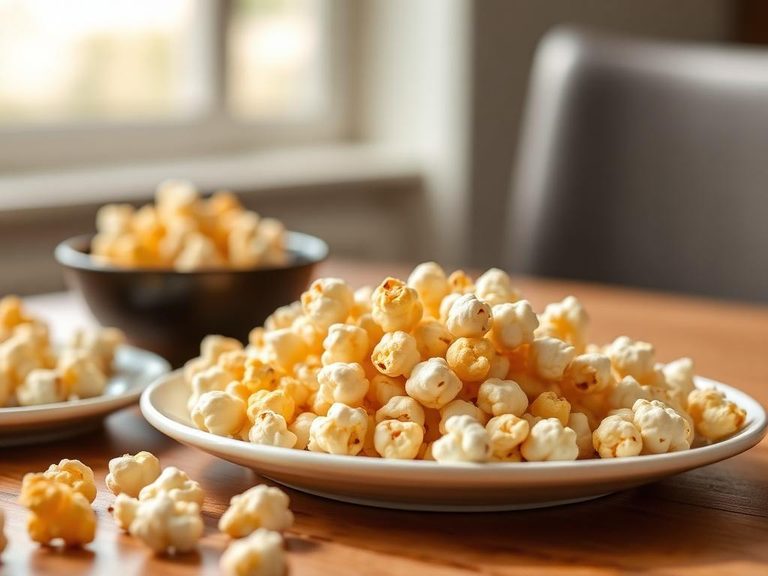
Plain ready-to-eat popcorn is a light, airy whole-grain snack with a satisfyingly crisp texture and a subtle, nutty sweetness. Its simple flavor profile makes it a blank canvas for seasonings, while its high fiber content offers a surprisingly filling treat for its volume.
Calorie split: 8% protein · 49% carbs · 42% fat
↓ Full nutrition💚 Why it's loved
People adore popcorn for its irresistible crunch and the nostalgic, comforting ritual of snacking it brings. Its versatility allows it to be dressed up with savory or sweet toppings, making it a staple for movie nights, parties, and casual munching.
⚠️ Watch-outs & how to enjoy it better
The relatively high fat content (23.26g per 100g) and calorie density (482 kcal) can be a concern for strict calorie control, and some commercial brands may add excessive sodium or artificial flavors. To counteract this, practice portion control (stick to a single serving), choose lightly salted or unsalted varieties, and pair it with a protein-rich food like nuts or Greek yogurt to enhance satiety.
Key benefits
- High in dietary fiber (11.4g per 100g) for digestive health
- Whole-grain snack that provides sustained energy
- Low in sugar (0.68g per 100g) compared to many snacks
- Good source of plant-based protein (10.19g per 100g)
- Naturally gluten-free
🍽️ Popular dishes

🌍 Where it's eaten
💡 Did you know?
Archaeologists have found 6,700-year-old popcorn kernels in Peru that are still capable of popping!
Full nutrition (USDA data · scales with serving)
| Water | 2.6 g |
| Energy | 482 kcal |
| Protein | 10.2 g |
| Total lipid (fat) | 23.3 g |
| Carbohydrate, by difference | 61.2 g |
| Fiber, total dietary | 11.4 g |
| Total Sugars | 0.68 g |
| Calcium, Ca | 6.0 mg |
| Iron, Fe | 2.5 mg |
| Magnesium, Mg | 113 mg |
| Phosphorus, P | 282 mg |
| Potassium, K | 259 mg |
| Sodium, Na | 616 mg |
| Zinc, Zn | 2.4 mg |
| Copper, Cu | 0.21 mg |
| Selenium, Se | 0.00 ug |
| Vitamin C, total ascorbic acid | 0.00 mg |
| Thiamin | 0.08 mg |
| Riboflavin | 0.07 mg |
| Niacin | 1.8 mg |
| Vitamin B-6 | 0.12 mg |
| Folate, total | 24.0 ug |
| Folic acid | 0.00 ug |
| Folate, food | 24.0 ug |
| Folate, DFE | 24.0 ug |
| Choline, total | 16.7 mg |
| Vitamin B-12 | 0.00 ug |
| Vitamin B-12, added | 0.00 ug |
| Vitamin A, RAE | 8.0 ug |
| Retinol | 0.00 ug |
| Carotene, beta | 70.0 ug |
| Carotene, alpha | 46.0 ug |
| Cryptoxanthin, beta | 0.00 ug |
| Lycopene | 0.00 ug |
| Lutein + zeaxanthin | 1142 ug |
| Vitamin E (alpha-tocopherol) | 4.7 mg |
| Vitamin E, added | 0.00 mg |
| Vitamin D (D2 + D3) | 0.00 ug |
| Vitamin K (phylloquinone) | 1.3 ug |
| Alcohol, ethyl | 0.00 g |
| Caffeine | 0.00 mg |
| Theobromine | 0.00 mg |
Fat & fatty acid profile (per 100g)
| Fatty acids, total saturated | 3.1 g |
| SFA 4:0 | 0.00 g |
| SFA 6:0 | 0.00 g |
| SFA 8:0 | 0.00 g |
| SFA 10:0 | 0.00 g |
| SFA 12:0 | 0.00 g |
| SFA 14:0 | 0.01 g |
| SFA 16:0 | 2.6 g |
| SFA 18:0 | 0.37 g |
| Fatty acids, total monounsaturated | 6.2 g |
| MUFA 16:1 | 0.02 g |
| MUFA 18:1 | 6.1 g |
| MUFA 20:1 | 0.08 g |
| MUFA 22:1 | 0.00 g |
| Fatty acids, total polyunsaturated | 12.2 g |
| PUFA 18:2 | 12.0 g |
| PUFA 18:3 | 0.25 g |
| PUFA 18:4 | 0.00 g |
| PUFA 20:4 | 0.00 g |
| PUFA 20:5 n-3 (EPA) | 0.00 g |
| PUFA 22:5 n-3 (DPA) | 0.00 g |
| PUFA 22:6 n-3 (DHA) | 0.00 g |
| Cholesterol | 0.00 mg |
Amino acid profile (per 100g)
Estimated from Snacks, popcorn, oil-popped, white popcorn, salt added — USDA does not publish this profile for Popcorn.
| Tryptophan | 0.06 g |
| Threonine | 0.34 g |
| Isoleucine | 0.32 g |
| Leucine | 1.1 g |
| Lysine | 0.25 g |
| Methionine | 0.19 g |
| Cystine | 0.16 g |
| Phenylalanine | 0.44 g |
| Tyrosine | 0.37 g |
| Valine | 0.46 g |
| Arginine | 0.45 g |
| Histidine | 0.28 g |
| Alanine | 0.67 g |
| Aspartic acid | 0.63 g |
| Glutamic acid | 1.7 g |
| Glycine | 0.37 g |
| Proline | 0.79 g |
| Serine | 0.43 g |
FAQ
Is plain popcorn a healthy snack?
Yes, it's a whole-grain, high-fiber snack that's low in sugar. Its healthiness depends on preparation; air-popped or lightly oil-popped with minimal salt is the best option.
Why is the fat content so high?
The fat comes from the oil used to pop the kernels (like coconut, canola, or palm oil) and is necessary for the classic texture and flavor. You can reduce fat by air-popping or using an oil mister.
Can I eat popcorn on a gluten-free diet?
Pure popcorn is naturally gluten-free. However, always check labels on pre-packaged or flavored varieties to ensure no gluten-containing additives were used.
Nutrient density (calculated · NRF9.3)
Nutrient Rich Foods index: beneficial nutrients (protein, fiber, vitamins, minerals) minus saturated fat, added sugar & sodium, per 100 kcal.
NRF9.3 index — Fulgoni, Keast & Drewnowski, 2009. Computed from USDA nutrients.
Weight-loss friendliness (composite index)
Energy density 4.82 kcal/g · 8% calories from protein · 11.4 g fiber · 0.7 g sugar per 100 g.
Composite of energy density (Rolls et al., 1999), protein & fiber satiety, minus sugar. A calculated heuristic — ranks satiety-per-calorie, not a clinical measure.
Dietary load (calculated from USDA values)
Potential renal acid load. Positive = acid-forming, negative = alkaline-forming.
Sodium-to-potassium ratio: 2.38 (lower is better — aim for ≤ 1)
Sodium:potassium per WHO potassium guidance. Computed from USDA nutrients.