

Ice cream, NFS
Common food
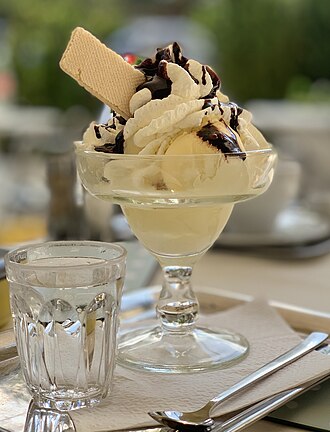
Photo: Wikipedia
Ice cream, NFS (Not Further Specified) is a classic, creamy frozen dessert made from a base of milk, cream, and sugar, churned to incorporate air for a smooth, scoopable texture. Its taste is typically sweet and rich, with a melt-in-your-mouth quality that varies from dense and velvety to light and fluffy. Nutritionally, it's a significant source of quick energy from carbohydrates, primarily simple sugars, with a moderate fat content contributing to its satisfying mouthfeel.
Calorie split: 6% protein · 48% carbs · 46% fat
↓ Full nutrition💚 Why it's loved
People adore ice cream for its unparalleled ability to deliver immediate, cooling comfort and a burst of sweet flavor, making it a universal symbol of celebration and indulgence. Its versatility is unmatched, serving as a base for countless flavor combinations, from classic vanilla to complex, layered sundaes and artisanal creations.
⚠️ Watch-outs & how to enjoy it better
The high sugar and saturated fat content can contribute to blood-sugar spikes and is a concern for those managing calorie intake or heart health. A concrete tip is to practice portion control by using a small scoop or cup, and to pair it with a source of protein or fiber (like a handful of nuts or a piece of fruit) to slow sugar absorption and increase satiety.
Key benefits
- Provides quick energy from carbohydrates and sugars
- Source of calcium and phosphorus from dairy content
- Contains protein from milk and cream ingredients
- Offers a concentrated source of calories for energy needs
- Can be a vehicle for fat-soluble vitamins like A and D if fortified
🍽️ Popular dishes





🌍 Where it's eaten
💡 Did you know?
The air incorporated during churning, called 'overrun,' can account for 50% or more of the final volume of commercial ice cream, making it a frozen dessert that is literally half air.
Full nutrition (USDA data · scales with serving)
| Water | 57.8 g |
| Energy | 221 kcal |
| Protein | 3.6 g |
| Total lipid (fat) | 11.3 g |
| Carbohydrate, by difference | 26.4 g |
| Fiber, total dietary | 0.80 g |
| Total Sugars | 22.9 g |
| Calcium, Ca | 124 mg |
| Iron, Fe | 0.30 mg |
| Magnesium, Mg | 16.0 mg |
| Phosphorus, P | 106 mg |
| Potassium, K | 203 mg |
| Sodium, Na | 90.0 mg |
| Zinc, Zn | 0.72 mg |
| Copper, Cu | 0.04 mg |
| Selenium, Se | 1.9 ug |
| Vitamin C, total ascorbic acid | 0.60 mg |
| Thiamin | 0.04 mg |
| Riboflavin | 0.24 mg |
| Niacin | 0.15 mg |
| Vitamin B-6 | 0.05 mg |
| Folate, total | 6.0 ug |
| Folic acid | 1.0 ug |
| Folate, food | 5.0 ug |
| Folate, DFE | 6.0 ug |
| Choline, total | 25.3 mg |
| Vitamin B-12 | 0.38 ug |
| Vitamin B-12, added | 0.00 ug |
| Vitamin A, RAE | 112 ug |
| Retinol | 110 ug |
| Carotene, beta | 18.0 ug |
| Carotene, alpha | 0.00 ug |
| Cryptoxanthin, beta | 0.00 ug |
| Lycopene | 0.00 ug |
| Lutein + zeaxanthin | 0.00 ug |
| Vitamin E (alpha-tocopherol) | 0.39 mg |
| Vitamin E, added | 0.00 mg |
| Vitamin D (D2 + D3) | 0.20 ug |
| Vitamin K (phylloquinone) | 0.80 ug |
| Alcohol, ethyl | 0.00 g |
| Caffeine | 1.0 mg |
| Theobromine | 12.0 mg |
Fat & fatty acid profile (per 100g)
| Fatty acids, total saturated | 6.9 g |
| SFA 4:0 | 0.35 g |
| SFA 6:0 | 0.20 g |
| SFA 8:0 | 0.12 g |
| SFA 10:0 | 0.27 g |
| SFA 12:0 | 0.30 g |
| SFA 14:0 | 1.1 g |
| SFA 16:0 | 3.1 g |
| SFA 18:0 | 1.4 g |
| Fatty acids, total monounsaturated | 3.1 g |
| MUFA 16:1 | 0.20 g |
| MUFA 18:1 | 2.9 g |
| MUFA 20:1 | 0.00 g |
| MUFA 22:1 | 0.00 g |
| Fatty acids, total polyunsaturated | 0.50 g |
| PUFA 18:2 | 0.33 g |
| PUFA 18:3 | 0.17 g |
| PUFA 18:4 | 0.00 g |
| PUFA 20:4 | 0.00 g |
| PUFA 20:5 n-3 (EPA) | 0.00 g |
| PUFA 22:5 n-3 (DPA) | 0.00 g |
| PUFA 22:6 n-3 (DHA) | 0.00 g |
| Cholesterol | 42.0 mg |
Amino acid profile (per 100g)
Estimated from Ice creams, vanilla, rich — USDA does not publish this profile for Ice cream.
| Tryptophan | 0.04 g |
| Threonine | 0.14 g |
| Isoleucine | 0.18 g |
| Leucine | 0.30 g |
| Lysine | 0.25 g |
| Methionine | 0.08 g |
| Cystine | 0.03 g |
| Phenylalanine | 0.15 g |
| Tyrosine | 0.14 g |
| Valine | 0.20 g |
| Arginine | 0.14 g |
| Histidine | 0.08 g |
| Alanine | 0.14 g |
| Glutamic acid | 0.65 g |
| Glycine | 0.15 g |
| Proline | 0.34 g |
| Serine | 0.17 g |
FAQ
What does 'NFS' mean on a nutrition label for ice cream?
'NFS' stands for 'Not Further Specified.' It indicates the data is for a generic or average ice cream product, without specifying the exact flavor, brand, or style (like premium, light, or soft-serve).
Is the protein in ice cream considered high quality?
Yes, the protein in dairy-based ice cream is considered high quality because it comes from milk and cream, providing all nine essential amino acids needed by the body.
Why does ice cream have so much sugar?
Sugar is a key functional ingredient in ice cream. Beyond sweetness, it lowers the freezing point, which helps keep the dessert scoopable and prevents it from turning into a solid block of ice, while also contributing to its smooth texture.
Nutrient density (calculated · NRF9.3)
Nutrient Rich Foods index: beneficial nutrients (protein, fiber, vitamins, minerals) minus saturated fat, added sugar & sodium, per 100 kcal.
NRF9.3 index — Fulgoni, Keast & Drewnowski, 2009. Computed from USDA nutrients.
Weight-loss friendliness (composite index)
Energy density 2.21 kcal/g · 6% calories from protein · 0.8 g fiber · 22.9 g sugar per 100 g.
Composite of energy density (Rolls et al., 1999), protein & fiber satiety, minus sugar. A calculated heuristic — ranks satiety-per-calorie, not a clinical measure.
Dietary load (calculated from USDA values)
Potential renal acid load. Positive = acid-forming, negative = alkaline-forming.
Sodium-to-potassium ratio: 0.44 (lower is better — aim for ≤ 1)
Sodium:potassium per WHO potassium guidance. Computed from USDA nutrients.