

Crab cake sandwich
Common food

Photo: Wikipedia
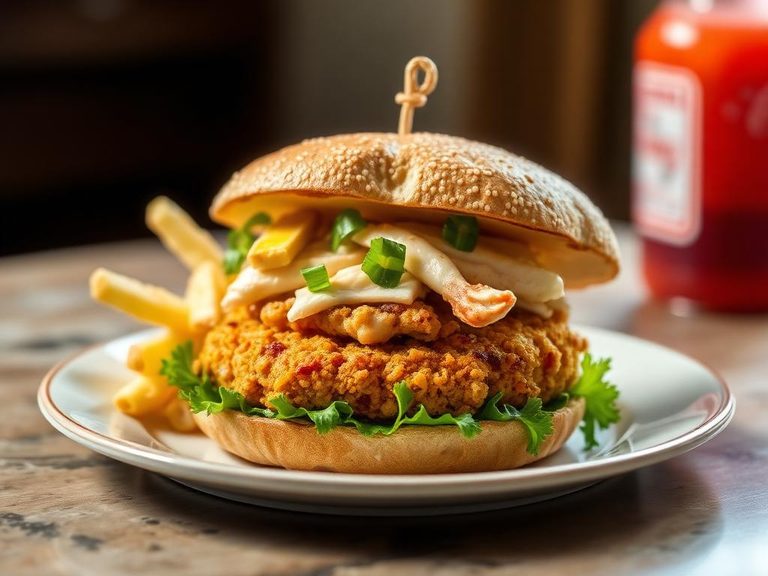
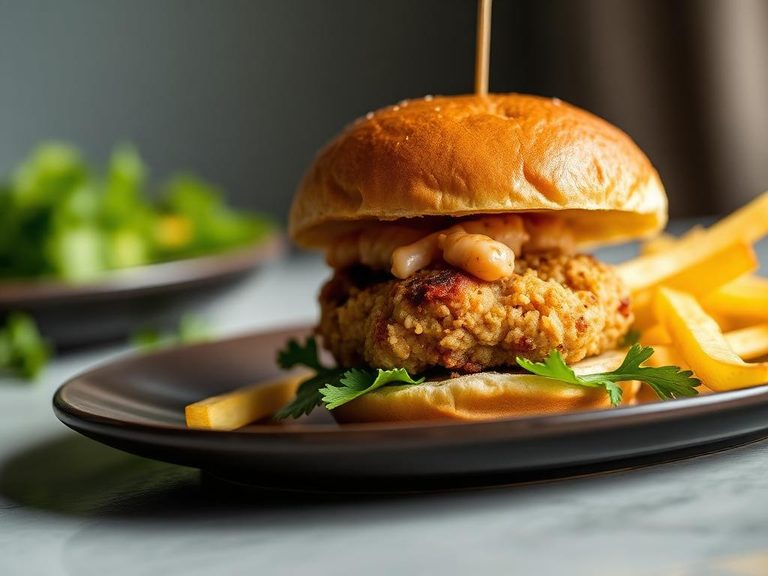
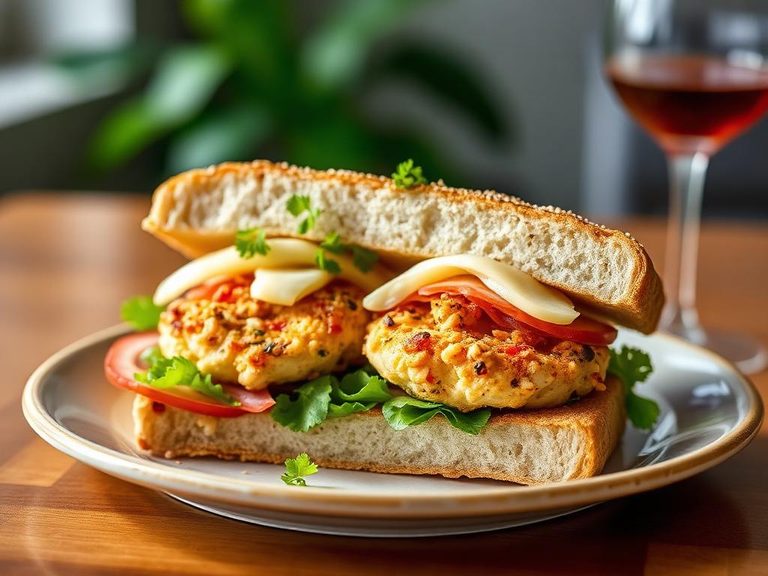
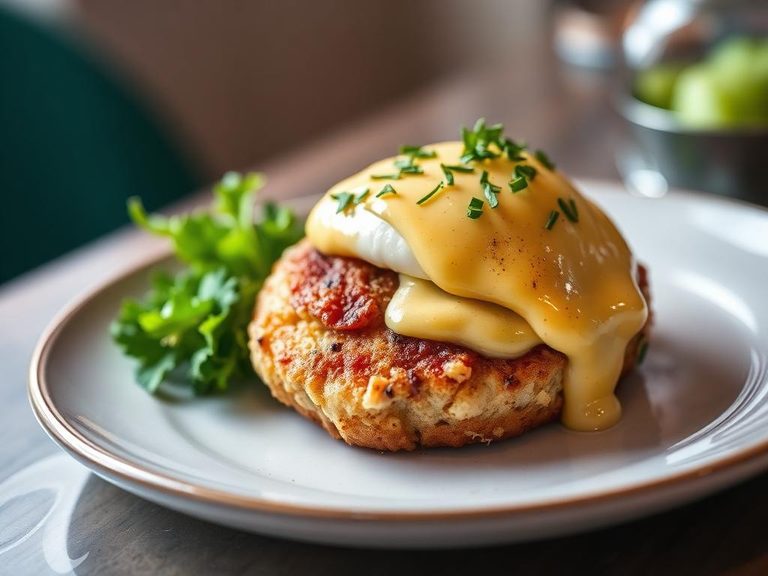
A crab cake sandwich is a coastal American classic: a golden, crispy, pan-fried patty of sweet crab meat and binder, served on a soft bun. It offers a delightful contrast between the crunchy exterior and the tender, flaky, savory crab inside. While indulgent, a 100g serving provides a solid protein boost (12.74g) to complement its rich flavor.
Calorie split: 22% protein · 34% carbs · 44% fat
↓ Full nutrition💚 Why it's loved
People adore the luxurious yet approachable taste of sweet, briny crab held together in a crispy, savory cake. It's a versatile centerpiece that can be dressed up with gourmet remoulade or kept simple with tartar sauce, embodying casual coastal elegance.
⚠️ Watch-outs & how to enjoy it better
The sandwich can be high in sodium from seasoning and sauces, and the frying adds significant fat and calories. Those monitoring blood sugar should be mindful of the refined carb bun. To counteract, choose a whole-grain bun for fiber, opt for a side salad instead of fries, and ask for sauce on the side to control portions.
Key benefits
- Excellent source of high-quality protein for muscle maintenance.
- Contains omega-3 fatty acids from crab meat, beneficial for heart health.
- Provides essential minerals like zinc and selenium.
- A satisfying, flavorful meal that can curb cravings.
🍽️ Popular dishes

🌍 Where it's eaten
💡 Did you know?
True Maryland crab cakes are defined by using jumbo lump blue crab and minimal filler, often just mayonnaise, mustard, and seasoning, to let the crab's natural sweetness shine.
Full nutrition (USDA data · scales with serving)
| Water | 54.8 g |
| Energy | 231 kcal |
| Protein | 12.7 g |
| Total lipid (fat) | 11.2 g |
| Carbohydrate, by difference | 19.4 g |
| Fiber, total dietary | 1.0 g |
| Total Sugars | 2.2 g |
| Calcium, Ca | 123 mg |
| Iron, Fe | 1.7 mg |
| Magnesium, Mg | 28.0 mg |
| Phosphorus, P | 166 mg |
| Potassium, K | 180 mg |
| Sodium, Na | 436 mg |
| Zinc, Zn | 2.2 mg |
| Copper, Cu | 0.42 mg |
| Selenium, Se | 30.5 ug |
| Vitamin C, total ascorbic acid | 1.7 mg |
| Thiamin | 0.21 mg |
| Riboflavin | 0.17 mg |
| Niacin | 3.1 mg |
| Vitamin B-6 | 0.12 mg |
| Folate, total | 68.0 ug |
| Folic acid | 31.0 ug |
| Folate, food | 37.0 ug |
| Folate, DFE | 90.0 ug |
| Choline, total | 63.7 mg |
| Vitamin B-12 | 1.6 ug |
| Vitamin B-12, added | 0.00 ug |
| Vitamin A, RAE | 14.0 ug |
| Retinol | 14.0 ug |
| Carotene, beta | 0.00 ug |
| Carotene, alpha | 0.00 ug |
| Cryptoxanthin, beta | 1.0 ug |
| Lycopene | 0.00 ug |
| Lutein + zeaxanthin | 51.0 ug |
| Vitamin E (alpha-tocopherol) | 1.9 mg |
| Vitamin E, added | 0.00 mg |
| Vitamin D (D2 + D3) | 0.20 ug |
| Vitamin K (phylloquinone) | 15.4 ug |
| Alcohol, ethyl | 0.00 g |
| Caffeine | 0.00 mg |
| Theobromine | 0.00 mg |
Fat & fatty acid profile (per 100g)
| Fatty acids, total saturated | 1.9 g |
| SFA 4:0 | 0.00 g |
| SFA 6:0 | 0.00 g |
| SFA 8:0 | 0.00 g |
| SFA 10:0 | 0.00 g |
| SFA 12:0 | 0.01 g |
| SFA 14:0 | 0.02 g |
| SFA 16:0 | 1.3 g |
| SFA 18:0 | 0.51 g |
| Fatty acids, total monounsaturated | 3.3 g |
| MUFA 16:1 | 0.06 g |
| MUFA 18:1 | 3.2 g |
| MUFA 20:1 | 0.05 g |
| MUFA 22:1 | 0.00 g |
| Fatty acids, total polyunsaturated | 5.4 g |
| PUFA 18:2 | 4.7 g |
| PUFA 18:3 | 0.61 g |
| PUFA 18:4 | 0.00 g |
| PUFA 20:4 | 0.02 g |
| PUFA 20:5 n-3 (EPA) | 0.05 g |
| PUFA 22:5 n-3 (DPA) | 0.00 g |
| PUFA 22:6 n-3 (DHA) | 0.03 g |
| Cholesterol | 76.0 mg |
Amino acid profile (per 100g)
Estimated from Crustaceans, crab, blue, crab cakes, home recipe — USDA does not publish this profile for Crab cake sandwich.
| Tryptophan | 0.28 g |
| Threonine | 0.83 g |
| Isoleucine | 1.00 g |
| Leucine | 1.6 g |
| Lysine | 1.7 g |
| Methionine | 0.57 g |
| Cystine | 0.24 g |
| Phenylalanine | 0.87 g |
| Tyrosine | 0.68 g |
| Valine | 0.98 g |
| Arginine | 1.7 g |
| Histidine | 0.41 g |
| Alanine | 1.1 g |
| Aspartic acid | 2.1 g |
| Glutamic acid | 3.4 g |
| Glycine | 1.2 g |
| Proline | 0.68 g |
| Serine | 0.84 g |
FAQ
What's the difference between a crab cake and a fish cake?
A crab cake is specifically made with crab meat, while a fish cake can be made from various types of fish or seafood. Crab cakes are prized for the sweet, delicate flavor of the crab itself.
Are crab cakes usually deep-fried or pan-fried?
Most quality crab cakes are pan-fried or broiled to achieve a crispy crust without absorbing excess oil. Deep-frying is less common as it can overwhelm the delicate crab flavor.
What is the best bun for a crab cake sandwich?
A soft, slightly sweet brioche bun or a classic potato roll are popular choices. They provide a tender contrast to the crispy cake and can absorb sauces without falling apart.
Nutrient density (calculated · NRF9.3)
Nutrient Rich Foods index: beneficial nutrients (protein, fiber, vitamins, minerals) minus saturated fat, added sugar & sodium, per 100 kcal.
NRF9.3 index — Fulgoni, Keast & Drewnowski, 2009. Computed from USDA nutrients.
Weight-loss friendliness (composite index)
Energy density 2.31 kcal/g · 22% calories from protein · 1.0 g fiber · 2.2 g sugar per 100 g.
Composite of energy density (Rolls et al., 1999), protein & fiber satiety, minus sugar. A calculated heuristic — ranks satiety-per-calorie, not a clinical measure.
Dietary load (calculated from USDA values)
Potential renal acid load. Positive = acid-forming, negative = alkaline-forming.
Sodium-to-potassium ratio: 2.42 (lower is better — aim for ≤ 1)
Sodium:potassium per WHO potassium guidance. Computed from USDA nutrients.