

Coconut, packaged
Common food
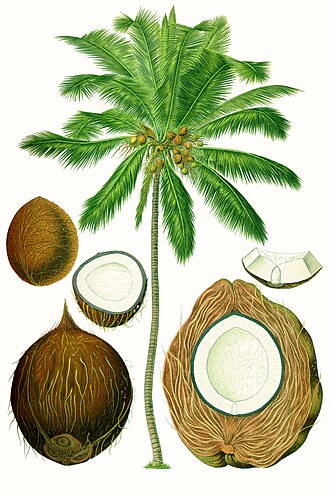
Photo: Wikipedia
Packaged coconut, typically in the form of sweetened shredded or flaked coconut, offers a delightful chewy texture and a rich, sweet, tropical flavor. It's a calorie-dense treat, packing nearly 460 kcal per 100g, with a significant portion coming from its high fat and sugar content. Despite its indulgence, it provides a notable source of dietary fiber.
Calorie split: 3% protein · 44% carbs · 53% fat
↓ Full nutrition💚 Why it's loved
People love it for its intense, sweet coconut flavor and satisfying chewy texture that elevates both baked goods and savory dishes. It's a versatile ingredient that instantly brings a tropical, nostalgic feel to everything from cookies to curries.
⚠️ Watch-outs & how to enjoy it better
The high sugar (36.75g) and fat content can cause blood sugar spikes and add significant calories if over-consumed. To counteract this, practice strict portion control (stick to 1-2 tablespoons) and pair it with protein or healthy fats (like in yogurt or nuts) to slow sugar absorption. It is also a tree nut, a common allergen.
Key benefits
- Excellent source of dietary fiber (9.9g per 100g)
- Provides quick energy from natural sugars and carbohydrates
- Contains medium-chain triglycerides (MCTs) from coconut fat
- Adds texture and natural sweetness to recipes
🍽️ Popular dishes





🌍 Where it's eaten
💡 Did you know?
The 'packaged' form is often toasted to enhance its flavor, a process that can deepen its golden color and create a more complex, nutty taste compared to its raw counterpart.
Full nutrition (USDA data · scales with serving)
| Water | 15.5 g |
| Energy | 456 kcal |
| Protein | 3.1 g |
| Total lipid (fat) | 28.0 g |
| Carbohydrate, by difference | 51.9 g |
| Fiber, total dietary | 9.9 g |
| Total Sugars | 36.8 g |
| Calcium, Ca | 11.0 mg |
| Iron, Fe | 1.5 mg |
| Magnesium, Mg | 51.0 mg |
| Phosphorus, P | 100 mg |
| Potassium, K | 361 mg |
| Sodium, Na | 285 mg |
| Zinc, Zn | 0.71 mg |
| Copper, Cu | 0.29 mg |
| Selenium, Se | 16.1 ug |
| Vitamin C, total ascorbic acid | 0.00 mg |
| Thiamin | 0.01 mg |
| Riboflavin | 0.01 mg |
| Niacin | 0.70 mg |
| Vitamin B-6 | 0.03 mg |
| Folate, total | 3.0 ug |
| Folic acid | 0.00 ug |
| Folate, food | 3.0 ug |
| Folate, DFE | 3.0 ug |
| Choline, total | 19.3 mg |
| Vitamin B-12 | 0.00 ug |
| Vitamin B-12, added | 0.00 ug |
| Vitamin A, RAE | 0.00 ug |
| Retinol | 0.00 ug |
| Carotene, beta | 0.00 ug |
| Carotene, alpha | 0.00 ug |
| Cryptoxanthin, beta | 0.00 ug |
| Lycopene | 0.00 ug |
| Lutein + zeaxanthin | 0.00 ug |
| Vitamin E (alpha-tocopherol) | 0.00 mg |
| Vitamin E, added | 0.00 mg |
| Vitamin D (D2 + D3) | 0.00 ug |
| Vitamin K (phylloquinone) | 0.00 ug |
| Alcohol, ethyl | 0.00 g |
| Caffeine | 0.00 mg |
| Theobromine | 0.00 mg |
Fat & fatty acid profile (per 100g)
| Fatty acids, total saturated | 26.4 g |
| SFA 4:0 | 0.00 g |
| SFA 6:0 | 0.21 g |
| SFA 8:0 | 2.4 g |
| SFA 10:0 | 1.8 g |
| SFA 12:0 | 13.8 g |
| SFA 14:0 | 5.1 g |
| SFA 16:0 | 2.2 g |
| SFA 18:0 | 0.82 g |
| Fatty acids, total monounsaturated | 1.4 g |
| MUFA 16:1 | 0.00 g |
| MUFA 18:1 | 1.4 g |
| MUFA 20:1 | 0.01 g |
| MUFA 22:1 | 0.00 g |
| Fatty acids, total polyunsaturated | 0.22 g |
| PUFA 18:2 | 0.22 g |
| PUFA 18:3 | 0.00 g |
| PUFA 18:4 | 0.00 g |
| PUFA 20:4 | 0.00 g |
| PUFA 20:5 n-3 (EPA) | 0.00 g |
| PUFA 22:5 n-3 (DPA) | 0.00 g |
| PUFA 22:6 n-3 (DHA) | 0.00 g |
| Cholesterol | 0.00 mg |
Amino acid profile (per 100g)
Estimated from Nuts, coconut meat, dried (desiccated), sweetened, shredded — USDA does not publish this profile for Coconut.
| Tryptophan | 0.03 g |
| Threonine | 0.10 g |
| Isoleucine | 0.11 g |
| Leucine | 0.21 g |
| Lysine | 0.13 g |
| Methionine | 0.05 g |
| Cystine | 0.06 g |
| Phenylalanine | 0.15 g |
| Tyrosine | 0.09 g |
| Valine | 0.17 g |
| Arginine | 0.47 g |
| Histidine | 0.07 g |
| Alanine | 0.15 g |
| Aspartic acid | 0.28 g |
| Glutamic acid | 0.66 g |
| Glycine | 0.14 g |
| Proline | 0.12 g |
| Serine | 0.15 g |
FAQ
What's the difference between sweetened and unsweetened packaged coconut?
Sweetened coconut is coated in sugar syrup, making it softer and much higher in sugar (as seen in the nutrition data). Unsweetened is simply dried coconut meat, with a chewier texture and a pure, nutty flavor, making it better for savory dishes or controlling sugar intake.
Is packaged coconut healthy?
It's a source of fiber and healthy fats, but the sweetened version is very high in added sugar and calories. It's best viewed as a flavorful ingredient to use in moderation, not a health food. Unsweetened versions offer the benefits without the added sugar.
How should I store it to keep it fresh?
Once opened, keep packaged coconut in an airtight container in a cool, dark pantry for a few weeks, or in the refrigerator for several months. Freezing it in a sealed bag can extend its life to up to a year.
Nutrient density (calculated · NRF9.3)
Nutrient Rich Foods index: beneficial nutrients (protein, fiber, vitamins, minerals) minus saturated fat, added sugar & sodium, per 100 kcal.
NRF9.3 index — Fulgoni, Keast & Drewnowski, 2009. Computed from USDA nutrients.
Weight-loss friendliness (composite index)
Energy density 4.56 kcal/g · 3% calories from protein · 9.9 g fiber · 36.8 g sugar per 100 g.
Composite of energy density (Rolls et al., 1999), protein & fiber satiety, minus sugar. A calculated heuristic — ranks satiety-per-calorie, not a clinical measure.
Dietary load (calculated from USDA values)
Potential renal acid load. Positive = acid-forming, negative = alkaline-forming.
Sodium-to-potassium ratio: 0.79 (lower is better — aim for ≤ 1)
Sodium:potassium per WHO potassium guidance. Computed from USDA nutrients.