

Cereal, corn flakes, flavored
Common food

Photo: Wikipedia
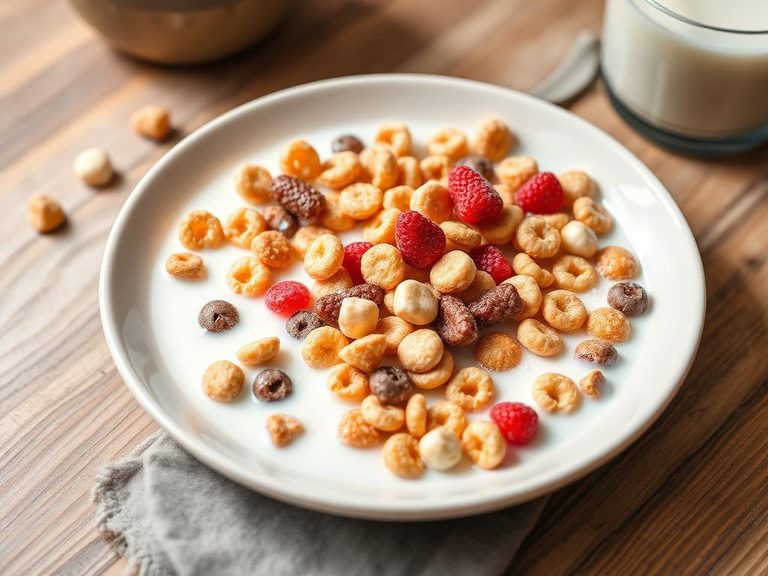
These are thin, crispy flakes made from milled corn, coated in a sweet, often honey or sugar-based glaze that caramelizes during toasting. They offer a satisfying crunch and a mild, toasty corn flavor with a pronounced sweetness. Nutritionally, they are a high-carbohydrate, energy-dense food with very little protein or fat.
Calorie split: 5% protein · 92% carbs · 3% fat
↓ Full nutrition💚 Why it's loved
People love them for the immediate, satisfying crunch and the familiar, comforting sweetness that pairs perfectly with cold milk. They are a nostalgic, effortless breakfast staple and a versatile ingredient for quick snacks and desserts.
⚠️ Watch-outs & how to enjoy it better
The high sugar content (over 32g per 100g) can lead to rapid blood sugar spikes and subsequent energy crashes, making it a poor choice for sustained energy. To counteract this, always pair a portion with a source of protein (like Greek yogurt or milk) and healthy fat (like nuts or seeds) to slow digestion. Portion control is key; stick to a single serving.
Key benefits
- Quick source of energy from carbohydrates
- Convenient and requires no cooking
- Fortified with vitamins and minerals in many brands
- Lightweight and portable for on-the-go eating
- Long shelf life when stored properly
🍽️ Popular dishes

🌍 Where it's eaten
💡 Did you know?
The original corn flakes were created by John Harvey Kellogg and his brother Will Keith Kellogg in 1894 as a healthy food for patients at their Battle Creek Sanitarium.
Full nutrition (USDA data · scales with serving)
| Water | 7.5 g |
| Energy | 375 kcal |
| Protein | 4.8 g |
| Total lipid (fat) | 1.3 g |
| Carbohydrate, by difference | 84.7 g |
| Fiber, total dietary | 2.6 g |
| Total Sugars | 32.5 g |
| Calcium, Ca | 3.0 mg |
| Iron, Fe | 9.9 mg |
| Magnesium, Mg | 21.0 mg |
| Phosphorus, P | 66.0 mg |
| Potassium, K | 96.0 mg |
| Sodium, Na | 516 mg |
| Zinc, Zn | 0.45 mg |
| Copper, Cu | 0.05 mg |
| Selenium, Se | 7.2 ug |
| Vitamin C, total ascorbic acid | 0.00 mg |
| Thiamin | 0.55 mg |
| Riboflavin | 0.54 mg |
| Niacin | 6.8 mg |
| Vitamin B-6 | 0.77 mg |
| Folate, total | 142 ug |
| Folic acid | 122 ug |
| Folate, food | 20.0 ug |
| Folate, DFE | 227 ug |
| Choline, total | 5.8 mg |
| Vitamin B-12 | 0.92 ug |
| Vitamin B-12, added | 0.92 ug |
| Vitamin A, RAE | 7.0 ug |
| Retinol | 0.00 ug |
| Carotene, beta | 65.0 ug |
| Carotene, alpha | 42.0 ug |
| Cryptoxanthin, beta | 0.00 ug |
| Lycopene | 0.00 ug |
| Lutein + zeaxanthin | 1092 ug |
| Vitamin E (alpha-tocopherol) | 0.08 mg |
| Vitamin E, added | 0.00 mg |
| Vitamin D (D2 + D3) | 5.1 ug |
| Vitamin K (phylloquinone) | 0.00 ug |
| Alcohol, ethyl | 0.00 g |
| Caffeine | 0.00 mg |
| Theobromine | 0.00 mg |
Fat & fatty acid profile (per 100g)
| Fatty acids, total saturated | 0.15 g |
| SFA 4:0 | 0.00 g |
| SFA 6:0 | 0.00 g |
| SFA 8:0 | 0.00 g |
| SFA 10:0 | 0.00 g |
| SFA 12:0 | 0.00 g |
| SFA 14:0 | 0.00 g |
| SFA 16:0 | 0.12 g |
| SFA 18:0 | 0.03 g |
| Fatty acids, total monounsaturated | 0.26 g |
| MUFA 16:1 | 0.00 g |
| MUFA 18:1 | 0.26 g |
| MUFA 20:1 | 0.00 g |
| MUFA 22:1 | 0.00 g |
| Fatty acids, total polyunsaturated | 0.56 g |
| PUFA 18:2 | 0.54 g |
| PUFA 18:3 | 0.01 g |
| PUFA 18:4 | 0.00 g |
| PUFA 20:4 | 0.00 g |
| PUFA 20:5 n-3 (EPA) | 0.00 g |
| PUFA 22:5 n-3 (DPA) | 0.00 g |
| PUFA 22:6 n-3 (DHA) | 0.00 g |
| Cholesterol | 0.00 mg |
Amino acid profile (per 100g)
Estimated from Cereals ready-to-eat, POST, HONEY BUNCHES OF OATS, honey roasted — USDA does not publish this profile for Cereal.
| Tryptophan | 0.09 g |
| Threonine | 0.24 g |
| Isoleucine | 0.26 g |
| Leucine | 0.80 g |
| Lysine | 0.12 g |
| Methionine | 0.10 g |
| Cystine | 0.11 g |
| Phenylalanine | 0.39 g |
| Tyrosine | 0.21 g |
| Valine | 0.34 g |
| Arginine | 0.24 g |
| Histidine | 0.18 g |
| Alanine | 0.46 g |
| Aspartic acid | 0.48 g |
| Glutamic acid | 1.9 g |
| Glycine | 0.27 g |
| Proline | 0.49 g |
| Serine | 0.38 g |
FAQ
Are corn flakes gluten-free?
While corn itself is gluten-free, many brands are processed in facilities that handle wheat, posing a cross-contamination risk. Always check for a certified gluten-free label if you have celiac disease or severe sensitivity.
Why are corn flakes often fortified?
Manufacturers add vitamins and minerals (like iron, B vitamins, and vitamin D) to compensate for nutrients lost during processing and to align with public health goals for a nutrient-dense breakfast.
Can I use corn flakes for baking?
Yes, they are excellent as a crunchy coating for baked chicken or fish, as a topping for casseroles, or crushed into desserts like no-bake cookies and ice cream sundaes.
Nutrient density (calculated · NRF9.3)
Nutrient Rich Foods index: beneficial nutrients (protein, fiber, vitamins, minerals) minus saturated fat, added sugar & sodium, per 100 kcal.
NRF9.3 index — Fulgoni, Keast & Drewnowski, 2009. Computed from USDA nutrients.
Weight-loss friendliness (composite index)
Energy density 3.75 kcal/g · 5% calories from protein · 2.6 g fiber · 32.5 g sugar per 100 g.
Composite of energy density (Rolls et al., 1999), protein & fiber satiety, minus sugar. A calculated heuristic — ranks satiety-per-calorie, not a clinical measure.
Dietary load (calculated from USDA values)
Potential renal acid load. Positive = acid-forming, negative = alkaline-forming.
Sodium-to-potassium ratio: 5.38 (lower is better — aim for ≤ 1)
Sodium:potassium per WHO potassium guidance. Computed from USDA nutrients.