

Baby Toddler sweet potatoes, Stage 1
Common food

Photo: Wikipedia
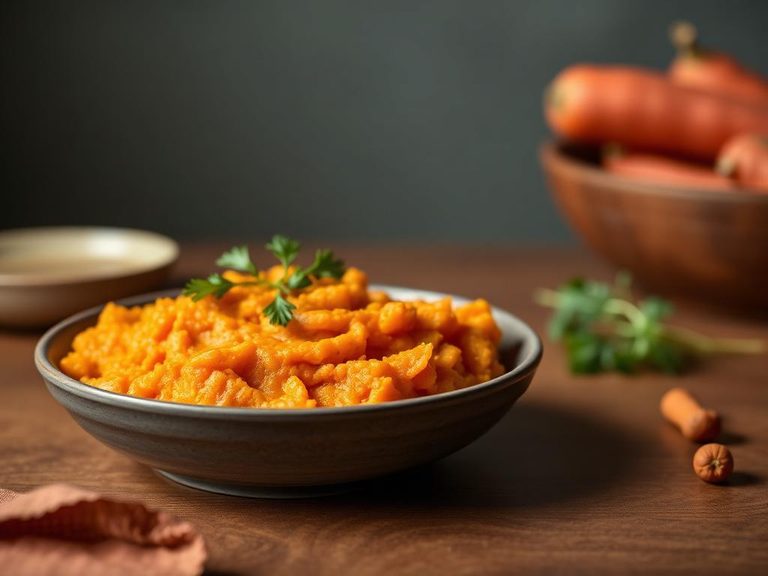
This is a smooth, vibrant orange purée made from steamed and mashed sweet potatoes, designed for a baby's first foods. It has a naturally sweet, earthy flavor and a velvety, spoonable texture that's easy for little mouths to swallow. It's a nutritional powerhouse, packed with beta-carotene (vitamin A) and fiber for healthy digestion.
Calorie split: 8% protein · 91% carbs · 2% fat
↓ Full nutrition💚 Why it's loved
Parents love it for its naturally sweet taste that babies often accept readily, making it an ideal first vegetable. Its smooth, simple texture is perfect for introducing solids, and it blends well with other purées like apple or pear.
⚠️ Watch-outs & how to enjoy it better
The high natural sugar content can cause blood-sugar spikes if served alone in large portions. To counteract this, pair it with a small amount of protein or fat, like a spoonful of plain yogurt or avocado, and practice portion control. Some babies may experience gas or bloating due to the fiber, so introduce it gradually.
Key benefits
- Excellent source of beta-carotene, which the body converts to vitamin A for vision and immune health.
- High in dietary fiber to support a developing digestive system.
- Naturally sweet flavor encourages acceptance of vegetables.
- Low in fat and contains no added sugars or sodium.
- Provides a good source of complex carbohydrates for steady energy.
🍽️ Popular dishes
🌍 Where it's eaten
💡 Did you know?
Sweet potatoes are not related to regular potatoes; they are a member of the morning glory family, Convolvulaceae.
Full nutrition (USDA data · scales with serving)
| Water | 84.8 g |
| Energy | 57.0 kcal |
| Protein | 1.1 g |
| Total lipid (fat) | 0.10 g |
| Carbohydrate, by difference | 13.2 g |
| Fiber, total dietary | 1.5 g |
| Total Sugars | 4.0 g |
| Calcium, Ca | 16.0 mg |
| Iron, Fe | 0.37 mg |
| Magnesium, Mg | 13.0 mg |
| Phosphorus, P | 24.0 mg |
| Potassium, K | 263 mg |
| Sodium, Na | 22.0 mg |
| Zinc, Zn | 0.21 mg |
| Copper, Cu | 0.08 mg |
| Selenium, Se | 0.70 ug |
| Vitamin C, total ascorbic acid | 9.9 mg |
| Thiamin | 0.03 mg |
| Riboflavin | 0.03 mg |
| Niacin | 0.36 mg |
| Vitamin B-6 | 0.09 mg |
| Folate, total | 10.0 ug |
| Folic acid | 0.00 ug |
| Folate, food | 10.0 ug |
| Folate, DFE | 10.0 ug |
| Choline, total | 13.1 mg |
| Vitamin B-12 | 0.00 ug |
| Vitamin B-12, added | 0.00 ug |
| Vitamin A, RAE | 322 ug |
| Retinol | 0.00 ug |
| Carotene, beta | 3863 ug |
| Carotene, alpha | 0.00 ug |
| Cryptoxanthin, beta | 0.00 ug |
| Lycopene | 0.00 ug |
| Lutein + zeaxanthin | 0.00 ug |
| Vitamin E (alpha-tocopherol) | 0.52 mg |
| Vitamin E, added | 0.00 mg |
| Vitamin D (D2 + D3) | 0.00 ug |
| Vitamin K (phylloquinone) | 1.4 ug |
| Alcohol, ethyl | 0.00 g |
| Caffeine | 0.00 mg |
| Theobromine | 0.00 mg |
Fat & fatty acid profile (per 100g)
| Fatty acids, total saturated | 0.02 g |
| SFA 4:0 | 0.00 g |
| SFA 6:0 | 0.00 g |
| SFA 8:0 | 0.00 g |
| SFA 10:0 | 0.00 g |
| SFA 12:0 | 0.00 g |
| SFA 14:0 | 0.00 g |
| SFA 16:0 | 0.02 g |
| SFA 18:0 | 0.00 g |
| Fatty acids, total monounsaturated | 0.00 g |
| MUFA 16:1 | 0.00 g |
| MUFA 18:1 | 0.00 g |
| MUFA 20:1 | 0.00 g |
| MUFA 22:1 | 0.00 g |
| Fatty acids, total polyunsaturated | 0.04 g |
| PUFA 18:2 | 0.04 g |
| PUFA 18:3 | 0.01 g |
| PUFA 18:4 | 0.00 g |
| PUFA 20:4 | 0.00 g |
| PUFA 20:5 n-3 (EPA) | 0.00 g |
| PUFA 22:5 n-3 (DPA) | 0.00 g |
| PUFA 22:6 n-3 (DHA) | 0.00 g |
| Cholesterol | 0.00 mg |
Amino acid profile (per 100g)
Estimated from Babyfood, dinner, chicken stew, toddler — USDA does not publish this profile for Baby Toddler sweet potatoes.
| Tryptophan | 0.06 g |
| Threonine | 0.22 g |
| Isoleucine | 0.26 g |
| Leucine | 0.41 g |
| Lysine | 0.41 g |
| Methionine | 0.11 g |
| Cystine | 0.05 g |
| Phenylalanine | 0.21 g |
| Tyrosine | 0.17 g |
| Valine | 0.29 g |
| Arginine | 0.33 g |
| Histidine | 0.13 g |
| Alanine | 0.30 g |
| Aspartic acid | 0.47 g |
| Glutamic acid | 0.90 g |
| Glycine | 0.29 g |
| Proline | 0.35 g |
| Serine | 0.21 g |
FAQ
At what age can I introduce sweet potato purée to my baby?
It's typically introduced around 6 months, when babies show signs of readiness for solids, such as good head control and interest in food.
Is sweet potato purée a common allergen?
No, sweet potatoes are not a common allergen. However, as with any new food, introduce it alone and watch for any signs of reaction.
How should I store homemade sweet potato purée?
Store in an airtight container in the refrigerator for up to 3 days, or freeze in ice cube trays for up to 3 months.
Nutrient density (calculated · NRF9.3)
Nutrient Rich Foods index: beneficial nutrients (protein, fiber, vitamins, minerals) minus saturated fat, added sugar & sodium, per 100 kcal.
NRF9.3 index — Fulgoni, Keast & Drewnowski, 2009. Computed from USDA nutrients.
Weight-loss friendliness (composite index)
Energy density 0.57 kcal/g · 8% calories from protein · 1.5 g fiber · 4.0 g sugar per 100 g.
Composite of energy density (Rolls et al., 1999), protein & fiber satiety, minus sugar. A calculated heuristic — ranks satiety-per-calorie, not a clinical measure.
Dietary load (calculated from USDA values)
Potential renal acid load. Positive = acid-forming, negative = alkaline-forming.
Sodium-to-potassium ratio: 0.08 (lower is better — aim for ≤ 1)
Sodium:potassium per WHO potassium guidance. Computed from USDA nutrients.