Beef, brisket, whole, separable lean only, all grades, raw
Whole food · Beef Products

Photo: Wikipedia
Beef brisket is a primal cut from the lower chest of the cow, prized for its rich, beefy flavor and a texture that transforms from tough to melt-in-your-mouth tender with proper cooking. As a lean-only cut, it offers a dense, satisfying chew with a clean, meaty taste, making it a powerhouse of high-quality protein with minimal fat and zero carbohydrates. It is the ultimate canvas for slow-cooking methods, where its robust flavor and connective tissue break down into a succulent, savory experience.
💚 Why it's loved
People love brisket for its deep, savory flavor that intensifies with slow cooking, and its cultural significance in barbecue traditions, from Texas smokehouses to Jewish holiday feasts. Its ability to become incredibly tender and flavorful when braised or smoked makes it a celebratory centerpiece for gatherings.
⚠️ Watch-outs & how to enjoy it better
The primary downside is its toughness if not cooked properly, requiring long, slow preparation to break down collagen. For those monitoring sodium intake, brisket is often cured or seasoned with high-salt rubs; counteract this by using low-sodium marinades and rinsing before cooking. It is also a red meat, which some dietary guidelines recommend limiting; balance it with plenty of vegetables and lean protein sources throughout the week.
Key benefits
- Exceptionally high in complete protein (20.72g per 100g) for muscle repair and satiety.
- Very low in carbohydrates (0.6g) and sugars, making it ideal for low-carb and ketogenic diets.
- Rich source of essential minerals like iron, zinc, and B vitamins (especially B12).
- Contains the amino acid creatine, which may support exercise performance and brain function.
🍽️ Popular dishes

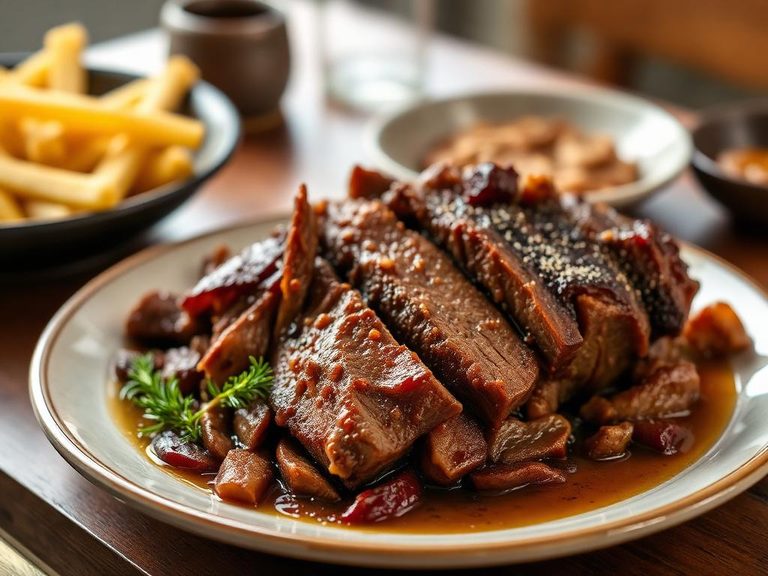
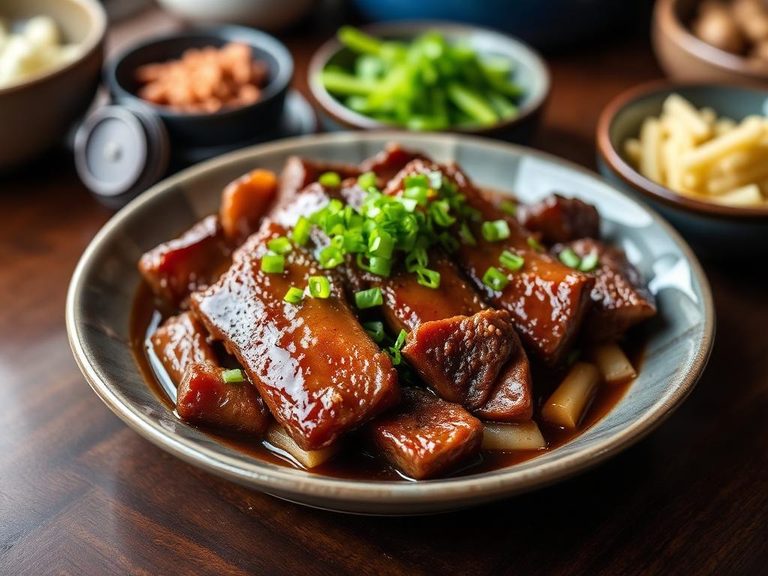
🌍 Where it's eaten
💡 Did you know?
The word 'brisket' comes from the Middle English 'brusket,' meaning the part of the breast under the shoulder, and it's the only major cut of beef that is not named for the animal's location on the skeleton (like rib or loin) but for its function—it's the muscle used for breathing and supporting the animal's weight.
Full nutrition (scales with serving)
| Water | 70.3 g |
| Energy | 157 kcal |
| Energy | 658 kj |
| Protein | 20.7 g |
| Total lipid (fat) | 7.4 g |
| Ash | 1.0 g |
| Carbohydrate, by difference | 0.60 g |
| Fiber, total dietary | 0.00 g |
| Total Sugars | 0.00 g |
| Calcium, Ca | 5.0 mg |
| Iron, Fe | 1.9 mg |
| Magnesium, Mg | 23.0 mg |
| Phosphorus, P | 201 mg |
| Potassium, K | 330 mg |
| Sodium, Na | 79.0 mg |
| Zinc, Zn | 4.3 mg |
| Copper, Cu | 0.08 mg |
| Manganese, Mn | 0.01 mg |
| Selenium, Se | 16.4 ug |
| Vitamin C, total ascorbic acid | 0.00 mg |
| Thiamin | 0.10 mg |
| Riboflavin | 0.17 mg |
| Niacin | 3.9 mg |
| Pantothenic acid | 0.35 mg |
| Vitamin B-6 | 0.42 mg |
| Folate, total | 7.0 ug |
| Folic acid | 0.00 ug |
| Folate, food | 7.0 ug |
| Folate, DFE | 7.0 ug |
| Choline, total | 86.5 mg |
| Vitamin B-12 | 2.4 ug |
| Vitamin B-12, added | 0.00 ug |
| Vitamin A, RAE | 0.00 ug |
| Retinol | 0.00 ug |
| Carotene, beta | 0.00 ug |
| Carotene, alpha | 0.00 ug |
| Cryptoxanthin, beta | 0.00 ug |
| Vitamin A, IU | 0.00 iu |
| Lycopene | 0.00 ug |
| Lutein + zeaxanthin | 0.00 ug |
| Vitamin E (alpha-tocopherol) | 0.32 mg |
| Vitamin E, added | 0.00 mg |
| Vitamin K (phylloquinone) | 1.3 ug |
| Alcohol, ethyl | 0.00 g |
| Caffeine | 0.00 mg |
| Theobromine | 0.00 mg |
Fat & fatty acid profile (per 100g)
| Fatty acids, total saturated | 2.6 g |
| SFA 4:0 | 0.00 g |
| SFA 6:0 | 0.00 g |
| SFA 8:0 | 0.00 g |
| SFA 10:0 | 0.00 g |
| SFA 12:0 | 0.00 g |
| SFA 14:0 | 0.22 g |
| SFA 16:0 | 1.6 g |
| SFA 18:0 | 0.73 g |
| Fatty acids, total monounsaturated | 3.5 g |
| MUFA 16:1 | 0.35 g |
| MUFA 18:1 | 3.1 g |
| MUFA 20:1 | 0.00 g |
| MUFA 22:1 | 0.00 g |
| Fatty acids, total polyunsaturated | 0.23 g |
| PUFA 18:2 | 0.18 g |
| PUFA 18:3 | 0.02 g |
| PUFA 18:4 | 0.00 g |
| PUFA 20:4 | 0.03 g |
| PUFA 20:5 n-3 (EPA) | 0.00 g |
| PUFA 22:5 n-3 (DPA) | 0.00 g |
| PUFA 22:6 n-3 (DHA) | 0.00 g |
| Cholesterol | 62.0 mg |
Amino acid profile (per 100g)
| Tryptophan | 0.23 g |
| Threonine | 0.91 g |
| Isoleucine | 0.93 g |
| Leucine | 1.6 g |
| Lysine | 1.7 g |
| Methionine | 0.53 g |
| Cystine | 0.23 g |
| Phenylalanine | 0.81 g |
| Tyrosine | 0.70 g |
| Valine | 1.0 g |
| Arginine | 1.3 g |
| Histidine | 0.71 g |
| Alanine | 1.3 g |
| Aspartic acid | 1.9 g |
| Glutamic acid | 3.1 g |
| Glycine | 1.1 g |
| Proline | 0.92 g |
| Serine | 0.79 g |
FAQ
What is the difference between flat and point brisket?
The flat is leaner and more uniform, ideal for slicing, while the point has more marbling and fat, making it juicier and often preferred for burnt ends or chopped beef.
How do I make tough brisket tender?
Low and slow cooking (braising, smoking, or slow-roasting at 225-275°F/107-135°C) for several hours is key. This breaks down the tough collagen into gelatin, resulting in tender, flavorful meat.
Can I eat brisket raw or undercooked?
No, brisket must be cooked to a safe internal temperature (at least 145°F/63°C with a 3-minute rest, though for tenderness it's usually cooked to 190-205°F/88-96°C). Raw or undercooked beef poses a risk of bacterial contamination.