

Puddings, banana, dry mix, instant, prepared with 2% milk
Whole food · Sweets

Photo: Wikipedia
This is a creamy, pale-yellow dessert made from a shelf-stable powder that transforms instantly into a smooth, spoonable pudding when whisked with 2% milk. Its texture is light and slightly gelatinous, with a sweet, artificial banana flavor reminiscent of classic American childhood snacks. Nutritionally, it's a low-calorie, low-fat treat that provides a quick energy boost from carbohydrates.
Calorie split: 10% protein · 75% carbs · 15% fat
↓ Full nutrition💚 Why it's loved
People love it for its nostalgic, comforting banana flavor and the sheer ease of making a satisfying dessert in minutes. It's a versatile base that can be topped with fruit, cookies, or whipped cream for added texture and fun.
⚠️ Watch-outs & how to enjoy it better
The primary downside is its high carbohydrate content relative to protein and fiber, which can cause blood-sugar spikes, especially for those with insulin sensitivity. To counteract this, pair a small portion with a source of protein (like a handful of nuts) or fat (like a dollop of Greek yogurt) to slow digestion and stabilize blood sugar.
Key benefits
- Quick and convenient preparation with no cooking required
- Low in fat and calories, making it a light dessert option
- Provides a quick source of energy from carbohydrates
- Long shelf life as a dry mix for pantry storage
- Consistent flavor and texture every time
🍽️ Popular dishes
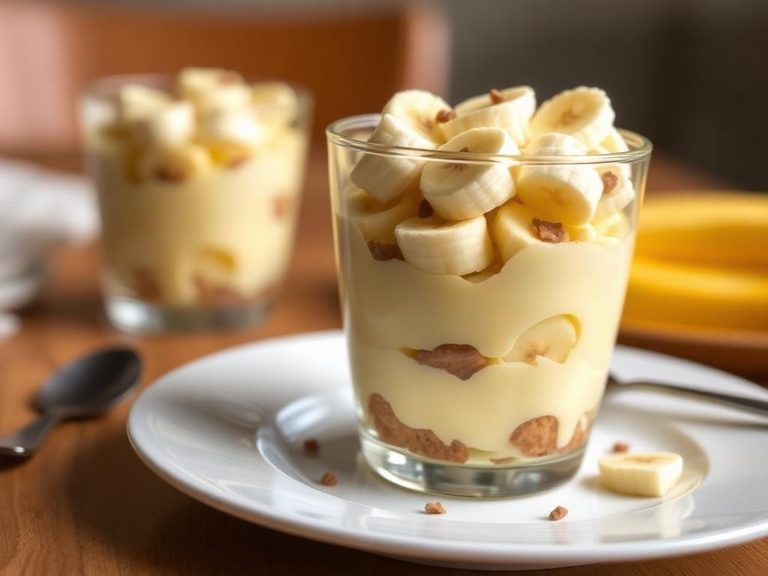
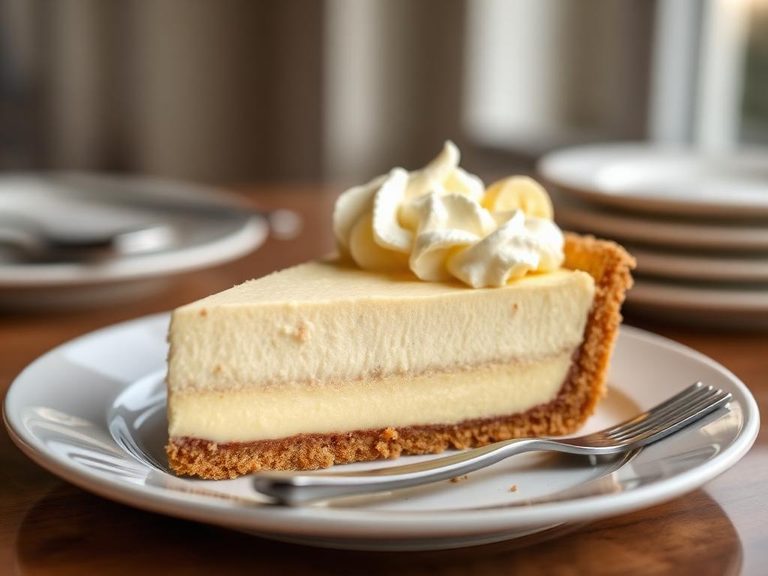
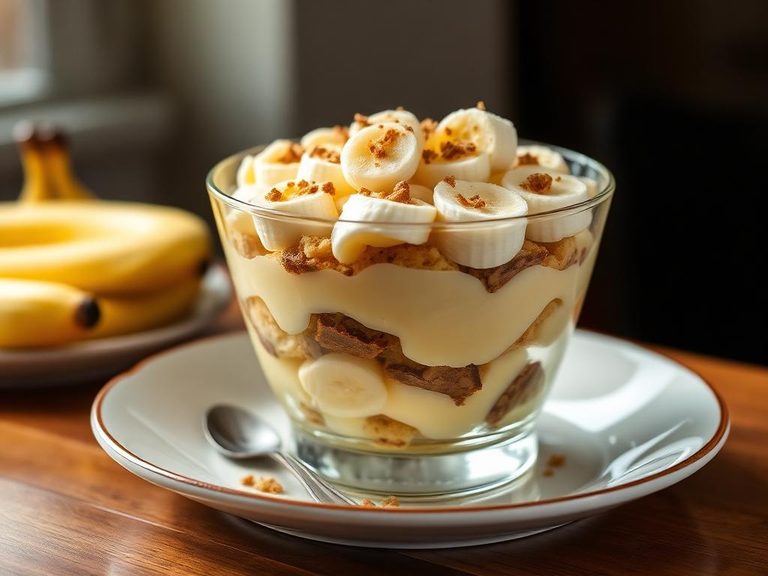
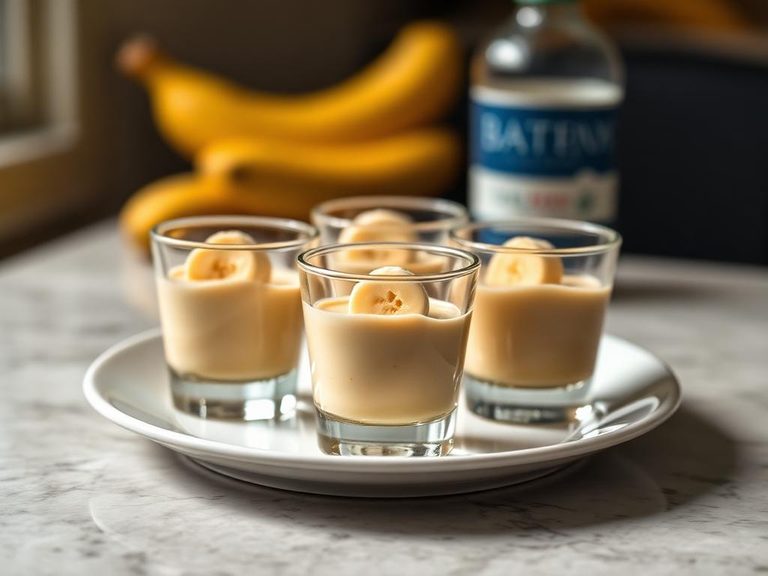
🌍 Where it's eaten
💡 Did you know?
The instant pudding mix relies on modified cornstarch and tetrasodium pyrophosphate to create its thick, smooth texture without any cooking, a food science innovation popularized in the mid-20th century.
Full nutrition (USDA data · scales with serving)
| Water | 74.5 g |
| Energy | 105 kcal |
| Energy | 441 kj |
| Protein | 2.8 g |
| Total lipid (fat) | 1.7 g |
| Ash | 1.3 g |
| Carbohydrate, by difference | 19.7 g |
| Fiber, total dietary | 0.00 g |
| Calcium, Ca | 102 mg |
| Iron, Fe | 0.06 mg |
| Magnesium, Mg | 12.0 mg |
| Phosphorus, P | 216 mg |
| Potassium, K | 131 mg |
| Sodium, Na | 296 mg |
| Zinc, Zn | 0.33 mg |
| Copper, Cu | 0.01 mg |
| Manganese, Mn | 0.00 mg |
| Selenium, Se | 2.0 ug |
| Vitamin C, total ascorbic acid | 0.80 mg |
| Thiamin | 0.03 mg |
| Riboflavin | 0.14 mg |
| Niacin | 0.07 mg |
| Pantothenic acid | 0.27 mg |
| Vitamin B-6 | 0.04 mg |
| Folate, total | 4.0 ug |
| Folic acid | 0.00 ug |
| Folate, food | 4.0 ug |
| Folate, DFE | 4.0 ug |
| Vitamin B-12 | 0.30 ug |
| Vitamin A, RAE | 46.0 ug |
| Retinol | 46.0 ug |
| Carotene, beta | 10.0 ug |
| Vitamin A, IU | 170 iu |
| Vitamin D (D2 + D3), International Units | 33.0 iu |
| Vitamin D (D2 + D3) | 0.80 ug |
| Alcohol, ethyl | 0.00 g |
| Caffeine | 0.00 mg |
| Theobromine | 0.00 mg |
Fat & fatty acid profile (per 100g)
| Fatty acids, total saturated | 0.97 g |
| SFA 4:0 | 0.05 g |
| SFA 6:0 | 0.03 g |
| SFA 8:0 | 0.02 g |
| SFA 10:0 | 0.04 g |
| SFA 12:0 | 0.04 g |
| SFA 14:0 | 0.16 g |
| SFA 16:0 | 0.43 g |
| SFA 18:0 | 0.20 g |
| Fatty acids, total monounsaturated | 0.46 g |
| MUFA 16:1 | 0.04 g |
| MUFA 18:1 | 0.42 g |
| MUFA 20:1 | 0.00 g |
| MUFA 22:1 | 0.00 g |
| Fatty acids, total polyunsaturated | 0.12 g |
| PUFA 18:2 | 0.09 g |
| PUFA 18:3 | 0.03 g |
| PUFA 18:4 | 0.00 g |
| PUFA 20:4 | 0.00 g |
| PUFA 20:5 n-3 (EPA) | 0.00 g |
| PUFA 22:5 n-3 (DPA) | 0.00 g |
| PUFA 22:6 n-3 (DHA) | 0.00 g |
| Cholesterol | 6.0 mg |
Amino acid profile (per 100g)
| Tryptophan | 0.04 g |
| Threonine | 0.13 g |
| Isoleucine | 0.17 g |
| Leucine | 0.27 g |
| Lysine | 0.22 g |
| Methionine | 0.07 g |
| Cystine | 0.03 g |
| Phenylalanine | 0.13 g |
| Tyrosine | 0.13 g |
| Valine | 0.18 g |
| Arginine | 0.10 g |
| Histidine | 0.07 g |
| Alanine | 0.10 g |
| Aspartic acid | 0.21 g |
| Glutamic acid | 0.58 g |
| Glycine | 0.06 g |
| Proline | 0.27 g |
| Serine | 0.15 g |
FAQ
How does the nutrition change if made with whole milk instead of 2% milk?
Using whole milk will increase the fat and calorie content significantly, adding about 5-6 grams of fat and 50-60 calories per serving compared to 2% milk.
Is this pudding gluten-free?
Most instant banana pudding mixes are gluten-free, but you must check the specific brand's label, as some may contain wheat-based thickeners or cross-contamination warnings.
Can I use a non-dairy milk like almond or oat milk?
Yes, but the texture may be thinner and the flavor slightly different. Oat milk often works best for creaminess, while almond milk can make it lighter. The pudding may not set as firmly with some plant-based milks.
Nutrient density (calculated · NRF9.3)
Nutrient Rich Foods index: beneficial nutrients (protein, fiber, vitamins, minerals) minus saturated fat, added sugar & sodium, per 100 kcal.
NRF9.3 index — Fulgoni, Keast & Drewnowski, 2009. Computed from USDA nutrients.
Weight-loss friendliness (composite index)
Energy density 1.05 kcal/g · 11% calories from protein · 0.0 g fiber · 0.0 g sugar per 100 g.
Composite of energy density (Rolls et al., 1999), protein & fiber satiety, minus sugar. A calculated heuristic — ranks satiety-per-calorie, not a clinical measure.
Dietary load (calculated from USDA values)
Potential renal acid load. Positive = acid-forming, negative = alkaline-forming.
Sodium-to-potassium ratio: 2.26 (lower is better — aim for ≤ 1)
Sodium:potassium per WHO potassium guidance. Computed from USDA nutrients.