

Pork, fresh, variety meats and by-products, tail, cooked, simmered
Whole food · Pork Products
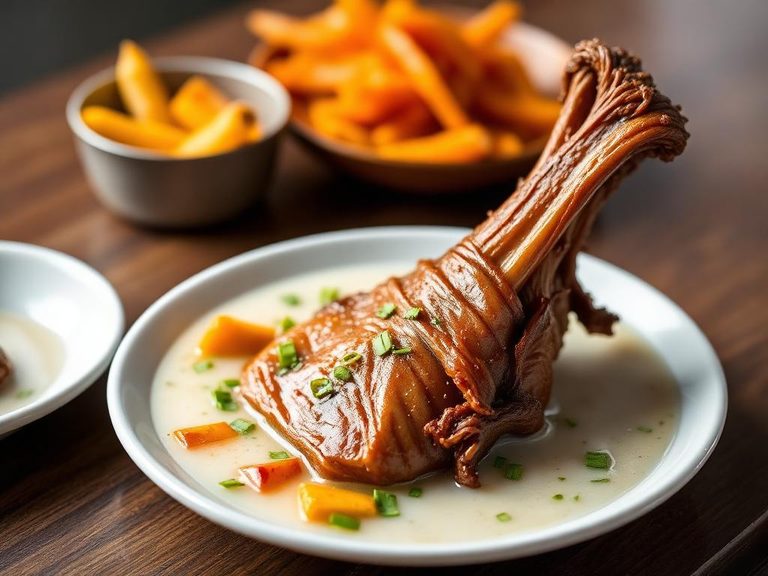
Pork tail is a gelatin-rich cut that, when simmered, transforms into a meltingly tender, collagen-packed delicacy. Its flavor is deeply savory and porky, with a unique texture that is both soft and slightly springy, thanks to the breakdown of connective tissue. Nutritionally, it's a high-fat, high-protein source with virtually no carbohydrates.
Calorie split: 17% protein · 0% carbs · 83% fat
↓ Full nutrition💚 Why it's loved
People love it for its rich, unctuous mouthfeel and deep, savory flavor that serves as a flavor sponge in broths and stews. It's a prized textural ingredient in many cuisines, valued for the luxurious gelatin it adds to dishes.
⚠️ Watch-outs & how to enjoy it better
The high saturated fat content (over 50% of total fat) means it should be enjoyed in moderation, especially by those monitoring cholesterol or heart health. To counteract this, pair it with fiber-rich vegetables and lean proteins in the same meal, and practice strict portion control.
Key benefits
- Excellent source of collagen and gelatin for joint and skin health.
- Provides complete protein with all essential amino acids.
- Rich in B vitamins, especially thiamine and B12.
- Contains minerals like zinc and iron in a highly bioavailable form.
- The rendered fat is stable for high-heat cooking.
🍽️ Popular dishes
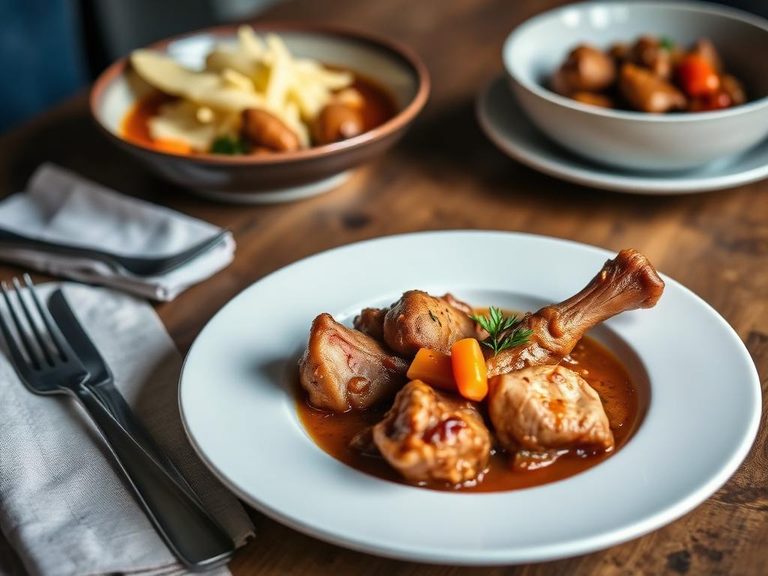
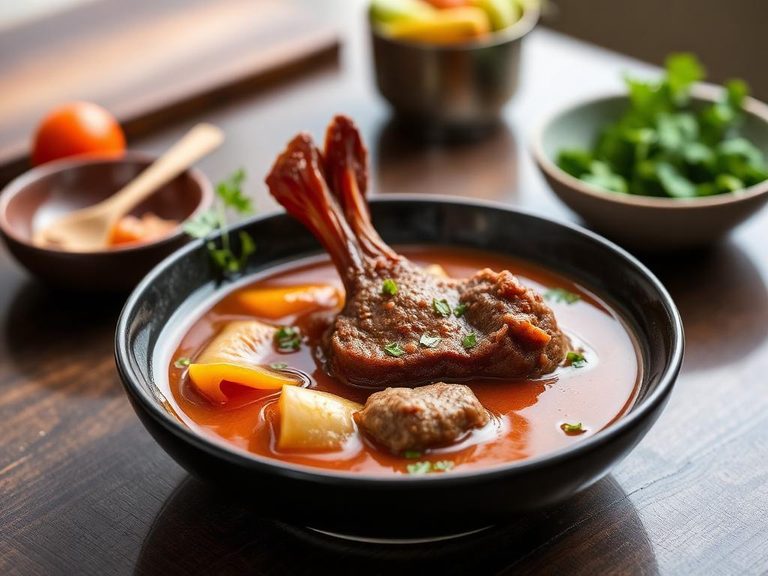
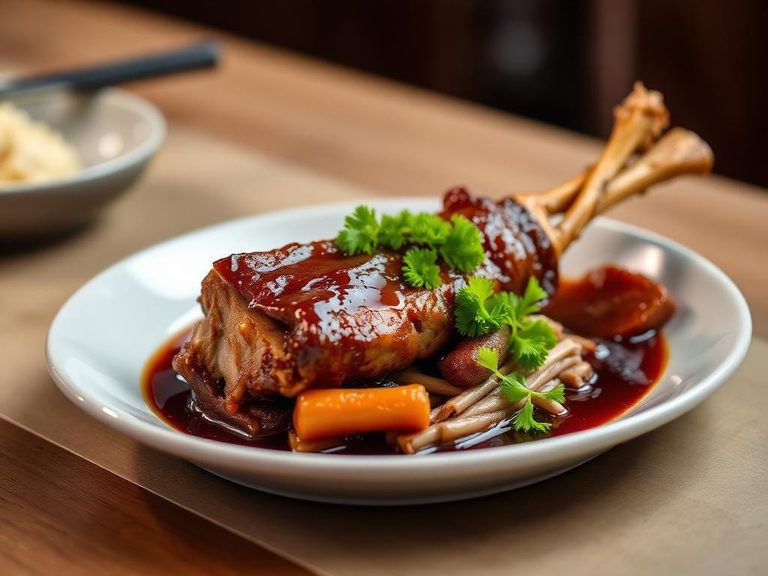
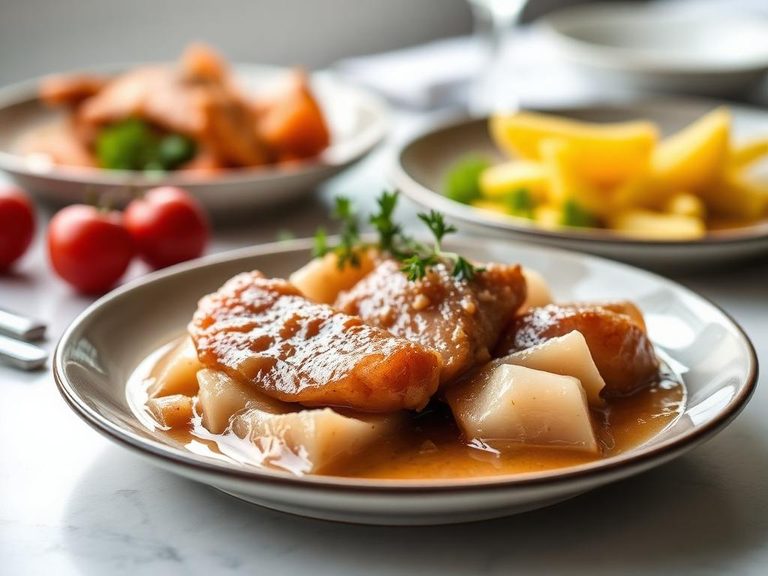
🌍 Where it's eaten
💡 Did you know?
The high gelatin content is why a well-made pork tail broth will set into a firm, wobbly jelly when chilled in the refrigerator.
Full nutrition (USDA data · scales with serving)
| Water | 46.7 g |
| Energy | 396 kcal |
| Energy | 1657 kj |
| Protein | 17.0 g |
| Total lipid (fat) | 35.8 g |
| Ash | 0.40 g |
| Carbohydrate, by difference | 0.00 g |
| Fiber, total dietary | 0.00 g |
| Calcium, Ca | 14.0 mg |
| Iron, Fe | 0.79 mg |
| Magnesium, Mg | 7.0 mg |
| Phosphorus, P | 47.0 mg |
| Potassium, K | 157 mg |
| Sodium, Na | 25.0 mg |
| Zinc, Zn | 1.6 mg |
| Copper, Cu | 0.07 mg |
| Manganese, Mn | 0.01 mg |
| Selenium, Se | 3.1 ug |
| Vitamin C, total ascorbic acid | 0.00 mg |
| Thiamin | 0.07 mg |
| Riboflavin | 0.07 mg |
| Niacin | 1.1 mg |
| Pantothenic acid | 0.42 mg |
| Vitamin B-6 | 0.27 mg |
| Folate, total | 4.0 ug |
| Folic acid | 0.00 ug |
| Folate, food | 4.0 ug |
| Folate, DFE | 4.0 ug |
| Vitamin B-12 | 0.55 ug |
| Vitamin A, RAE | 0.00 ug |
| Retinol | 0.00 ug |
| Vitamin A, IU | 0.00 iu |
| Alcohol, ethyl | 0.00 g |
Fat & fatty acid profile (per 100g)
| Fatty acids, total saturated | 12.4 g |
| SFA 4:0 | 0.00 g |
| SFA 6:0 | 0.00 g |
| SFA 8:0 | 0.00 g |
| SFA 10:0 | 0.00 g |
| SFA 12:0 | 0.00 g |
| SFA 14:0 | 0.57 g |
| SFA 16:0 | 8.1 g |
| SFA 18:0 | 3.8 g |
| Fatty acids, total monounsaturated | 16.9 g |
| MUFA 16:1 | 1.3 g |
| MUFA 18:1 | 15.6 g |
| MUFA 20:1 | 0.00 g |
| MUFA 22:1 | 0.00 g |
| Fatty acids, total polyunsaturated | 3.9 g |
| PUFA 18:2 | 3.4 g |
| PUFA 18:3 | 0.30 g |
| PUFA 18:4 | 0.00 g |
| PUFA 20:4 | 0.23 g |
| PUFA 20:5 n-3 (EPA) | 0.00 g |
| PUFA 22:5 n-3 (DPA) | 0.00 g |
| PUFA 22:6 n-3 (DHA) | 0.00 g |
| Cholesterol | 129 mg |
| Phytosterols | 0.00 mg |
Amino acid profile (per 100g)
| Tryptophan | 0.10 g |
| Threonine | 0.59 g |
| Isoleucine | 0.39 g |
| Leucine | 0.95 g |
| Lysine | 1.0 g |
| Methionine | 0.31 g |
| Cystine | 0.22 g |
| Phenylalanine | 0.51 g |
| Tyrosine | 0.34 g |
| Valine | 0.51 g |
| Arginine | 1.2 g |
| Histidine | 0.31 g |
| Alanine | 1.3 g |
| Aspartic acid | 1.4 g |
| Glutamic acid | 2.2 g |
| Glycine | 2.3 g |
| Proline | 1.4 g |
| Serine | 0.73 g |
FAQ
How is pork tail different from pork hock or trotters?
The tail is smaller, has a higher ratio of skin and bone to meat, and is even richer in collagen. Hocks and trotters (feet) have more meat and larger bones, making them better for hearty stews, while tails are often used for broths and gelatinous dishes.
Why is it always cooked by simmering or braising?
Dry-heat methods like grilling or frying would make it tough and chewy. Long, slow, moist cooking is required to break down the abundant connective tissue into soft, edible gelatin, resulting in the desired tender texture.
Is the fat content a concern?
Yes, it is a very high-fat cut. For a balanced diet, it's best considered an occasional treat or flavor enhancer rather than a primary protein source. Serving it in a broth where some fat can be skimmed off, or pairing it with large portions of vegetables, can help moderate intake.
Nutrient density (calculated · NRF9.3)
Nutrient Rich Foods index: beneficial nutrients (protein, fiber, vitamins, minerals) minus saturated fat, added sugar & sodium, per 100 kcal.
NRF9.3 index — Fulgoni, Keast & Drewnowski, 2009. Computed from USDA nutrients.
Weight-loss friendliness (composite index)
Energy density 3.96 kcal/g · 17% calories from protein · 0.0 g fiber · 0.0 g sugar per 100 g.
Composite of energy density (Rolls et al., 1999), protein & fiber satiety, minus sugar. A calculated heuristic — ranks satiety-per-calorie, not a clinical measure.
Dietary load (calculated from USDA values)
Potential renal acid load. Positive = acid-forming, negative = alkaline-forming.
Sodium-to-potassium ratio: 0.16 (lower is better — aim for ≤ 1)
Sodium:potassium per WHO potassium guidance. Computed from USDA nutrients.