

Popcorn, air-popped, no butter added
Common food

Photo: Wikipedia
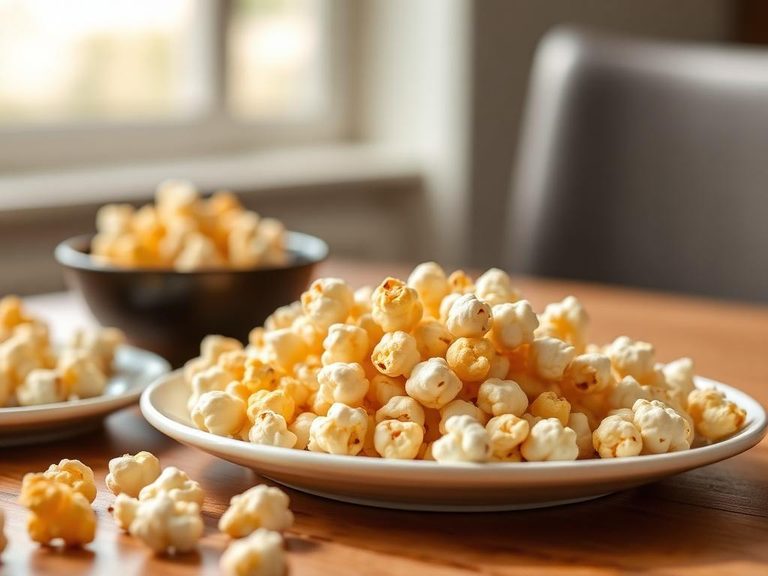
Air-popped popcorn is a light, crunchy whole grain snack with a clean, subtly nutty flavor and a satisfyingly dry texture. It's remarkably high in dietary fiber relative to its calorie count, making it a filling, low-energy-density food. Each kernel is a tiny, natural package of complex carbohydrates and plant-based protein.
Calorie split: 13% protein · 77% carbs · 10% fat
↓ Full nutrition💚 Why it's loved
People love popcorn for its satisfying crunch, its ability to be a blank canvas for both sweet and savory flavors, and its deep cultural ties to movie nights, carnivals, and shared gatherings.
⚠️ Watch-outs & how to enjoy it better
The high fiber content can cause digestive discomfort like bloating or gas if consumed in large quantities, especially for those unaccustomed to it. To mitigate this, start with a small portion, drink plenty of water, and consider pairing it with a source of fat or protein (like a handful of nuts) to slow digestion and enhance satiety.
Key benefits
- Excellent source of dietary fiber (14.4g per 100g)
- Very low in fat, especially without added butter
- Provides plant-based protein (12.89g per 100g)
- Whole-grain food with minimal processing
- Naturally low in sugar
🍽️ Popular dishes




🌍 Where it's eaten
💡 Did you know?
The 'pop' of popcorn is caused by superheated water inside the kernel turning to steam, building pressure until the hull ruptures and the starch expands into a foam that instantly solidifies.
Full nutrition (USDA data · scales with serving)
| Water | 3.3 g |
| Energy | 385 kcal |
| Protein | 12.9 g |
| Total lipid (fat) | 4.5 g |
| Carbohydrate, by difference | 77.5 g |
| Fiber, total dietary | 14.4 g |
| Total Sugars | 0.87 g |
| Calcium, Ca | 7.0 mg |
| Iron, Fe | 3.2 mg |
| Magnesium, Mg | 143 mg |
| Phosphorus, P | 357 mg |
| Potassium, K | 328 mg |
| Sodium, Na | 162 mg |
| Zinc, Zn | 3.1 mg |
| Copper, Cu | 0.26 mg |
| Selenium, Se | 0.00 ug |
| Vitamin C, total ascorbic acid | 0.00 mg |
| Thiamin | 0.10 mg |
| Riboflavin | 0.08 mg |
| Niacin | 2.3 mg |
| Vitamin B-6 | 0.16 mg |
| Folate, total | 31.0 ug |
| Folic acid | 0.00 ug |
| Folate, food | 31.0 ug |
| Folate, DFE | 31.0 ug |
| Choline, total | 21.1 mg |
| Vitamin B-12 | 0.00 ug |
| Vitamin B-12, added | 0.00 ug |
| Vitamin A, RAE | 10.0 ug |
| Retinol | 0.00 ug |
| Carotene, beta | 89.0 ug |
| Carotene, alpha | 58.0 ug |
| Cryptoxanthin, beta | 0.00 ug |
| Lycopene | 0.00 ug |
| Lutein + zeaxanthin | 1444 ug |
| Vitamin E (alpha-tocopherol) | 0.29 mg |
| Vitamin E, added | 0.00 mg |
| Vitamin D (D2 + D3) | 0.00 ug |
| Vitamin K (phylloquinone) | 1.2 ug |
| Alcohol, ethyl | 0.00 g |
| Caffeine | 0.00 mg |
| Theobromine | 0.00 mg |
Fat & fatty acid profile (per 100g)
| Fatty acids, total saturated | 0.63 g |
| SFA 4:0 | 0.00 g |
| SFA 6:0 | 0.00 g |
| SFA 8:0 | 0.00 g |
| SFA 10:0 | 0.00 g |
| SFA 12:0 | 0.00 g |
| SFA 14:0 | 0.00 g |
| SFA 16:0 | 0.53 g |
| SFA 18:0 | 0.08 g |
| Fatty acids, total monounsaturated | 0.95 g |
| MUFA 16:1 | 0.01 g |
| MUFA 18:1 | 0.93 g |
| MUFA 20:1 | 0.01 g |
| MUFA 22:1 | 0.00 g |
| Fatty acids, total polyunsaturated | 2.3 g |
| PUFA 18:2 | 2.3 g |
| PUFA 18:3 | 0.05 g |
| PUFA 18:4 | 0.00 g |
| PUFA 20:4 | 0.00 g |
| PUFA 20:5 n-3 (EPA) | 0.00 g |
| PUFA 22:5 n-3 (DPA) | 0.00 g |
| PUFA 22:6 n-3 (DHA) | 0.00 g |
| Cholesterol | 0.00 mg |
Amino acid profile (per 100g)
Estimated from Snacks, popcorn, oil-popped, white popcorn, salt added — USDA does not publish this profile for Popcorn.
| Tryptophan | 0.06 g |
| Threonine | 0.34 g |
| Isoleucine | 0.32 g |
| Leucine | 1.1 g |
| Lysine | 0.25 g |
| Methionine | 0.19 g |
| Cystine | 0.16 g |
| Phenylalanine | 0.44 g |
| Tyrosine | 0.37 g |
| Valine | 0.46 g |
| Arginine | 0.45 g |
| Histidine | 0.28 g |
| Alanine | 0.67 g |
| Aspartic acid | 0.63 g |
| Glutamic acid | 1.7 g |
| Glycine | 0.37 g |
| Proline | 0.79 g |
| Serine | 0.43 g |
FAQ
Is air-popped popcorn a healthy snack?
Yes, it is considered a very healthy snack. It is a whole-grain, high-fiber food that is low in calories and fat when prepared without added butter or excessive salt.
Why is air-popped popcorn so high in fiber?
Popcorn is a whole grain, meaning it includes all parts of the kernel—the bran, germ, and endosperm. The bran layer is particularly rich in insoluble dietary fiber.
Can I eat popcorn on a low-carb diet?
While lower in net carbs than many snacks due to its high fiber, popcorn is still a carbohydrate-rich food. A standard serving contains a significant amount of carbs, so portion control is key for low-carb diets.
Nutrient density (calculated · NRF9.3)
Nutrient Rich Foods index: beneficial nutrients (protein, fiber, vitamins, minerals) minus saturated fat, added sugar & sodium, per 100 kcal.
NRF9.3 index — Fulgoni, Keast & Drewnowski, 2009. Computed from USDA nutrients.
Weight-loss friendliness (composite index)
Energy density 3.85 kcal/g · 13% calories from protein · 14.4 g fiber · 0.9 g sugar per 100 g.
Composite of energy density (Rolls et al., 1999), protein & fiber satiety, minus sugar. A calculated heuristic — ranks satiety-per-calorie, not a clinical measure.
Dietary load (calculated from USDA values)
Potential renal acid load. Positive = acid-forming, negative = alkaline-forming.
Sodium-to-potassium ratio: 0.49 (lower is better — aim for ≤ 1)
Sodium:potassium per WHO potassium guidance. Computed from USDA nutrients.