

Light ice cream cone, chocolate, prepackaged
Common food

Photo: Wikipedia
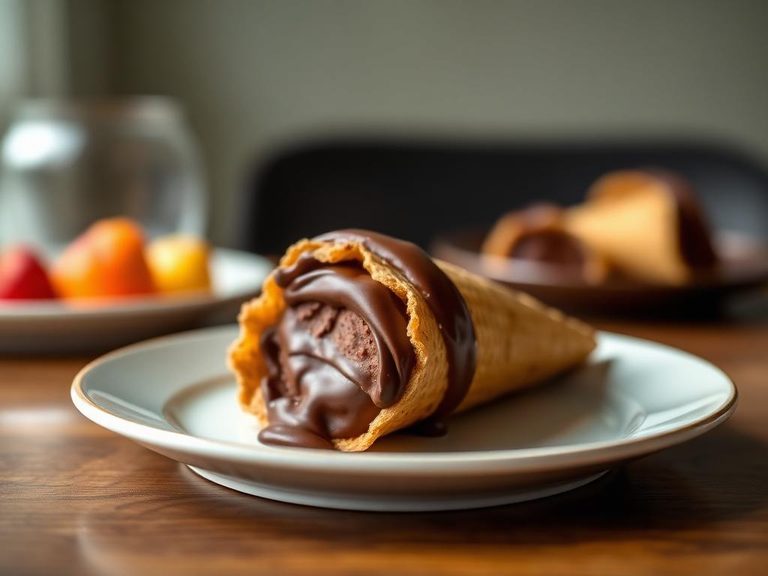
This is a prepackaged, light chocolate ice cream cone, offering a crisp, edible wafer shell filled with a creamy, chocolate-flavored frozen dessert. The texture contrasts the crunchy cone with the smooth, cold interior. Nutritionally, it's a lower-calorie treat at 227 kcal per 100g, with a modest protein content of 5.32g.
Calorie split: 9% protein · 61% carbs · 30% fat
↓ Full nutrition💚 Why it's loved
People love it for the nostalgic, satisfying combination of a crunchy cone and creamy chocolate ice cream, evoking simple summer pleasures. Its prepackaged format makes it a convenient, no-mess treat for both children and adults.
⚠️ Watch-outs & how to enjoy it better
The relatively high sugar content (17.11g per 100g) can lead to a quick blood-sugar spike, making it less ideal for those monitoring glucose levels. To mitigate this, pair it with a source of protein or healthy fat (like a handful of nuts) to slow sugar absorption, and practice mindful portion control by enjoying one cone slowly. Also, check for common allergens like wheat (cone) and milk (ice cream).
Key benefits
- Provides a controlled, single-serving portion for calorie management.
- Offers a source of quick energy from carbohydrates.
- Contains a small amount of protein for satiety.
- The edible cone adds a satisfying textural element.
- Convenient and portable for on-the-go enjoyment.
🍽️ Popular dishes


🌍 Where it's eaten
💡 Did you know?
The iconic pointed sugar cone was patented in 1903 by Italo Marchioni, an Italian immigrant, who first sold ice cream in pastry shells to avoid the cost and breakage of glass dishes.
Full nutrition (USDA data · scales with serving)
| Water | 51.3 g |
| Energy | 227 kcal |
| Protein | 5.3 g |
| Total lipid (fat) | 7.6 g |
| Carbohydrate, by difference | 34.9 g |
| Fiber, total dietary | 1.3 g |
| Total Sugars | 17.1 g |
| Calcium, Ca | 121 mg |
| Iron, Fe | 1.1 mg |
| Magnesium, Mg | 25.0 mg |
| Phosphorus, P | 104 mg |
| Potassium, K | 197 mg |
| Sodium, Na | 124 mg |
| Zinc, Zn | 0.55 mg |
| Copper, Cu | 0.11 mg |
| Selenium, Se | 3.0 ug |
| Vitamin C, total ascorbic acid | 0.80 mg |
| Thiamin | 0.10 mg |
| Riboflavin | 0.18 mg |
| Niacin | 1.1 mg |
| Vitamin B-6 | 0.05 mg |
| Folate, total | 24.0 ug |
| Folic acid | 16.0 ug |
| Folate, food | 7.0 ug |
| Folate, DFE | 35.0 ug |
| Choline, total | 15.8 mg |
| Vitamin B-12 | 0.21 ug |
| Vitamin B-12, added | 0.00 ug |
| Vitamin A, RAE | 58.0 ug |
| Retinol | 54.0 ug |
| Carotene, beta | 58.0 ug |
| Carotene, alpha | 0.00 ug |
| Cryptoxanthin, beta | 0.00 ug |
| Lycopene | 0.00 ug |
| Lutein + zeaxanthin | 2.0 ug |
| Vitamin E (alpha-tocopherol) | 0.49 mg |
| Vitamin E, added | 0.00 mg |
| Vitamin D (D2 + D3) | 0.10 ug |
| Vitamin K (phylloquinone) | 2.0 ug |
| Alcohol, ethyl | 0.00 g |
| Caffeine | 1.0 mg |
| Theobromine | 42.0 mg |
Fat & fatty acid profile (per 100g)
| Fatty acids, total saturated | 3.7 g |
| SFA 4:0 | 0.16 g |
| SFA 6:0 | 0.07 g |
| SFA 8:0 | 0.06 g |
| SFA 10:0 | 0.11 g |
| SFA 12:0 | 0.10 g |
| SFA 14:0 | 0.51 g |
| SFA 16:0 | 1.7 g |
| SFA 18:0 | 0.71 g |
| Fatty acids, total monounsaturated | 2.3 g |
| MUFA 16:1 | 0.11 g |
| MUFA 18:1 | 2.2 g |
| MUFA 20:1 | 0.02 g |
| MUFA 22:1 | 0.00 g |
| Fatty acids, total polyunsaturated | 0.79 g |
| PUFA 18:2 | 0.71 g |
| PUFA 18:3 | 0.08 g |
| PUFA 18:4 | 0.00 g |
| PUFA 20:4 | 0.00 g |
| PUFA 20:5 n-3 (EPA) | 0.00 g |
| PUFA 22:5 n-3 (DPA) | 0.00 g |
| PUFA 22:6 n-3 (DHA) | 0.00 g |
| Cholesterol | 18.0 mg |
Amino acid profile (per 100g)
Estimated from Ice creams, vanilla, rich — USDA does not publish this profile for Light ice cream cone.
| Tryptophan | 0.04 g |
| Threonine | 0.14 g |
| Isoleucine | 0.18 g |
| Leucine | 0.30 g |
| Lysine | 0.25 g |
| Methionine | 0.08 g |
| Cystine | 0.03 g |
| Phenylalanine | 0.15 g |
| Tyrosine | 0.14 g |
| Valine | 0.20 g |
| Arginine | 0.14 g |
| Histidine | 0.08 g |
| Alanine | 0.14 g |
| Glutamic acid | 0.65 g |
| Glycine | 0.15 g |
| Proline | 0.34 g |
| Serine | 0.17 g |
FAQ
How does 'light' ice cream differ from regular?
'Light' ice cream is legally defined in the US as having at least 25% less fat and/or 33% fewer calories than the regular version. This often results in a slightly icier texture and different mouthfeel.
Is the cone itself nutritious?
The cone is primarily a source of refined carbohydrates from flour and sugar, providing energy but little fiber or micronutrients. Its main role is textural contrast and convenience.
Can I eat this as part of a balanced diet?
Yes, as an occasional treat within your daily calorie and nutrient goals. Its pre-portioned size helps with moderation. Balance it by choosing nutrient-dense foods for your other meals.
Nutrient density (calculated · NRF9.3)
Nutrient Rich Foods index: beneficial nutrients (protein, fiber, vitamins, minerals) minus saturated fat, added sugar & sodium, per 100 kcal.
NRF9.3 index — Fulgoni, Keast & Drewnowski, 2009. Computed from USDA nutrients.
Weight-loss friendliness (composite index)
Energy density 2.27 kcal/g · 9% calories from protein · 1.3 g fiber · 17.1 g sugar per 100 g.
Composite of energy density (Rolls et al., 1999), protein & fiber satiety, minus sugar. A calculated heuristic — ranks satiety-per-calorie, not a clinical measure.
Dietary load (calculated from USDA values)
Potential renal acid load. Positive = acid-forming, negative = alkaline-forming.
Sodium-to-potassium ratio: 0.63 (lower is better — aim for ≤ 1)
Sodium:potassium per WHO potassium guidance. Computed from USDA nutrients.