

Ice cream sundae, NFS
Common food
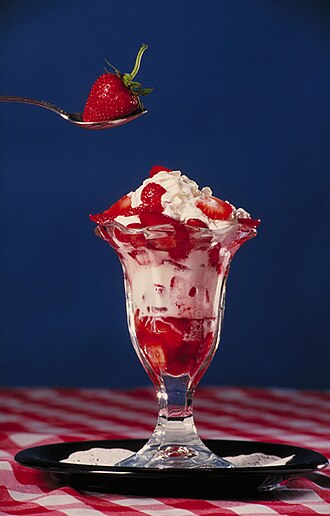
Photo: Wikipedia
A decadent assembly of ice cream scoops adorned with syrup, whipped cream, and toppings, the sundae is a celebration of sweet, creamy, and crunchy textures. Its high sugar and fat content makes it a rich, indulgent treat, providing a quick energy boost but little in the way of essential nutrients. It is a dessert designed for pure, unadulterated pleasure.
Calorie split: 6% protein · 53% carbs · 41% fat
↓ Full nutrition💚 Why it's loved
People love sundaes for the customizable joy they bring, allowing for endless combinations of flavors and textures that cater to personal cravings. It's a nostalgic treat often associated with celebrations, childhood memories, and the simple pleasure of a cold, sweet dessert on a warm day.
⚠️ Watch-outs & how to enjoy it better
The high sugar content can lead to blood-sugar spikes and crashes, and it's often high in saturated fat and calories, making it unsuitable for those monitoring their intake. To counteract this, practice portion control by sharing a sundae or choosing a smaller size, and pair it with a source of protein or fiber (like nuts or fruit) to slow sugar absorption.
Key benefits
- Quick source of energy from carbohydrates
- Provides calcium from dairy ice cream
- Can be a mood booster due to sugar and fat
- Highly customizable with various toppings
- A classic celebratory dessert
🍽️ Popular dishes



🌍 Where it's eaten
💡 Did you know?
The term 'sundae' is widely believed to have originated in the late 19th century in the United States, with various towns in Illinois, Wisconsin, and New York all claiming to be the birthplace of the dessert.
Full nutrition (USDA data · scales with serving)
| Water | 52.1 g |
| Energy | 243 kcal |
| Protein | 3.7 g |
| Total lipid (fat) | 11.2 g |
| Carbohydrate, by difference | 31.9 g |
| Fiber, total dietary | 1.1 g |
| Total Sugars | 23.9 g |
| Calcium, Ca | 108 mg |
| Iron, Fe | 0.36 mg |
| Magnesium, Mg | 21.0 mg |
| Phosphorus, P | 102 mg |
| Potassium, K | 215 mg |
| Sodium, Na | 137 mg |
| Zinc, Zn | 0.71 mg |
| Copper, Cu | 0.10 mg |
| Selenium, Se | 1.9 ug |
| Vitamin C, total ascorbic acid | 0.50 mg |
| Thiamin | 0.04 mg |
| Riboflavin | 0.20 mg |
| Niacin | 0.14 mg |
| Vitamin B-6 | 0.04 mg |
| Folate, total | 5.0 ug |
| Folic acid | 0.00 ug |
| Folate, food | 5.0 ug |
| Folate, DFE | 5.0 ug |
| Choline, total | 21.2 mg |
| Vitamin B-12 | 0.31 ug |
| Vitamin B-12, added | 0.00 ug |
| Vitamin A, RAE | 97.0 ug |
| Retinol | 96.0 ug |
| Carotene, beta | 14.0 ug |
| Carotene, alpha | 0.00 ug |
| Cryptoxanthin, beta | 0.00 ug |
| Lycopene | 0.00 ug |
| Lutein + zeaxanthin | 1.0 ug |
| Vitamin E (alpha-tocopherol) | 0.83 mg |
| Vitamin E, added | 0.00 mg |
| Vitamin D (D2 + D3) | 0.20 ug |
| Vitamin K (phylloquinone) | 0.90 ug |
| Alcohol, ethyl | 0.00 g |
| Caffeine | 2.0 mg |
| Theobromine | 55.0 mg |
Fat & fatty acid profile (per 100g)
| Fatty acids, total saturated | 6.5 g |
| SFA 4:0 | 0.29 g |
| SFA 6:0 | 0.17 g |
| SFA 8:0 | 0.10 g |
| SFA 10:0 | 0.24 g |
| SFA 12:0 | 0.27 g |
| SFA 14:0 | 0.99 g |
| SFA 16:0 | 2.9 g |
| SFA 18:0 | 1.2 g |
| Fatty acids, total monounsaturated | 3.3 g |
| MUFA 16:1 | 0.19 g |
| MUFA 18:1 | 3.1 g |
| MUFA 20:1 | 0.00 g |
| MUFA 22:1 | 0.00 g |
| Fatty acids, total polyunsaturated | 0.44 g |
| PUFA 18:2 | 0.28 g |
| PUFA 18:3 | 0.14 g |
| PUFA 18:4 | 0.00 g |
| PUFA 20:4 | 0.00 g |
| PUFA 20:5 n-3 (EPA) | 0.00 g |
| PUFA 22:5 n-3 (DPA) | 0.00 g |
| PUFA 22:6 n-3 (DHA) | 0.00 g |
| Cholesterol | 36.0 mg |
Amino acid profile (per 100g)
Estimated from Ice creams, vanilla, rich — USDA does not publish this profile for Ice cream sundae.
| Tryptophan | 0.04 g |
| Threonine | 0.14 g |
| Isoleucine | 0.18 g |
| Leucine | 0.30 g |
| Lysine | 0.25 g |
| Methionine | 0.08 g |
| Cystine | 0.03 g |
| Phenylalanine | 0.15 g |
| Tyrosine | 0.14 g |
| Valine | 0.20 g |
| Arginine | 0.14 g |
| Histidine | 0.08 g |
| Alanine | 0.14 g |
| Glutamic acid | 0.65 g |
| Glycine | 0.15 g |
| Proline | 0.34 g |
| Serine | 0.17 g |
FAQ
What is the difference between a sundae and an ice cream float?
A sundae is ice cream topped with syrup, whipped cream, and other toppings, while a float (or ice cream soda) consists of ice cream dropped into a carbonated beverage like soda.
Can a sundae be made with non-dairy ice cream?
Yes, sundaes can be made with any type of ice cream, including dairy-free alternatives made from almond, soy, coconut, or oat milk.
What are the most popular sundae toppings?
Classic toppings include hot fudge, caramel, strawberry sauce, whipped cream, nuts, cherries, and sprinkles.
Nutrient density (calculated · NRF9.3)
Nutrient Rich Foods index: beneficial nutrients (protein, fiber, vitamins, minerals) minus saturated fat, added sugar & sodium, per 100 kcal.
NRF9.3 index — Fulgoni, Keast & Drewnowski, 2009. Computed from USDA nutrients.
Weight-loss friendliness (composite index)
Energy density 2.43 kcal/g · 6% calories from protein · 1.1 g fiber · 23.9 g sugar per 100 g.
Composite of energy density (Rolls et al., 1999), protein & fiber satiety, minus sugar. A calculated heuristic — ranks satiety-per-calorie, not a clinical measure.
Dietary load (calculated from USDA values)
Potential renal acid load. Positive = acid-forming, negative = alkaline-forming.
Sodium-to-potassium ratio: 0.64 (lower is better — aim for ≤ 1)
Sodium:potassium per WHO potassium guidance. Computed from USDA nutrients.