

Ice cream cone, scooped, chocolate
Common food
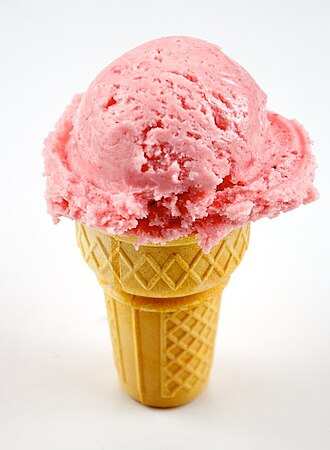
Photo: Wikipedia
A crisp, golden wafer cone cradling one or more scoops of rich, creamy chocolate ice cream. The experience is a delightful contrast between the cold, smooth, cocoa-infused cream and the sweet, crunchy, edible vessel. Nutritionally, it's a significant source of quick energy from carbohydrates and sugar, with a moderate amount of fat for satiety.
Calorie split: 7% protein · 52% carbs · 42% fat
↓ Full nutrition💚 Why it's loved
People adore it for the perfect marriage of the cold, creamy, chocolatey scoop and the sweet, crunchy cone, which acts as both a utensil and a tasty part of the dessert. It's a universally recognized symbol of summer, childhood joy, and simple indulgence.
⚠️ Watch-outs & how to enjoy it better
The high sugar content can lead to rapid blood-sugar spikes and subsequent crashes, and the dairy and wheat in the cone are common allergens. To mitigate, enjoy a single scoop as an occasional treat, pair it with a source of protein or healthy fat like nuts to slow sugar absorption, and be mindful of portion sizes.
Key benefits
- Quick source of energy from carbohydrates
- Contains calcium from dairy components
- Provides a small amount of protein
- Can be a mood-enhancing treat
- Offers a satisfying textural contrast
🍽️ Popular dishes



🌍 Where it's eaten
💡 Did you know?
The first ice cream cones were popularized at the 1904 St. Louis World's Fair, where a waffle maker reportedly rolled his waffles into a cone shape to help a neighboring ice cream vendor who had run out of dishes.
Full nutrition (USDA data · scales with serving)
| Water | 53.7 g |
| Energy | 224 kcal |
| Protein | 4.0 g |
| Total lipid (fat) | 10.8 g |
| Carbohydrate, by difference | 30.2 g |
| Fiber, total dietary | 1.3 g |
| Total Sugars | 24.6 g |
| Calcium, Ca | 106 mg |
| Iron, Fe | 1.0 mg |
| Magnesium, Mg | 29.0 mg |
| Phosphorus, P | 107 mg |
| Potassium, K | 244 mg |
| Sodium, Na | 83.0 mg |
| Zinc, Zn | 0.58 mg |
| Copper, Cu | 0.14 mg |
| Selenium, Se | 2.6 ug |
| Vitamin C, total ascorbic acid | 0.70 mg |
| Thiamin | 0.05 mg |
| Riboflavin | 0.20 mg |
| Niacin | 0.39 mg |
| Vitamin B-6 | 0.05 mg |
| Folate, total | 22.0 ug |
| Folic acid | 7.0 ug |
| Folate, food | 16.0 ug |
| Folate, DFE | 27.0 ug |
| Choline, total | 22.0 mg |
| Vitamin B-12 | 0.28 ug |
| Vitamin B-12, added | 0.00 ug |
| Vitamin A, RAE | 113 ug |
| Retinol | 111 ug |
| Carotene, beta | 18.0 ug |
| Carotene, alpha | 0.00 ug |
| Cryptoxanthin, beta | 0.00 ug |
| Lycopene | 0.00 ug |
| Lutein + zeaxanthin | 1.0 ug |
| Vitamin E (alpha-tocopherol) | 0.32 mg |
| Vitamin E, added | 0.00 mg |
| Vitamin D (D2 + D3) | 0.20 ug |
| Vitamin K (phylloquinone) | 0.40 ug |
| Alcohol, ethyl | 0.00 g |
| Caffeine | 3.0 mg |
| Theobromine | 60.0 mg |
Fat & fatty acid profile (per 100g)
| Fatty acids, total saturated | 6.6 g |
| SFA 4:0 | 0.33 g |
| SFA 6:0 | 0.19 g |
| SFA 8:0 | 0.12 g |
| SFA 10:0 | 0.25 g |
| SFA 12:0 | 0.28 g |
| SFA 14:0 | 1.0 g |
| SFA 16:0 | 3.0 g |
| SFA 18:0 | 1.4 g |
| Fatty acids, total monounsaturated | 3.2 g |
| MUFA 16:1 | 0.23 g |
| MUFA 18:1 | 2.9 g |
| MUFA 20:1 | 0.00 g |
| MUFA 22:1 | 0.00 g |
| Fatty acids, total polyunsaturated | 0.52 g |
| PUFA 18:2 | 0.36 g |
| PUFA 18:3 | 0.15 g |
| PUFA 18:4 | 0.00 g |
| PUFA 20:4 | 0.00 g |
| PUFA 20:5 n-3 (EPA) | 0.00 g |
| PUFA 22:5 n-3 (DPA) | 0.00 g |
| PUFA 22:6 n-3 (DHA) | 0.00 g |
| Cholesterol | 33.0 mg |
Amino acid profile (per 100g)
Estimated from Ice creams, vanilla, rich — USDA does not publish this profile for Ice cream cone.
| Tryptophan | 0.04 g |
| Threonine | 0.14 g |
| Isoleucine | 0.18 g |
| Leucine | 0.30 g |
| Lysine | 0.25 g |
| Methionine | 0.08 g |
| Cystine | 0.03 g |
| Phenylalanine | 0.15 g |
| Tyrosine | 0.14 g |
| Valine | 0.20 g |
| Arginine | 0.14 g |
| Histidine | 0.08 g |
| Alanine | 0.14 g |
| Glutamic acid | 0.65 g |
| Glycine | 0.15 g |
| Proline | 0.34 g |
| Serine | 0.17 g |
FAQ
Is an ice cream cone a good source of protein?
Not particularly. While it contains some protein from the dairy in the ice cream and wheat in the cone, it's primarily a source of carbohydrates and fats. A single cone provides roughly 4-5g of protein, which is modest compared to its calorie and sugar content.
How does the cone affect the nutrition compared to just a scoop in a bowl?
The cone adds approximately 50-80 calories, 10-15g of carbohydrates (mostly sugar), and a small amount of fiber and protein. It turns the dessert into a more substantial, handheld treat but increases the overall carbohydrate and calorie load.
Can people with lactose intolerance eat this?
It can be challenging, as traditional ice cream contains dairy lactose. However, many brands now offer lactose-free or dairy-free chocolate ice cream alternatives. The cone itself is typically dairy-free but may be processed in facilities that handle dairy.
Nutrient density (calculated · NRF9.3)
Nutrient Rich Foods index: beneficial nutrients (protein, fiber, vitamins, minerals) minus saturated fat, added sugar & sodium, per 100 kcal.
NRF9.3 index — Fulgoni, Keast & Drewnowski, 2009. Computed from USDA nutrients.
Weight-loss friendliness (composite index)
Energy density 2.24 kcal/g · 7% calories from protein · 1.3 g fiber · 24.6 g sugar per 100 g.
Composite of energy density (Rolls et al., 1999), protein & fiber satiety, minus sugar. A calculated heuristic — ranks satiety-per-calorie, not a clinical measure.
Dietary load (calculated from USDA values)
Potential renal acid load. Positive = acid-forming, negative = alkaline-forming.
Sodium-to-potassium ratio: 0.34 (lower is better — aim for ≤ 1)
Sodium:potassium per WHO potassium guidance. Computed from USDA nutrients.