

Hazelnuts, beaked (Northern Plains Indians)
Whole food · American Indian/Alaska Native Foods

Photo: Wikipedia
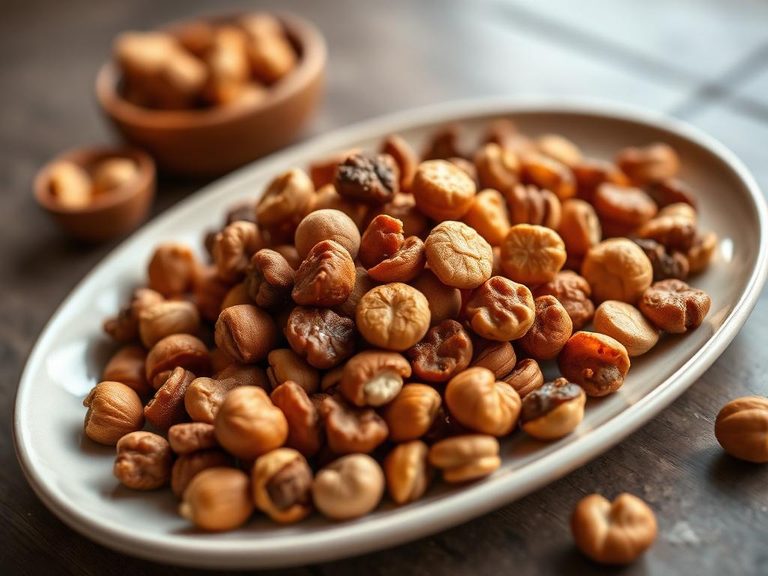
Beaked hazelnuts, a staple of the Northern Plains Indigenous peoples, offer a rich, buttery flavor with a satisfying crunch and a subtle, earthy sweetness. Packed with healthy fats and a notable protein content, these nuts are a dense source of energy, providing over 500 calories per 100 grams. Their unique, slightly more elongated shape distinguishes them from common hazelnuts, making them a prized ingredient in traditional and modern culinary applications.
Calorie split: 9% protein · 15% carbs · 76% fat
↓ Full nutrition💚 Why it's loved
People love these hazelnuts for their deep, nutty flavor and versatile texture, which adds a luxurious crunch to both sweet and savory dishes. They are also cherished for their cultural significance and connection to the heritage of the Northern Plains tribes, making them a meaningful addition to meals.
⚠️ Watch-outs & how to enjoy it better
Due to their high fat and calorie content, they can be easy to overconsume, potentially leading to weight gain if not portion-controlled. Additionally, as a tree nut, they are a common allergen, so individuals with nut allergies should avoid them. To counteract these issues, pair them with fiber-rich foods like oats or fruit, and use them in measured portions, such as a small handful (about 1 oz) as a snack or topping.
Key benefits
- High in monounsaturated fats, which support heart health.
- Excellent source of plant-based protein for muscle maintenance.
- Rich in dietary fiber, aiding in digestion and satiety.
- Provides essential minerals like manganese and copper.
- Contains antioxidants that help combat oxidative stress.
🍽️ Popular dishes

🌍 Where it's eaten
💡 Did you know?
Beaked hazelnuts (Corylus cornuta) get their name from the distinctive beak-like projection on their husk, which resembles a bird's beak and helps protect the nut inside.
Full nutrition (USDA data · scales with serving)
| Water | 5.9 g |
| Energy | 628 kcal |
| Energy | 2629 kj |
| Protein | 14.9 g |
| Total lipid (fat) | 53.0 g |
| Ash | 3.2 g |
| Carbohydrate, by difference | 23.0 g |
| Fiber, total dietary | 9.8 g |
| Calcium, Ca | 441 mg |
| Iron, Fe | 3.1 mg |
| Magnesium, Mg | 235 mg |
| Phosphorus, P | 411 mg |
| Potassium, K | 738 mg |
| Sodium, Na | 2.0 mg |
| Zinc, Zn | 2.1 mg |
| Copper, Cu | 1.2 mg |
| Manganese, Mn | 7.6 mg |
| Thiamin | 0.48 mg |
| Riboflavin | 0.16 mg |
| Niacin | 3.2 mg |
| Vitamin B-6 | 0.55 mg |
Fat & fatty acid profile (per 100g)
Estimated from Nuts, hazelnuts or filberts — USDA does not publish this profile for Hazelnuts.
| Fatty acids, total saturated | 4.5 g |
| SFA 4:0 | 0.00 g |
| SFA 6:0 | 0.00 g |
| SFA 8:0 | 0.00 g |
| SFA 10:0 | 0.00 g |
| SFA 12:0 | 0.00 g |
| SFA 13:0 | 0.00 g |
| SFA 14:0 | 0.00 g |
| SFA 15:0 | 0.00 g |
| SFA 16:0 | 3.1 g |
| SFA 17:0 | 0.00 g |
| SFA 18:0 | 1.3 g |
| SFA 20:0 | 0.10 g |
| SFA 22:0 | 0.00 g |
| SFA 24:0 | 0.00 g |
| Fatty acids, total monounsaturated | 45.7 g |
| MUFA 14:1 | 0.00 g |
| MUFA 16:1 | 0.12 g |
| MUFA 18:1 | 45.4 g |
| MUFA 20:1 | 0.13 g |
| MUFA 22:1 | 0.00 g |
| MUFA 24:1 c | 0.00 g |
| Fatty acids, total polyunsaturated | 7.9 g |
| PUFA 18:2 | 7.8 g |
| PUFA 18:3 | 0.09 g |
| PUFA 18:4 | 0.00 g |
| PUFA 20:2 n-6 c,c | 0.00 g |
| PUFA 20:3 | 0.00 g |
| PUFA 20:4 | 0.00 g |
| PUFA 20:5 n-3 (EPA) | 0.00 g |
| PUFA 22:5 n-3 (DPA) | 0.00 g |
| PUFA 22:6 n-3 (DHA) | 0.00 g |
| Cholesterol | 0.00 mg |
| Stigmasterol | 1.0 mg |
| Campesterol | 7.0 mg |
| Beta-sitosterol | 102 mg |
Amino acid profile (per 100g)
Estimated from Nuts, hazelnuts or filberts — USDA does not publish this profile for Hazelnuts.
| Tryptophan | 0.19 g |
| Threonine | 0.50 g |
| Isoleucine | 0.55 g |
| Leucine | 1.1 g |
| Lysine | 0.42 g |
| Methionine | 0.22 g |
| Cystine | 0.28 g |
| Phenylalanine | 0.66 g |
| Tyrosine | 0.36 g |
| Valine | 0.70 g |
| Arginine | 2.2 g |
| Histidine | 0.43 g |
| Alanine | 0.73 g |
| Aspartic acid | 1.7 g |
| Glutamic acid | 3.7 g |
| Glycine | 0.72 g |
| Proline | 0.56 g |
| Serine | 0.73 g |
FAQ
How do beaked hazelnuts differ from common hazelnuts?
Beaked hazelnuts have a more elongated shape with a beak-like husk projection, and their flavor is often described as slightly more earthy and robust compared to common hazelnuts.
Are beaked hazelnuts safe for people with nut allergies?
No, beaked hazelnuts are tree nuts and can trigger allergic reactions in individuals with nut allergies. They should be avoided if you have a known allergy.
How should I store beaked hazelnuts to maintain freshness?
Store them in an airtight container in a cool, dark place for up to 6 months, or refrigerate them for up to a year to prevent rancidity from their high fat content.
Nutrient density (calculated · NRF9.3)
Nutrient Rich Foods index: beneficial nutrients (protein, fiber, vitamins, minerals) minus saturated fat, added sugar & sodium, per 100 kcal.
NRF9.3 index — Fulgoni, Keast & Drewnowski, 2009. Computed from USDA nutrients.
Weight-loss friendliness (composite index)
Energy density 6.28 kcal/g · 9% calories from protein · 9.8 g fiber · 0.0 g sugar per 100 g.
Composite of energy density (Rolls et al., 1999), protein & fiber satiety, minus sugar. A calculated heuristic — ranks satiety-per-calorie, not a clinical measure.
Dietary load (calculated from USDA values)
Potential renal acid load. Positive = acid-forming, negative = alkaline-forming.
Sodium-to-potassium ratio: 0.00 (lower is better — aim for ≤ 1)
Sodium:potassium per WHO potassium guidance. Computed from USDA nutrients.