

Crackers, woven wheat
Common food

Photo: Wikipedia
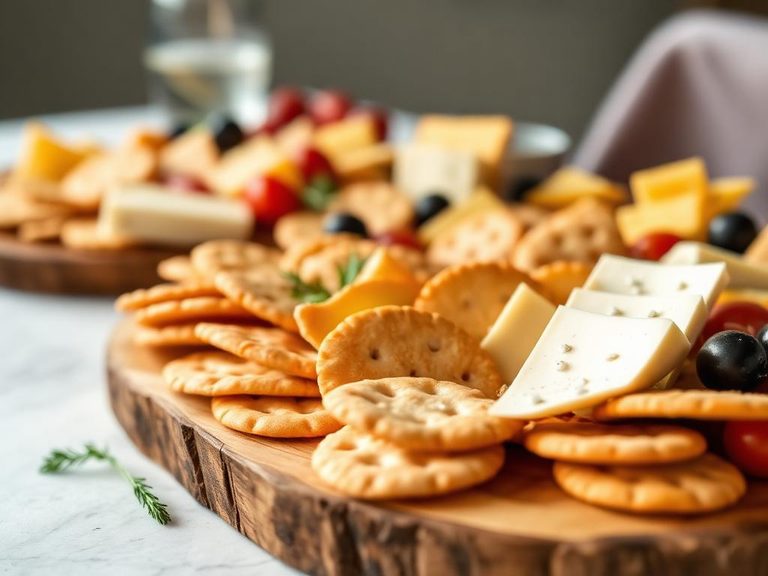
Woven wheat crackers are crisp, airy sheets of whole-wheat strands baked into a delicate lattice. They offer a satisfying, shattering crunch with a mild, toasty wheat flavor. Nutritionally, they are a high-carb, moderate-fiber snack that provides quick energy.
Calorie split: 8% protein · 62% carbs · 30% fat
↓ Full nutrition💚 Why it's loved
People love them for their addictive, light crunch and versatile, mild flavor that pairs well with both sweet and savory spreads. They are a classic, nostalgic snack often associated with casual gatherings and quick, simple meals.
⚠️ Watch-outs & how to enjoy it better
Their high carbohydrate content can cause blood-sugar spikes, especially when eaten alone. They are a common source of gluten, making them unsuitable for those with celiac disease or gluten sensitivity. To counteract blood-sugar impact, pair them with protein or healthy fats like cheese, hummus, or avocado, and practice portion control.
Key benefits
- Good source of dietary fiber for digestive health
- Provides plant-based protein from whole wheat
- Low in sugar compared to many sweet snacks
- Lightweight and portable for on-the-go eating
- Can serve as a neutral base for savory toppings
🍽️ Popular dishes
🌍 Where it's eaten
💡 Did you know?
The distinctive 'woven' texture isn't just for looks; it's created by extruding dough through a special die that forms the strands, which are then layered and baked, making them sturdier for dipping than a standard flat cracker.
Full nutrition (USDA data · scales with serving)
| Water | 2.8 g |
| Energy | 441 kcal |
| Protein | 8.9 g |
| Total lipid (fat) | 15.3 g |
| Carbohydrate, by difference | 70.1 g |
| Fiber, total dietary | 8.6 g |
| Total Sugars | 8.3 g |
| Calcium, Ca | 64.0 mg |
| Iron, Fe | 3.0 mg |
| Magnesium, Mg | 91.0 mg |
| Phosphorus, P | 316 mg |
| Potassium, K | 314 mg |
| Sodium, Na | 750 mg |
| Zinc, Zn | 2.1 mg |
| Copper, Cu | 0.35 mg |
| Selenium, Se | 10.0 ug |
| Vitamin C, total ascorbic acid | 0.00 mg |
| Thiamin | 0.23 mg |
| Riboflavin | 0.08 mg |
| Niacin | 4.3 mg |
| Vitamin B-6 | 0.21 mg |
| Folate, total | 33.0 ug |
| Folic acid | 1.0 ug |
| Folate, food | 32.0 ug |
| Folate, DFE | 34.0 ug |
| Choline, total | 27.2 mg |
| Vitamin B-12 | 0.00 ug |
| Vitamin B-12, added | 0.00 ug |
| Vitamin A, RAE | 0.00 ug |
| Retinol | 0.00 ug |
| Carotene, beta | 2.0 ug |
| Carotene, alpha | 0.00 ug |
| Cryptoxanthin, beta | 0.00 ug |
| Lycopene | 0.00 ug |
| Lutein + zeaxanthin | 180 ug |
| Vitamin E (alpha-tocopherol) | 1.5 mg |
| Vitamin E, added | 0.00 mg |
| Vitamin D (D2 + D3) | 0.00 ug |
| Vitamin K (phylloquinone) | 20.7 ug |
| Alcohol, ethyl | 0.00 g |
| Caffeine | 0.00 mg |
| Theobromine | 0.00 mg |
Fat & fatty acid profile (per 100g)
| Fatty acids, total saturated | 2.6 g |
| SFA 4:0 | 0.00 g |
| SFA 6:0 | 0.00 g |
| SFA 8:0 | 0.03 g |
| SFA 10:0 | 0.02 g |
| SFA 12:0 | 0.17 g |
| SFA 14:0 | 0.08 g |
| SFA 16:0 | 1.6 g |
| SFA 18:0 | 0.62 g |
| Fatty acids, total monounsaturated | 3.4 g |
| MUFA 16:1 | 0.01 g |
| MUFA 18:1 | 3.3 g |
| MUFA 20:1 | 0.04 g |
| MUFA 22:1 | 0.00 g |
| Fatty acids, total polyunsaturated | 7.7 g |
| PUFA 18:2 | 6.8 g |
| PUFA 18:3 | 0.92 g |
| PUFA 18:4 | 0.00 g |
| PUFA 20:4 | 0.00 g |
| PUFA 20:5 n-3 (EPA) | 0.00 g |
| PUFA 22:5 n-3 (DPA) | 0.00 g |
| PUFA 22:6 n-3 (DHA) | 0.00 g |
| Cholesterol | 0.00 mg |
Amino acid profile (per 100g)
Estimated from Crackers, cheese, sandwich-type with cheese filling — USDA does not publish this profile for Crackers.
| Tryptophan | 0.11 g |
| Threonine | 0.33 g |
| Isoleucine | 0.36 g |
| Leucine | 0.64 g |
| Lysine | 0.39 g |
| Methionine | 0.15 g |
| Cystine | 0.15 g |
| Phenylalanine | 0.35 g |
| Tyrosine | 0.25 g |
| Valine | 0.38 g |
| Arginine | 0.29 g |
| Histidine | 0.17 g |
| Alanine | 0.30 g |
| Aspartic acid | 0.52 g |
| Glutamic acid | 2.2 g |
| Glycine | 0.24 g |
| Proline | 0.77 g |
| Serine | 0.40 g |
FAQ
Are woven wheat crackers the same as whole-wheat crackers?
Not necessarily. While they are made from wheat, the 'woven' label refers to their physical structure. The ingredient list should specify if they are made with 100% whole-wheat flour.
Why do they sometimes have a slightly sweet taste?
Many commercial brands add a small amount of sugar or honey to balance the flavor and aid in browning during baking. Check the nutrition label for sugar content.
Can I use them in place of breadcrumbs?
Yes, they make an excellent, coarse-textured substitute. Crush them to use as a coating for baked chicken or fish, or as a binder in meatloaf.
Nutrient density (calculated · NRF9.3)
Nutrient Rich Foods index: beneficial nutrients (protein, fiber, vitamins, minerals) minus saturated fat, added sugar & sodium, per 100 kcal.
NRF9.3 index — Fulgoni, Keast & Drewnowski, 2009. Computed from USDA nutrients.
Weight-loss friendliness (composite index)
Energy density 4.41 kcal/g · 8% calories from protein · 8.6 g fiber · 8.3 g sugar per 100 g.
Composite of energy density (Rolls et al., 1999), protein & fiber satiety, minus sugar. A calculated heuristic — ranks satiety-per-calorie, not a clinical measure.
Dietary load (calculated from USDA values)
Potential renal acid load. Positive = acid-forming, negative = alkaline-forming.
Sodium-to-potassium ratio: 2.39 (lower is better — aim for ≤ 1)
Sodium:potassium per WHO potassium guidance. Computed from USDA nutrients.