

Pretzels, soft, from frozen, topped with cheese
Common food

Photo: Wikipedia
A soft, chewy pretzel, often baked from a frozen dough state, is generously topped with a melted cheese blend, creating a savory, salty, and satisfying snack. Its golden-brown crust gives way to a fluffy interior, while the cheese adds a rich, umami depth. Nutritionally, it's a significant source of carbohydrates for quick energy, with a moderate protein boost from the cheese.
Calorie split: 12% protein · 74% carbs · 14% fat
↓ Full nutrition💚 Why it's loved
People love it for the ultimate comfort-food combination: the warm, pillowy dough of a classic pretzel perfectly complemented by the salty, gooey richness of melted cheese. It's a beloved stadium snack and casual treat that feels both indulgent and nostalgic.
⚠️ Watch-outs & how to enjoy it better
The high carbohydrate content can lead to blood-sugar spikes, especially without balancing nutrients, and the cheese topping significantly increases sodium and saturated fat. Those watching their sodium intake or managing blood sugar should be cautious. To counteract, pair it with a side of non-starchy vegetables or a lean protein like grilled chicken, and practice portion control by enjoying half as a treat.
Key benefits
- Provides quick energy from complex carbohydrates
- Offers a good source of protein from the cheese topping
- Can be a convenient, ready-to-eat snack or meal component
- The cheese topping adds calcium and phosphorus
- Satisfying texture combination of soft bread and melted cheese
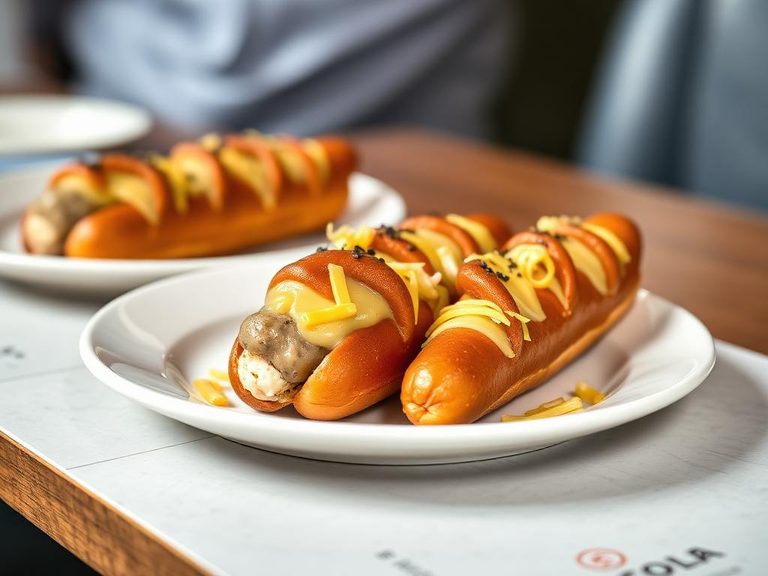
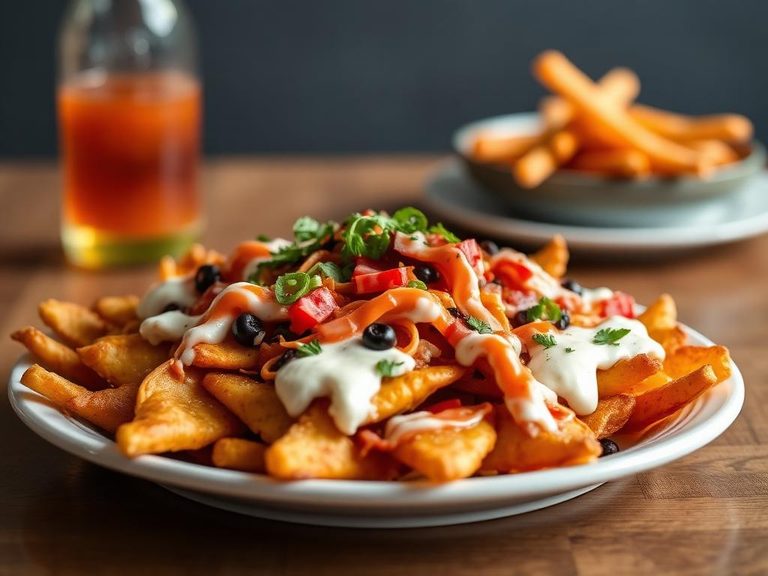
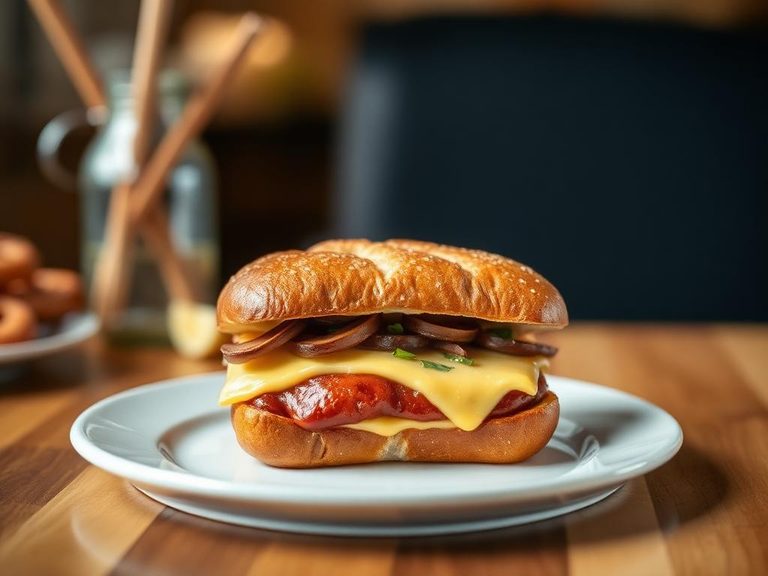
🍽️ Popular dishes



🌍 Where it's eaten
💡 Did you know?
The distinctive pretzel shape is thought to represent arms crossed in prayer, and the tradition of topping soft pretzels with cheese is a popular American innovation, especially in the Northeast and at sports venues.
Full nutrition (USDA data · scales with serving)
| Water | 19.3 g |
| Energy | 339 kcal |
| Protein | 10.2 g |
| Total lipid (fat) | 5.4 g |
| Carbohydrate, by difference | 62.4 g |
| Fiber, total dietary | 1.5 g |
| Total Sugars | 0.45 g |
| Calcium, Ca | 110 mg |
| Iron, Fe | 3.4 mg |
| Magnesium, Mg | 22.0 mg |
| Phosphorus, P | 138 mg |
| Potassium, K | 92.0 mg |
| Sodium, Na | 310 mg |
| Zinc, Zn | 1.3 mg |
| Copper, Cu | 0.11 mg |
| Selenium, Se | 18.4 ug |
| Vitamin C, total ascorbic acid | 0.00 mg |
| Thiamin | 0.36 mg |
| Riboflavin | 0.30 mg |
| Niacin | 3.7 mg |
| Vitamin B-6 | 0.03 mg |
| Folate, total | 24.0 ug |
| Folic acid | 0.00 ug |
| Folate, food | 24.0 ug |
| Folate, DFE | 24.0 ug |
| Choline, total | 17.1 mg |
| Vitamin B-12 | 0.20 ug |
| Vitamin B-12, added | 0.00 ug |
| Vitamin A, RAE | 26.0 ug |
| Retinol | 26.0 ug |
| Carotene, beta | 0.00 ug |
| Carotene, alpha | 0.00 ug |
| Cryptoxanthin, beta | 0.00 ug |
| Lycopene | 0.00 ug |
| Lutein + zeaxanthin | 15.0 ug |
| Vitamin E (alpha-tocopherol) | 0.54 mg |
| Vitamin E, added | 0.00 mg |
| Vitamin D (D2 + D3) | 0.10 ug |
| Vitamin K (phylloquinone) | 2.5 ug |
| Alcohol, ethyl | 0.00 g |
| Caffeine | 0.00 mg |
| Theobromine | 0.00 mg |
Fat & fatty acid profile (per 100g)
| Fatty acids, total saturated | 2.1 g |
| SFA 4:0 | 0.05 g |
| SFA 6:0 | 0.04 g |
| SFA 8:0 | 0.03 g |
| SFA 10:0 | 0.07 g |
| SFA 12:0 | 0.08 g |
| SFA 14:0 | 0.25 g |
| SFA 16:0 | 1.1 g |
| SFA 18:0 | 0.47 g |
| Fatty acids, total monounsaturated | 1.5 g |
| MUFA 16:1 | 0.04 g |
| MUFA 18:1 | 1.5 g |
| MUFA 20:1 | 0.01 g |
| MUFA 22:1 | 0.00 g |
| Fatty acids, total polyunsaturated | 0.92 g |
| PUFA 18:2 | 0.87 g |
| PUFA 18:3 | 0.06 g |
| PUFA 18:4 | 0.00 g |
| PUFA 20:4 | 0.00 g |
| PUFA 20:5 n-3 (EPA) | 0.00 g |
| PUFA 22:5 n-3 (DPA) | 0.00 g |
| PUFA 22:6 n-3 (DHA) | 0.00 g |
| Cholesterol | 8.0 mg |
Amino acid profile (per 100g)
Estimated from Snacks, pretzels, hard, confectioner's coating, chocolate-flavor — USDA does not publish this profile for Pretzels.
| Tryptophan | 0.10 g |
| Threonine | 0.25 g |
| Isoleucine | 0.29 g |
| Leucine | 0.53 g |
| Lysine | 0.25 g |
| Methionine | 0.13 g |
| Cystine | 0.15 g |
| Phenylalanine | 0.36 g |
| Tyrosine | 0.23 g |
| Valine | 0.33 g |
| Arginine | 0.31 g |
| Histidine | 0.16 g |
| Alanine | 0.27 g |
| Aspartic acid | 0.42 g |
| Glutamic acid | 2.2 g |
| Glycine | 0.27 g |
| Proline | 0.74 g |
| Serine | 0.36 g |
FAQ
Is this a good post-workout snack?
It can be, as the carbohydrates help replenish glycogen stores and the protein aids muscle recovery. However, its high sodium and fat content from the cheese make it less ideal than a leaner option like chocolate milk or a protein shake.
How does the nutrition change if I remove some cheese?
Removing the cheese topping will significantly reduce the fat, sodium, and calorie content, while also lowering the protein. The pretzel itself would then be a simpler, high-carb, lower-protein snack.
Are soft pretzels from frozen as good as fresh?
High-quality frozen dough can yield a product very close to fresh-baked, with a similar soft texture and flavor. The key is proper baking to achieve a crisp exterior and a fully cooked, fluffy interior.
Nutrient density (calculated · NRF9.3)
Nutrient Rich Foods index: beneficial nutrients (protein, fiber, vitamins, minerals) minus saturated fat, added sugar & sodium, per 100 kcal.
NRF9.3 index — Fulgoni, Keast & Drewnowski, 2009. Computed from USDA nutrients.
Weight-loss friendliness (composite index)
Energy density 3.39 kcal/g · 12% calories from protein · 1.5 g fiber · 0.5 g sugar per 100 g.
Composite of energy density (Rolls et al., 1999), protein & fiber satiety, minus sugar. A calculated heuristic — ranks satiety-per-calorie, not a clinical measure.
Dietary load (calculated from USDA values)
Potential renal acid load. Positive = acid-forming, negative = alkaline-forming.
Sodium-to-potassium ratio: 3.37 (lower is better — aim for ≤ 1)
Sodium:potassium per WHO potassium guidance. Computed from USDA nutrients.