

Potsticker or wonton, pork and vegetable, frozen, unprepared
Whole food · Meals, Entrees, and Side Dishes

Photo: Wikipedia
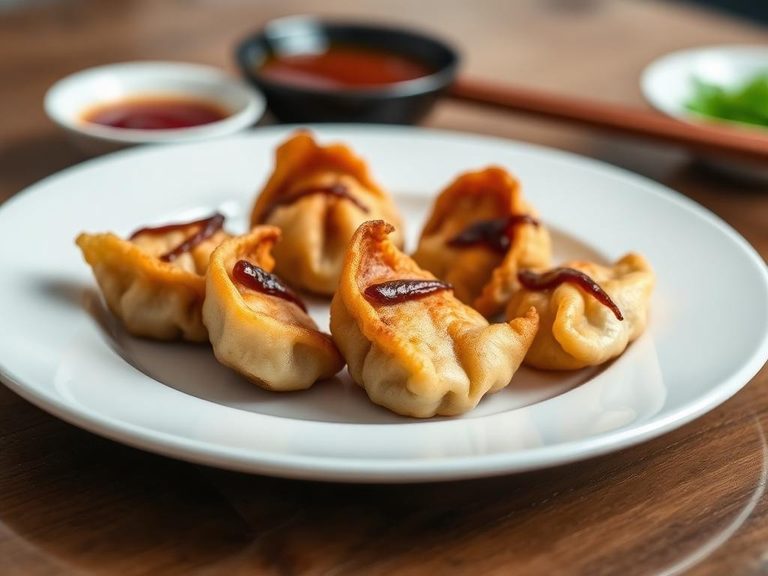
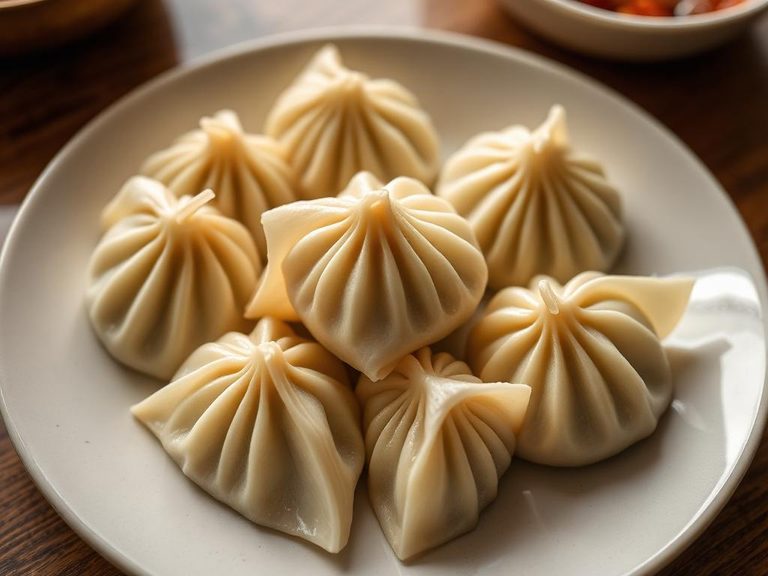
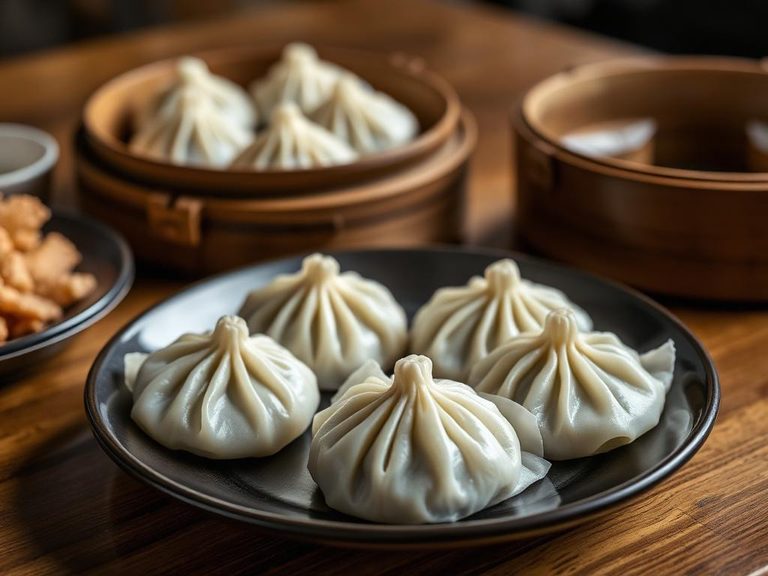
A frozen, uncooked dumpling with a thin, pleated wheat wrapper encasing a savory filling of minced pork and finely chopped vegetables like cabbage or chives. When cooked, the wrapper becomes tender or delightfully crispy if pan-fried, while the filling releases a juicy, umami-rich broth. Nutritionally, it's a balanced, protein-rich bite with moderate calories, making it a satisfying meal component.
Calorie split: 24% protein · 39% carbs · 37% fat
↓ Full nutrition💚 Why it's loved
People adore them for the perfect contrast of textures—a crisp or chewy wrapper giving way to a juicy, savory pork and vegetable filling. They are a beloved comfort food, deeply embedded in East Asian culinary traditions, and serve as a communal, shareable dish that's both hearty and satisfying.
⚠️ Watch-outs & how to enjoy it better
The frozen, uncooked versions can be high in sodium for flavor preservation, and the refined flour wrapper may cause blood-sugar spikes. To counteract this, pair with a fiber-rich vegetable stir-fry or a side of leafy greens, and consider a dipping sauce with vinegar or chili to add flavor without excess salt. Those with gluten sensitivities should avoid the wrapper entirely.
Key benefits
- Good source of complete protein from pork
- Provides quick energy from carbohydrate-rich wrapper
- Contains dietary fiber from vegetable filling
- Convenient, portion-controlled frozen meal option
- Versatile cooking methods: boil, steam, pan-fry
🍽️ Popular dishes
🌍 Where it's eaten
💡 Did you know?
The name 'potsticker' comes from the Chinese cooking method where dumplings are first fried in a pan, then steamed with water, and finally fried again, causing some to stick to the pot and develop a coveted crispy 'skirt' or bottom.
Full nutrition (USDA data · scales with serving)
| Water | 70.9 g |
| Energy | 136 kcal |
| Energy | 568 kj |
| Protein | 8.3 g |
| Total lipid (fat) | 5.5 g |
| Ash | 2.0 g |
| Carbohydrate, by difference | 13.3 g |
| Fiber, total dietary | 1.4 g |
| Total Sugars | 2.8 g |
| Calcium, Ca | 28.0 mg |
| Iron, Fe | 0.74 mg |
| Magnesium, Mg | 21.0 mg |
| Phosphorus, P | 127 mg |
| Potassium, K | 284 mg |
| Sodium, Na | 441 mg |
| Zinc, Zn | 1.7 mg |
| Copper, Cu | 0.03 mg |
| Selenium, Se | 17.7 ug |
| Vitamin C, total ascorbic acid | 8.3 mg |
| Thiamin | 0.37 mg |
| Riboflavin | 0.13 mg |
| Niacin | 2.2 mg |
| Pantothenic acid | 0.34 mg |
| Vitamin B-6 | 0.25 mg |
| Folate, total | 18.0 ug |
| Folic acid | 0.00 ug |
| Folate, food | 18.0 ug |
| Folate, DFE | 18.0 ug |
| Choline, total | 52.4 mg |
| Vitamin B-12 | 0.26 ug |
| Vitamin B-12, added | 0.00 ug |
| Vitamin A, RAE | 5.0 ug |
| Retinol | 1.0 ug |
| Carotene, beta | 45.0 ug |
| Carotene, alpha | 0.00 ug |
| Cryptoxanthin, beta | 0.00 ug |
| Vitamin A, IU | 78.0 iu |
| Lycopene | 0.00 ug |
| Lutein + zeaxanthin | 21.0 ug |
| Vitamin E (alpha-tocopherol) | 0.25 mg |
| Vitamin E, added | 0.00 mg |
| Vitamin D (D2 + D3), International Units | 10.0 iu |
| Vitamin D (D2 + D3) | 0.20 ug |
| Vitamin K (phylloquinone) | 55.0 ug |
| Alcohol, ethyl | 0.00 g |
| Caffeine | 0.00 mg |
| Theobromine | 0.00 mg |
Fat & fatty acid profile (per 100g)
| Fatty acids, total saturated | 1.7 g |
| SFA 4:0 | 0.00 g |
| SFA 6:0 | 0.00 g |
| SFA 8:0 | 0.00 g |
| SFA 10:0 | 0.01 g |
| SFA 12:0 | 0.00 g |
| SFA 13:0 | 0.00 g |
| SFA 14:0 | 0.07 g |
| SFA 15:0 | 0.00 g |
| SFA 16:0 | 1.0 g |
| SFA 17:0 | 0.00 g |
| SFA 18:0 | 0.55 g |
| SFA 20:0 | 0.00 g |
| SFA 22:0 | 0.00 g |
| SFA 24:0 | 0.00 g |
| Fatty acids, total monounsaturated | 2.5 g |
| MUFA 14:1 | 0.00 g |
| MUFA 15:1 | 0.00 g |
| MUFA 16:1 | 0.17 g |
| MUFA 17:1 | 0.00 g |
| MUFA 18:1 | 2.3 g |
| MUFA 20:1 | 0.04 g |
| MUFA 22:1 | 0.00 g |
| MUFA 24:1 c | 0.00 g |
| Fatty acids, total polyunsaturated | 0.78 g |
| PUFA 18:2 | 0.68 g |
| PUFA 18:3 | 0.06 g |
| PUFA 18:4 | 0.00 g |
| PUFA 20:2 n-6 c,c | 0.00 g |
| PUFA 20:3 | 0.00 g |
| PUFA 20:4 | 0.02 g |
| PUFA 20:5 n-3 (EPA) | 0.00 g |
| PUFA 22:4 | 0.00 g |
| PUFA 22:5 n-3 (DPA) | 0.00 g |
| PUFA 22:6 n-3 (DHA) | 0.00 g |
| Fatty acids, total trans | 0.00 g |
| Cholesterol | 17.0 mg |
FAQ
What's the difference between a potsticker and a wonton?
Potstickers are a type of Chinese dumpling with a thicker, pleated wrapper and are typically larger. Wontons have a thinner, smoother wrapper, are often smaller, and are most commonly boiled in soup, though they can also be fried.
How do I cook frozen potstickers from uncooked?
For pan-frying: heat oil in a skillet, add frozen dumplings, fry until bottoms are golden, then add a splash of water, cover, and steam until water evaporates. For boiling: drop into boiling water, stir gently, and cook until they float and the wrapper is translucent.
Can I eat the filling raw?
No. The raw pork filling must be cooked thoroughly to an internal temperature of 160°F (71°C) to ensure food safety. Always cook frozen, uncooked dumplings completely before eating.
Nutrient density (calculated · NRF9.3)
Nutrient Rich Foods index: beneficial nutrients (protein, fiber, vitamins, minerals) minus saturated fat, added sugar & sodium, per 100 kcal.
NRF9.3 index — Fulgoni, Keast & Drewnowski, 2009. Computed from USDA nutrients.
Weight-loss friendliness (composite index)
Energy density 1.36 kcal/g · 24% calories from protein · 1.4 g fiber · 2.8 g sugar per 100 g.
Composite of energy density (Rolls et al., 1999), protein & fiber satiety, minus sugar. A calculated heuristic — ranks satiety-per-calorie, not a clinical measure.
Dietary load (calculated from USDA values)
Potential renal acid load. Positive = acid-forming, negative = alkaline-forming.
Sodium-to-potassium ratio: 1.55 (lower is better — aim for ≤ 1)
Sodium:potassium per WHO potassium guidance. Computed from USDA nutrients.