

Potato chips, ruffled, other flavored
Common food

Photo: Wikipedia
Ruffled potato chips are a thicker, ridged version of the classic crisp, designed for a more substantial crunch and better at holding onto bold seasonings. Their texture is a key feature, offering a sturdier bite that contrasts with the delicate snap of a standard chip. Nutritionally, they are a dense source of energy, primarily from carbohydrates and fats.
Calorie split: 5% protein · 42% carbs · 53% fat
↓ Full nutrition💚 Why it's loved
People are drawn to the satisfying, audible crunch and the way the ridges trap and intensify the flavor of seasonings. They are a beloved comfort food and a staple for casual gatherings, movie nights, and as a crunchy side to sandwiches.
⚠️ Watch-outs & how to enjoy it better
As a fried snack, they are high in calories and fats, which can contribute to weight gain if consumed excessively. The refined carbohydrates can cause rapid blood-sugar spikes, and they are often high in sodium. To counteract this, practice strict portion control (e.g., a single serving from a small bag), pair them with a protein-rich food like hummus or cheese to slow digestion, and choose lower-sodium varieties when available.
Key benefits
- Provides a quick source of energy from carbohydrates.
- Contains some dietary fiber from the potato.
- Offers a small amount of plant-based protein.
- The ridged texture can make them feel more satisfying than thinner chips.
- A convenient, shelf-stable snack for on-the-go consumption.
🍽️ Popular dishes

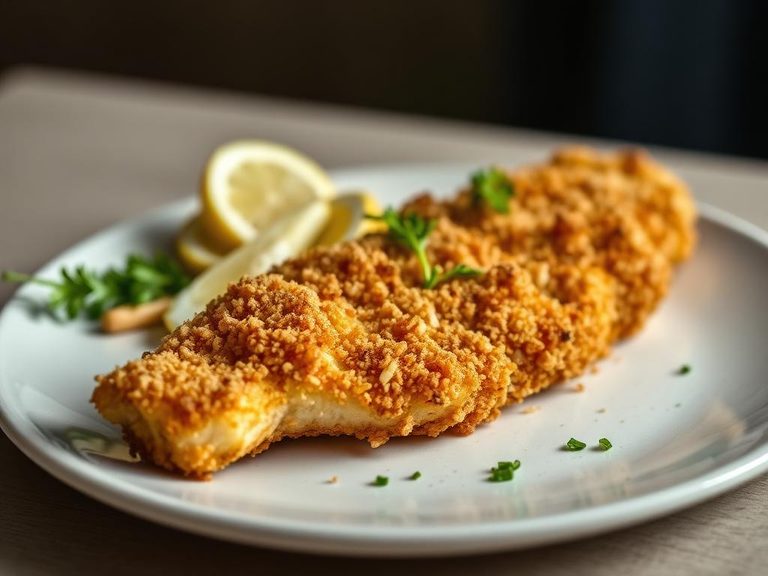
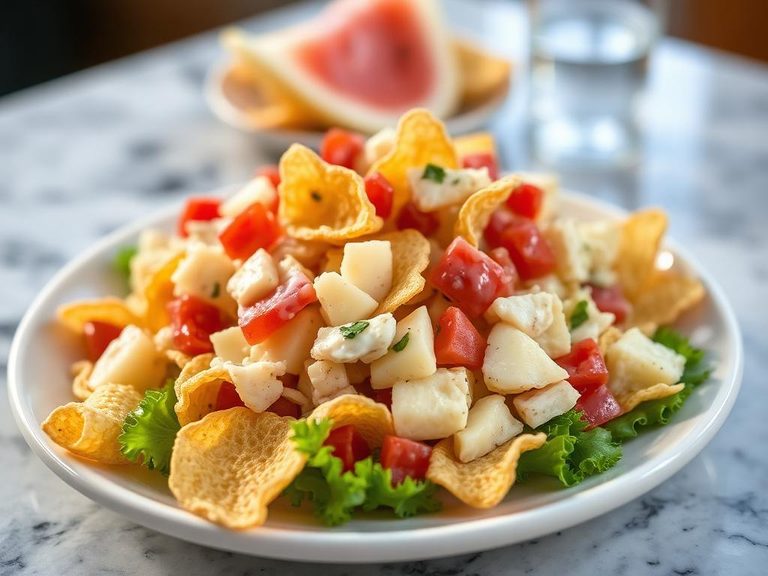
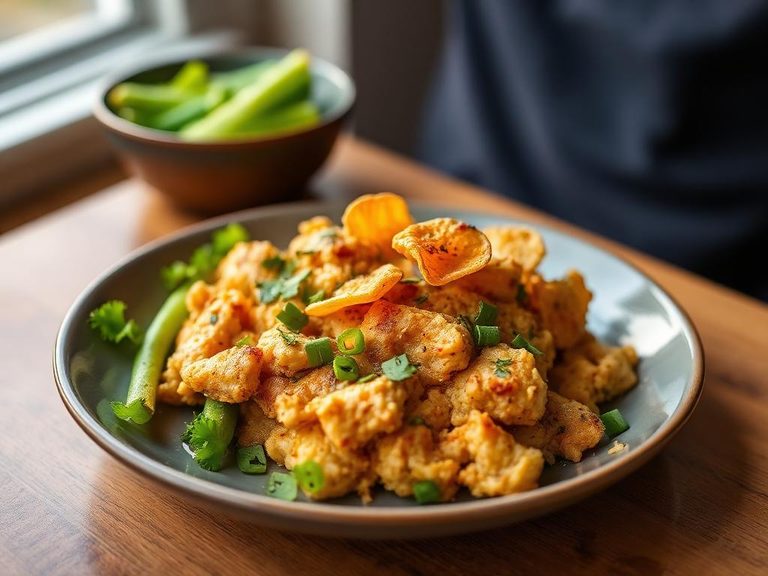

🌍 Where it's eaten
💡 Did you know?
The ruffled or ridged design was popularized by the brand Wise Foods in the 1950s, specifically engineered to be stronger and less prone to breaking in the bag than a flat chip.
Full nutrition (USDA data · scales with serving)
| Water | 2.5 g |
| Energy | 487 kcal |
| Protein | 6.5 g |
| Total lipid (fat) | 31.1 g |
| Carbohydrate, by difference | 55.9 g |
| Fiber, total dietary | 3.8 g |
| Total Sugars | 5.5 g |
| Calcium, Ca | 32.0 mg |
| Iron, Fe | 1.4 mg |
| Magnesium, Mg | 58.0 mg |
| Phosphorus, P | 145 mg |
| Potassium, K | 1186 mg |
| Sodium, Na | 545 mg |
| Zinc, Zn | 0.98 mg |
| Copper, Cu | 0.25 mg |
| Selenium, Se | 0.40 ug |
| Vitamin C, total ascorbic acid | 62.4 mg |
| Thiamin | 0.22 mg |
| Riboflavin | 0.12 mg |
| Niacin | 5.0 mg |
| Vitamin B-6 | 0.38 mg |
| Folate, total | 64.0 ug |
| Folic acid | 0.00 ug |
| Folate, food | 64.0 ug |
| Folate, DFE | 64.0 ug |
| Choline, total | 11.5 mg |
| Vitamin B-12 | 0.00 ug |
| Vitamin B-12, added | 0.00 ug |
| Vitamin A, RAE | 20.0 ug |
| Retinol | 0.00 ug |
| Carotene, beta | 203 ug |
| Carotene, alpha | 5.0 ug |
| Cryptoxanthin, beta | 60.0 ug |
| Lycopene | 130 ug |
| Lutein + zeaxanthin | 151 ug |
| Vitamin E (alpha-tocopherol) | 4.4 mg |
| Vitamin E, added | 0.00 mg |
| Vitamin D (D2 + D3) | 0.00 ug |
| Vitamin K (phylloquinone) | 16.1 ug |
| Alcohol, ethyl | 0.00 g |
| Caffeine | 0.00 mg |
| Theobromine | 0.00 mg |
Fat & fatty acid profile (per 100g)
| Fatty acids, total saturated | 4.0 g |
| SFA 4:0 | 0.00 g |
| SFA 6:0 | 0.00 g |
| SFA 8:0 | 0.01 g |
| SFA 10:0 | 0.01 g |
| SFA 12:0 | 0.00 g |
| SFA 14:0 | 0.05 g |
| SFA 16:0 | 2.8 g |
| SFA 18:0 | 0.80 g |
| Fatty acids, total monounsaturated | 13.2 g |
| MUFA 16:1 | 0.05 g |
| MUFA 18:1 | 13.0 g |
| MUFA 20:1 | 0.12 g |
| MUFA 22:1 | 0.00 g |
| Fatty acids, total polyunsaturated | 12.2 g |
| PUFA 18:2 | 11.9 g |
| PUFA 18:3 | 0.30 g |
| PUFA 18:4 | 0.01 g |
| PUFA 20:4 | 0.01 g |
| PUFA 20:5 n-3 (EPA) | 0.00 g |
| PUFA 22:5 n-3 (DPA) | 0.00 g |
| PUFA 22:6 n-3 (DHA) | 0.00 g |
| Cholesterol | 0.00 mg |
Amino acid profile (per 100g)
Estimated from Snacks, potato chips, made from dried potatoes, sour-cream and onion-flavor — USDA does not publish this profile for Potato chips.
| Tryptophan | 0.07 g |
| Threonine | 0.28 g |
| Isoleucine | 0.31 g |
| Leucine | 0.48 g |
| Lysine | 0.44 g |
| Methionine | 0.10 g |
| Cystine | 0.08 g |
| Phenylalanine | 0.29 g |
| Tyrosine | 0.25 g |
| Valine | 0.38 g |
| Arginine | 0.31 g |
| Histidine | 0.15 g |
| Alanine | 0.25 g |
| Aspartic acid | 0.93 g |
| Glutamic acid | 1.1 g |
| Glycine | 0.21 g |
| Proline | 0.37 g |
| Serine | 0.29 g |
FAQ
Why are ruffled chips often thicker than regular chips?
The increased thickness and ridges are designed for structural integrity. They resist breaking during packaging and shipping, and the ridges provide a more robust crunch and a larger surface area for holding seasonings.
Do ruffled chips have more calories than flat chips?
Not necessarily per gram, but because they are often thicker, a single ruffled chip may contain slightly more calories than a single flat chip. The primary factor is the overall serving size and the specific brand's recipe.
Are the ridges made from a different part of the potato?
No, the entire chip is sliced from the same potato. The ridges are created by using a corrugated blade during the slicing process, which cuts the potato into a wavy shape before frying.
Nutrient density (calculated · NRF9.3)
Nutrient Rich Foods index: beneficial nutrients (protein, fiber, vitamins, minerals) minus saturated fat, added sugar & sodium, per 100 kcal.
NRF9.3 index — Fulgoni, Keast & Drewnowski, 2009. Computed from USDA nutrients.
Weight-loss friendliness (composite index)
Energy density 4.87 kcal/g · 5% calories from protein · 3.8 g fiber · 5.5 g sugar per 100 g.
Composite of energy density (Rolls et al., 1999), protein & fiber satiety, minus sugar. A calculated heuristic — ranks satiety-per-calorie, not a clinical measure.
Dietary load (calculated from USDA values)
Potential renal acid load. Positive = acid-forming, negative = alkaline-forming.
Sodium-to-potassium ratio: 0.46 (lower is better — aim for ≤ 1)
Sodium:potassium per WHO potassium guidance. Computed from USDA nutrients.