

Peppers, poblano, seeded, raw
Whole food · Vegetables and Vegetable Products
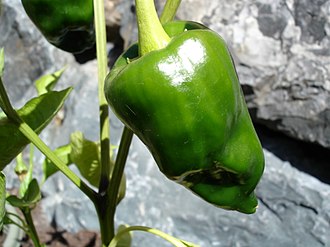
Photo: Wikipedia
The poblano is a mild, heart-shaped pepper with a deep, earthy flavor and a thick, meaty texture that holds up beautifully to heat. When raw, it offers a crisp, slightly grassy bite with a gentle, smoky undertone. Nutritionally, it's a low-calorie powerhouse, delivering a solid 2 grams of fiber per 100g with virtually no fat or sugar.
Calorie split: 20% protein · 73% carbs · 6% fat
↓ Full nutrition💚 Why it's loved
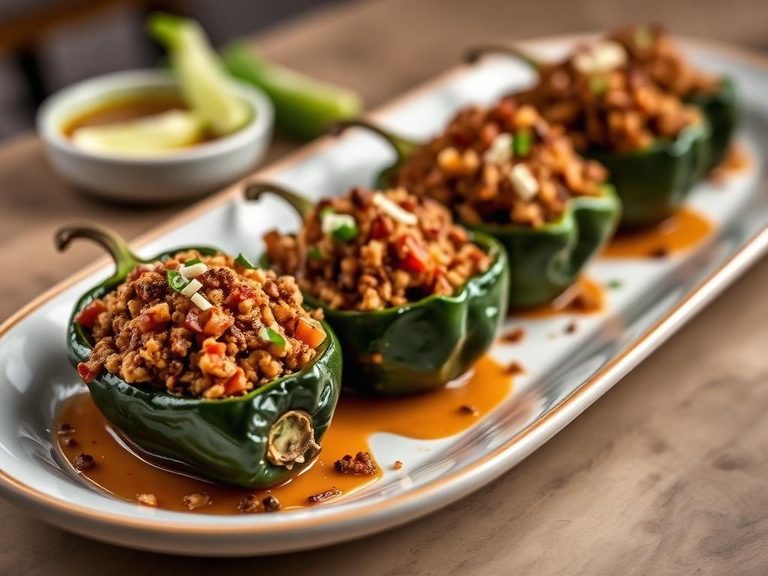
People adore the poblano for its complex, rich flavor that's more nuanced than a bell pepper but won't overwhelm with heat. Its thick walls make it the perfect vessel for stuffing, and it's the star of iconic dishes like chiles rellenos, beloved in Mexican cuisine.
⚠️ Watch-outs & how to enjoy it better
While mild, the skin can be tough and slightly bitter when raw, which some find unpleasant. To counteract this, you can roast and peel the skin to unlock a sweeter, smokier flavor, or simply slice it very thinly for salads to improve texture. Those with sensitive stomachs should be cautious, as the capsaicin can cause mild irritation; pairing it with a creamy element like cheese or avocado can help.
Key benefits
- High in fiber for digestive health
- Very low in calories and fat
- Excellent source of vitamin C
- Contains capsaicin, which may support metabolism
- Provides antioxidants like carotenoids
🍽️ Popular dishes
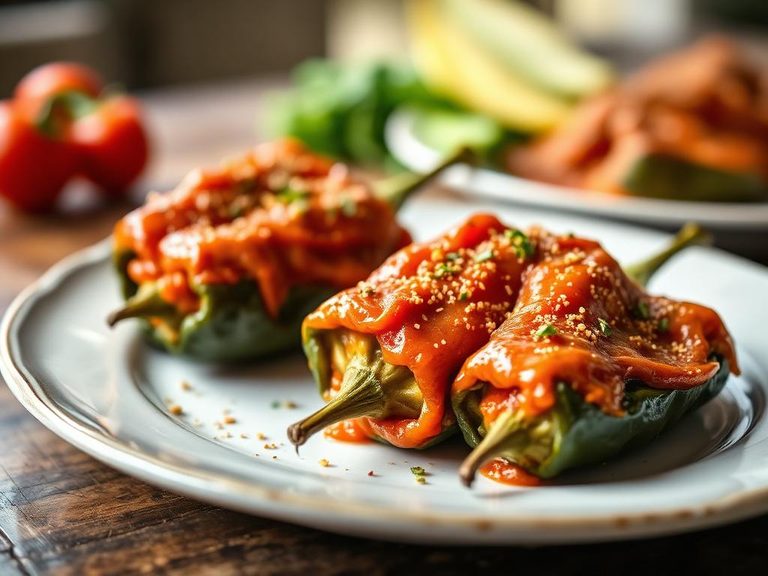
🌍 Where it's eaten
💡 Did you know?
The name 'poblano' comes from the Spanish word for 'people from Puebla,' the Mexican state where this pepper is believed to have originated.
Full nutrition (USDA data · scales with serving)
| Water | 92.8 g |
| Energy (Atwater General Factors) | 28.0 kcal |
| Nitrogen | 0.23 g |
| Protein | 1.4 g |
| Total lipid (fat) | 0.19 g |
| Ash | 0.41 g |
| Carbohydrate, by difference | 5.1 g |
| Fiber, total dietary | 2.1 g |
| Sugars, Total | 2.7 g |
| Sucrose | 0.00 g |
| Glucose | 1.6 g |
| Fructose | 1.1 g |
| Lactose | 0.00 g |
| Maltose | 0.00 g |
| Calcium, Ca | 8.4 mg |
| Iron, Fe | 0.12 mg |
| Magnesium, Mg | 10.7 mg |
| Phosphorus, P | 22.4 mg |
| Potassium, K | 192 mg |
| Sodium, Na | 0.00 mg |
| Zinc, Zn | 0.13 mg |
| Copper, Cu | 0.06 mg |
| Manganese, Mn | 0.15 mg |
| Vitamin C, total ascorbic acid | 128 mg |
| Niacin | 0.65 mg |
| Vitamin B-6 | 0.31 mg |
| Biotin | 1.4 ug |
| Folate, total | 26.1 ug |
Fat & fatty acid profile (per 100g)
Estimated from Peppers, hot chili, green, canned, pods, excluding seeds, solids and liquids — USDA does not publish this profile for Peppers.
| Fatty acids, total saturated | 0.01 g |
| SFA 4:0 | 0.00 g |
| SFA 6:0 | 0.00 g |
| SFA 8:0 | 0.00 g |
| SFA 10:0 | 0.00 g |
| SFA 12:0 | 0.00 g |
| SFA 14:0 | 0.00 g |
| SFA 16:0 | 0.01 g |
| SFA 18:0 | 0.00 g |
| Fatty acids, total monounsaturated | 0.01 g |
| MUFA 16:1 | 0.00 g |
| MUFA 18:1 | 0.01 g |
| MUFA 20:1 | 0.00 g |
| MUFA 22:1 | 0.00 g |
| Fatty acids, total polyunsaturated | 0.06 g |
| PUFA 18:2 | 0.05 g |
| PUFA 18:3 | 0.00 g |
| PUFA 18:4 | 0.00 g |
| PUFA 20:4 | 0.00 g |
| PUFA 20:5 n-3 (EPA) | 0.00 g |
| PUFA 22:5 n-3 (DPA) | 0.00 g |
| PUFA 22:6 n-3 (DHA) | 0.00 g |
| Fatty acids, total trans | 0.00 g |
| Cholesterol | 0.00 mg |
Amino acid profile (per 100g)
Estimated from Peppers, hot chili, green, canned, pods, excluding seeds, solids and liquids — USDA does not publish this profile for Peppers.
| Tryptophan | 0.01 g |
| Threonine | 0.03 g |
| Isoleucine | 0.03 g |
| Leucine | 0.05 g |
| Lysine | 0.04 g |
| Methionine | 0.01 g |
| Cystine | 0.02 g |
| Phenylalanine | 0.03 g |
| Tyrosine | 0.02 g |
| Valine | 0.04 g |
| Arginine | 0.04 g |
| Histidine | 0.02 g |
| Alanine | 0.04 g |
| Aspartic acid | 0.13 g |
| Glutamic acid | 0.12 g |
| Glycine | 0.03 g |
| Proline | 0.04 g |
| Serine | 0.04 g |
FAQ
How spicy is a poblano pepper?
Poblanos are generally mild, with a Scoville Heat Unit (SHU) range of 1,000 to 2,000. For comparison, a jalapeño is 2,500 to 8,000 SHU. The heat is gentle and often described as a warm, smoky tingle rather than a burn.
What's the difference between a poblano and an ancho pepper?
They are the same pepper! A poblano is the fresh, green version. When it's dried, it becomes an ancho chile, which has a sweeter, raisin-like flavor and is used in many mole sauces.
How do I remove the skin from a poblano?
The easiest method is to roast it. Place the whole pepper under a broiler, on a grill, or over a gas flame until the skin is charred and blistered. Then, place it in a bowl, cover with plastic wrap, and let it steam for 10-15 minutes. The skin will then peel off easily.
Nutrient density (calculated · NRF9.3)
Nutrient Rich Foods index: beneficial nutrients (protein, fiber, vitamins, minerals) minus saturated fat, added sugar & sodium, per 100 kcal.
NRF9.3 index — Fulgoni, Keast & Drewnowski, 2009. Computed from USDA nutrients.
Weight-loss friendliness (composite index)
Energy density 0.28 kcal/g · 20% calories from protein · 2.1 g fiber · 0.0 g sugar per 100 g.
Composite of energy density (Rolls et al., 1999), protein & fiber satiety, minus sugar. A calculated heuristic — ranks satiety-per-calorie, not a clinical measure.
Dietary load (calculated from USDA values)
Potential renal acid load. Positive = acid-forming, negative = alkaline-forming.
Sodium-to-potassium ratio: 0.00 (lower is better — aim for ≤ 1)
Sodium:potassium per WHO potassium guidance. Computed from USDA nutrients.