

Pate, goose liver, smoked, canned
Whole food · Sausages and Luncheon Meats

Photo: Wikipedia
Smoked goose liver pâté is a luxuriously rich, velvety spread with a deep, savory flavor and a hint of smokiness. Its texture is smooth and dense, often with a subtle, creamy mouthfeel that melts on the tongue. Nutritionally, it is a calorie-dense powerhouse, providing over 43 grams of fat per 100 grams, making it a high-energy, indulgent food.
Calorie split: 10% protein · 4% carbs · 86% fat
↓ Full nutrition💚 Why it's loved
People adore it for its intense, complex flavor—a blend of earthy, smoky, and umami notes that feels deeply satisfying. It is also cherished for its versatility, serving as a luxurious appetizer on toast, a filling for pastries, or a sophisticated addition to charcuterie boards.
⚠️ Watch-outs & how to enjoy it better
Its extremely high fat and calorie content can be a concern for those monitoring weight or cholesterol levels. To counteract this, practice strict portion control (e.g., a thin slice) and pair it with fiber-rich accompaniments like whole-grain bread or a crisp green salad to slow fat absorption and add volume.
Key benefits
- Exceptionally high in vitamin A, supporting vision and immune function.
- Rich in iron and B vitamins, particularly B12, essential for energy and nerve health.
- Provides a concentrated source of high-quality protein for muscle maintenance.
- Contains healthy monounsaturated fats, which can support heart health in moderation.
🍽️ Popular dishes
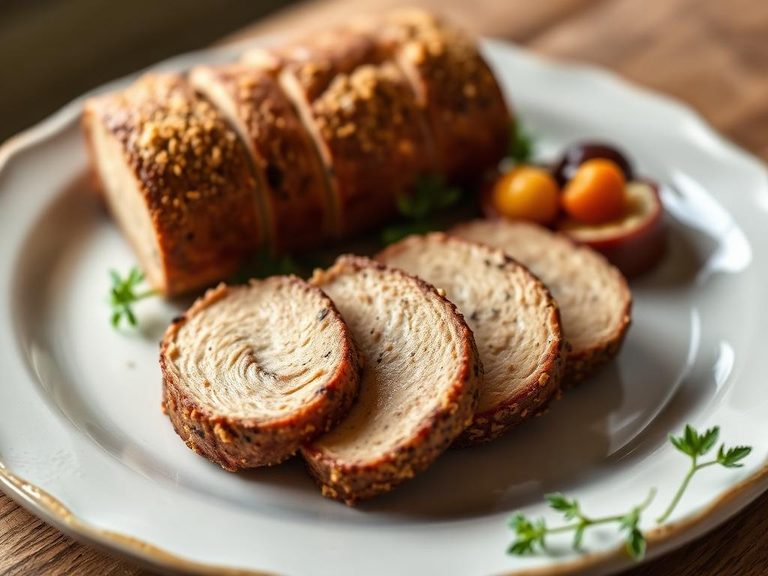
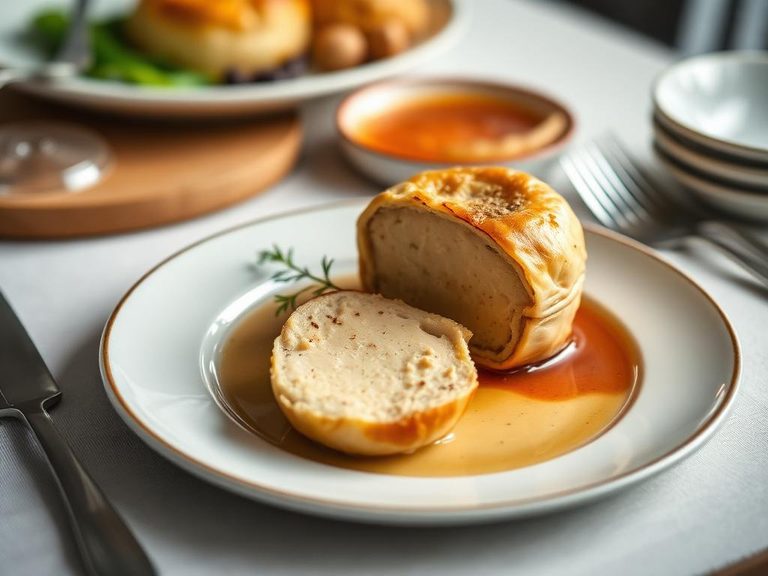

🌍 Where it's eaten
💡 Did you know?
Goose liver pâté's rich, buttery texture comes from the high fat content of the liver, which is often achieved through a process called 'gavage' (force-feeding), a practice that has been both a culinary tradition and a subject of ethical debate for centuries.
Full nutrition (USDA data · scales with serving)
| Water | 37.0 g |
| Energy | 462 kcal |
| Energy | 1933 kj |
| Protein | 11.4 g |
| Total lipid (fat) | 43.8 g |
| Ash | 3.0 g |
| Carbohydrate, by difference | 4.7 g |
| Fiber, total dietary | 0.00 g |
| Calcium, Ca | 70.0 mg |
| Iron, Fe | 5.5 mg |
| Magnesium, Mg | 13.0 mg |
| Phosphorus, P | 200 mg |
| Potassium, K | 138 mg |
| Sodium, Na | 697 mg |
| Zinc, Zn | 0.92 mg |
| Copper, Cu | 0.40 mg |
| Manganese, Mn | 0.12 mg |
| Selenium, Se | 44.0 ug |
| Vitamin C, total ascorbic acid | 0.00 mg |
| Thiamin | 0.09 mg |
| Riboflavin | 0.30 mg |
| Niacin | 2.5 mg |
| Pantothenic acid | 1.2 mg |
| Vitamin B-6 | 0.06 mg |
| Folate, total | 60.0 ug |
| Folic acid | 0.00 ug |
| Folate, food | 60.0 ug |
| Folate, DFE | 60.0 ug |
| Vitamin B-12 | 9.4 ug |
| Vitamin A, RAE | 1001 ug |
| Retinol | 1001 ug |
| Vitamin A, IU | 3333 iu |
Fat & fatty acid profile (per 100g)
| Fatty acids, total saturated | 14.4 g |
| SFA 4:0 | 0.00 g |
| SFA 6:0 | 0.00 g |
| SFA 8:0 | 0.00 g |
| SFA 10:0 | 0.00 g |
| SFA 12:0 | 0.03 g |
| SFA 14:0 | 0.29 g |
| SFA 16:0 | 9.4 g |
| SFA 18:0 | 4.6 g |
| Fatty acids, total monounsaturated | 25.6 g |
| MUFA 16:1 | 1.4 g |
| MUFA 18:1 | 24.0 g |
| MUFA 20:1 | 0.13 g |
| MUFA 22:1 | 0.00 g |
| Fatty acids, total polyunsaturated | 0.84 g |
| PUFA 18:2 | 0.57 g |
| PUFA 18:3 | 0.01 g |
| PUFA 18:4 | 0.00 g |
| PUFA 20:4 | 0.25 g |
| PUFA 20:5 n-3 (EPA) | 0.00 g |
| PUFA 22:5 n-3 (DPA) | 0.00 g |
| PUFA 22:6 n-3 (DHA) | 0.00 g |
| Cholesterol | 150 mg |
| Phytosterols | 0.00 mg |
Amino acid profile (per 100g)
| Tryptophan | 0.16 g |
| Threonine | 0.51 g |
| Isoleucine | 0.61 g |
| Leucine | 1.0 g |
| Lysine | 0.86 g |
| Methionine | 0.27 g |
| Cystine | 0.15 g |
| Phenylalanine | 0.57 g |
| Tyrosine | 0.40 g |
| Valine | 0.72 g |
| Arginine | 0.70 g |
| Histidine | 0.30 g |
| Alanine | 0.66 g |
| Aspartic acid | 1.1 g |
| Glutamic acid | 1.5 g |
| Glycine | 0.66 g |
| Proline | 0.56 g |
| Serine | 0.49 g |
FAQ
Is smoked goose liver pâté the same as foie gras?
No, while both are made from fatty duck or goose liver, foie gras is typically fresh and unsmoked, often served as a whole lobe or terrine, whereas smoked pâté is processed, smoked, and canned for preservation and a distinct flavor profile.
How long does canned smoked goose liver pâté last after opening?
Once opened, it should be stored in an airtight container in the refrigerator and consumed within 3 to 5 days to maintain freshness and safety.
Can I eat this if I have high cholesterol?
Due to its very high fat content (43.84g per 100g), it is best consumed in very small portions and not regularly if you have high cholesterol. Consult a healthcare provider for personalized advice.
Nutrient density (calculated · NRF9.3)
Nutrient Rich Foods index: beneficial nutrients (protein, fiber, vitamins, minerals) minus saturated fat, added sugar & sodium, per 100 kcal.
NRF9.3 index — Fulgoni, Keast & Drewnowski, 2009. Computed from USDA nutrients.
Weight-loss friendliness (composite index)
Energy density 4.62 kcal/g · 10% calories from protein · 0.0 g fiber · 0.0 g sugar per 100 g.
Composite of energy density (Rolls et al., 1999), protein & fiber satiety, minus sugar. A calculated heuristic — ranks satiety-per-calorie, not a clinical measure.
Dietary load (calculated from USDA values)
Potential renal acid load. Positive = acid-forming, negative = alkaline-forming.
Sodium-to-potassium ratio: 5.05 (lower is better — aim for ≤ 1)
Sodium:potassium per WHO potassium guidance. Computed from USDA nutrients.