

Beef, chopped, cured, smoked
Whole food · Sausages and Luncheon Meats

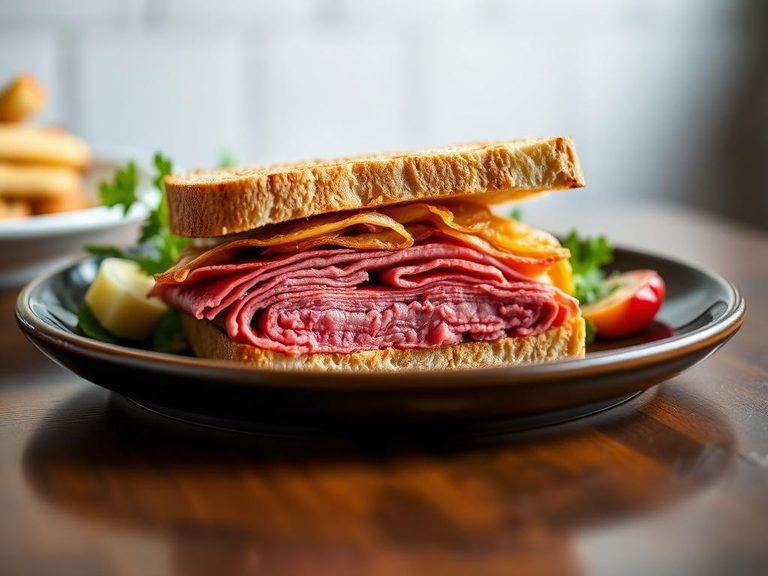
Photo: Wikipedia
This is beef that has been chopped, cured with salt and spices, and then smoked to develop a deep, savory flavor with a firm, slightly chewy texture. It's a lean, protein-packed powerhouse, offering over 20g of protein per 100g with minimal fat and carbs. The smoking process imparts a distinctive, rich aroma that makes it a favorite for adding instant depth to dishes.
Calorie split: 63% protein · 6% carbs · 31% fat
↓ Full nutrition💚 Why it's loved
People love it for its concentrated, smoky beef flavor and satisfying chew, which can elevate simple dishes. Its versatility makes it a staple in everything from breakfast scrambles to hearty stews and salads.
⚠️ Watch-outs & how to enjoy it better
The curing process means it is typically high in sodium, which can be a concern for those monitoring salt intake. It's also a processed meat, so moderation is advised. To counteract, pair it with potassium-rich foods like leafy greens or tomatoes, and use it as a flavor accent rather than the main protein source.
Key benefits
- Excellent source of high-quality protein for muscle maintenance.
- Very low in carbohydrates, suitable for low-carb diets.
- Provides essential minerals like zinc and iron.
- Long shelf life due to curing and smoking.
- Adds intense umami flavor without needing sauces.
🍽️ Popular dishes
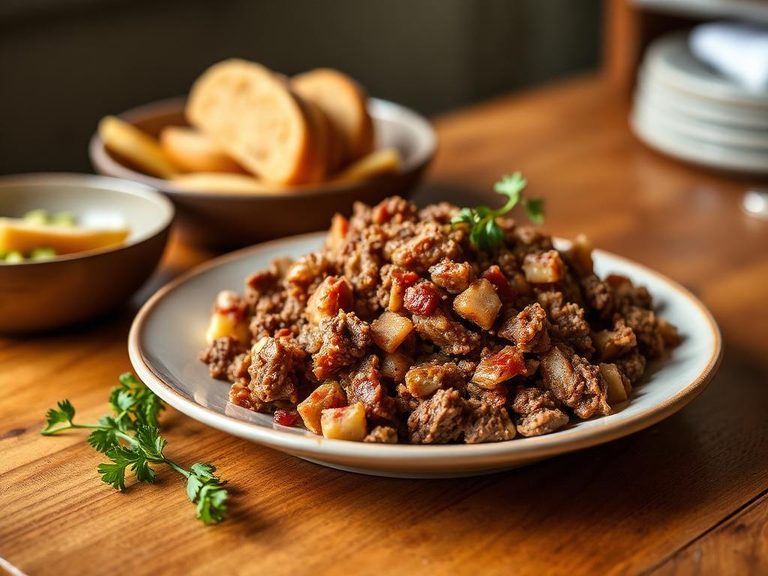
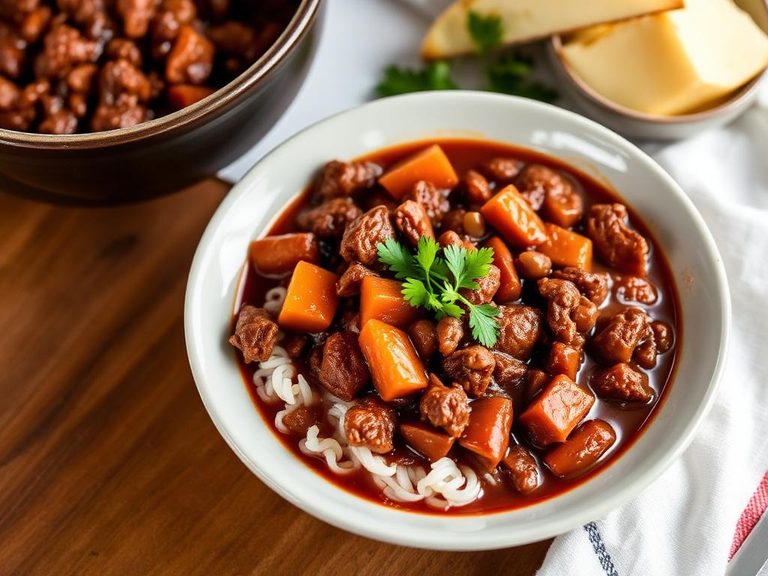
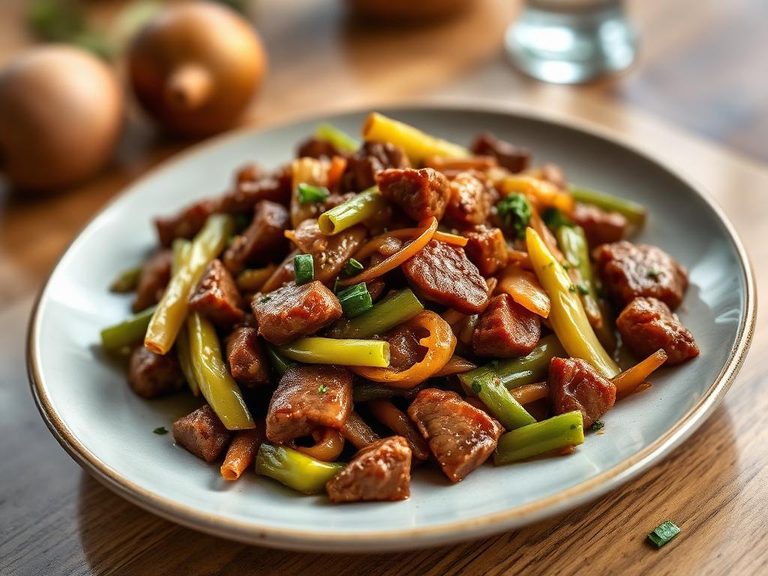

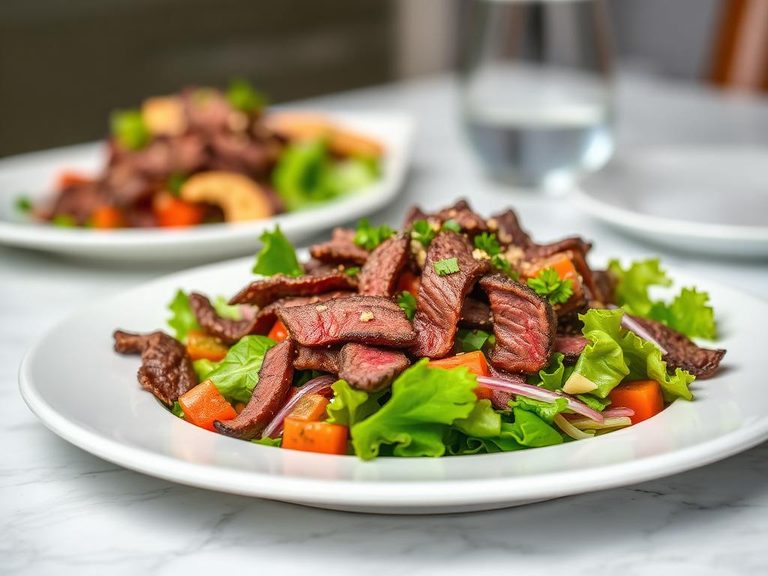
🌍 Where it's eaten
💡 Did you know?
The pink color in properly cured smoked beef comes from the reaction of myoglobin with nitric oxide from the curing salt, not from being undercooked.
Full nutrition (USDA data · scales with serving)
| Water | 68.9 g |
| Energy | 133 kcal |
| Energy | 556 kj |
| Protein | 20.2 g |
| Total lipid (fat) | 4.4 g |
| Ash | 4.6 g |
| Carbohydrate, by difference | 1.9 g |
| Fiber, total dietary | 0.00 g |
| Calcium, Ca | 8.0 mg |
| Iron, Fe | 2.9 mg |
| Magnesium, Mg | 21.0 mg |
| Phosphorus, P | 181 mg |
| Potassium, K | 377 mg |
| Sodium, Na | 1258 mg |
| Zinc, Zn | 3.9 mg |
| Copper, Cu | 0.03 mg |
| Manganese, Mn | 0.03 mg |
| Selenium, Se | 19.7 ug |
| Vitamin C, total ascorbic acid | 0.00 mg |
| Thiamin | 0.08 mg |
| Riboflavin | 0.17 mg |
| Niacin | 4.6 mg |
| Pantothenic acid | 0.59 mg |
| Vitamin B-6 | 0.35 mg |
| Folate, total | 8.0 ug |
| Folic acid | 0.00 ug |
| Folate, food | 8.0 ug |
| Folate, DFE | 8.0 ug |
| Vitamin B-12 | 1.7 ug |
| Vitamin A, RAE | 0.00 ug |
| Retinol | 0.00 ug |
| Vitamin A, IU | 0.00 iu |
Fat & fatty acid profile (per 100g)
| Fatty acids, total saturated | 1.8 g |
| SFA 4:0 | 0.00 g |
| SFA 6:0 | 0.00 g |
| SFA 8:0 | 0.00 g |
| SFA 10:0 | 0.02 g |
| SFA 12:0 | 0.02 g |
| SFA 14:0 | 0.11 g |
| SFA 16:0 | 0.94 g |
| SFA 18:0 | 0.66 g |
| Fatty acids, total monounsaturated | 1.8 g |
| MUFA 16:1 | 0.26 g |
| MUFA 18:1 | 1.6 g |
| MUFA 20:1 | 0.00 g |
| MUFA 22:1 | 0.00 g |
| Fatty acids, total polyunsaturated | 0.23 g |
| PUFA 18:2 | 0.19 g |
| PUFA 18:3 | 0.04 g |
| PUFA 18:4 | 0.00 g |
| PUFA 20:4 | 0.00 g |
| PUFA 20:5 n-3 (EPA) | 0.00 g |
| PUFA 22:5 n-3 (DPA) | 0.00 g |
| PUFA 22:6 n-3 (DHA) | 0.00 g |
| Cholesterol | 46.0 mg |
| Phytosterols | 0.00 mg |
Amino acid profile (per 100g)
| Tryptophan | 0.17 g |
| Threonine | 0.85 g |
| Isoleucine | 0.83 g |
| Leucine | 1.5 g |
| Lysine | 1.6 g |
| Methionine | 0.49 g |
| Cystine | 0.24 g |
| Phenylalanine | 0.76 g |
| Tyrosine | 0.61 g |
| Valine | 0.93 g |
| Arginine | 1.4 g |
| Histidine | 0.58 g |
| Alanine | 1.3 g |
| Aspartic acid | 1.8 g |
| Glutamic acid | 2.9 g |
| Glycine | 1.5 g |
| Proline | 1.1 g |
| Serine | 0.82 g |
FAQ
How is this different from regular smoked beef brisket?
This product is typically pre-cooked, cured, and fully smoked, meant to be eaten cold or quickly heated. A raw brisket requires hours of slow cooking to become tender.
Can I eat it straight from the package?
Yes, as it is a fully cooked, cured, and smoked product. It's ready to eat, though many prefer to warm it slightly to release its aromatic oils.
How should I store leftovers?
Keep it tightly wrapped in the refrigerator for up to 5-7 days. For longer storage, it can be frozen for 2-3 months, though the texture may become slightly drier upon thawing.
Nutrient density (calculated · NRF9.3)
Nutrient Rich Foods index: beneficial nutrients (protein, fiber, vitamins, minerals) minus saturated fat, added sugar & sodium, per 100 kcal.
NRF9.3 index — Fulgoni, Keast & Drewnowski, 2009. Computed from USDA nutrients.
Weight-loss friendliness (composite index)
Energy density 1.33 kcal/g · 61% calories from protein · 0.0 g fiber · 0.0 g sugar per 100 g.
Composite of energy density (Rolls et al., 1999), protein & fiber satiety, minus sugar. A calculated heuristic — ranks satiety-per-calorie, not a clinical measure.
Dietary load (calculated from USDA values)
Potential renal acid load. Positive = acid-forming, negative = alkaline-forming.
Sodium-to-potassium ratio: 3.34 (lower is better — aim for ≤ 1)
Sodium:potassium per WHO potassium guidance. Computed from USDA nutrients.