

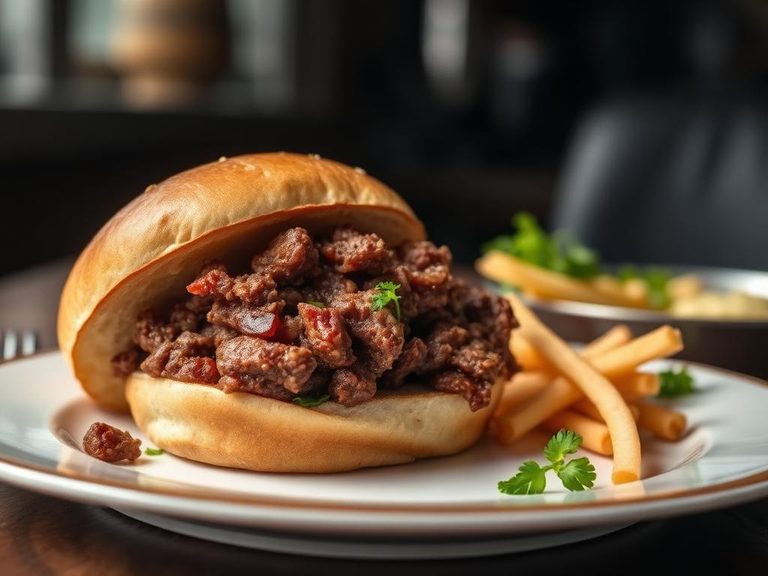
WENDY'S, Double Stack, with cheese
Whole food · Fast Foods

Photo: Wikipedia
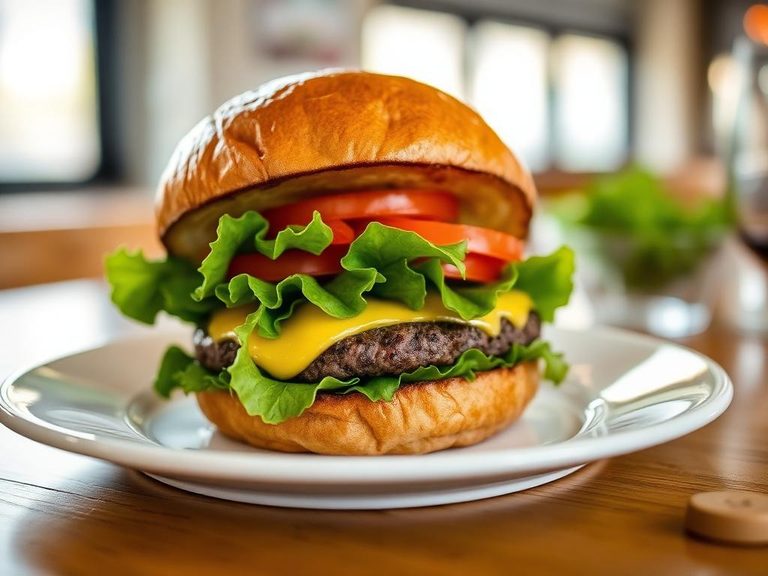
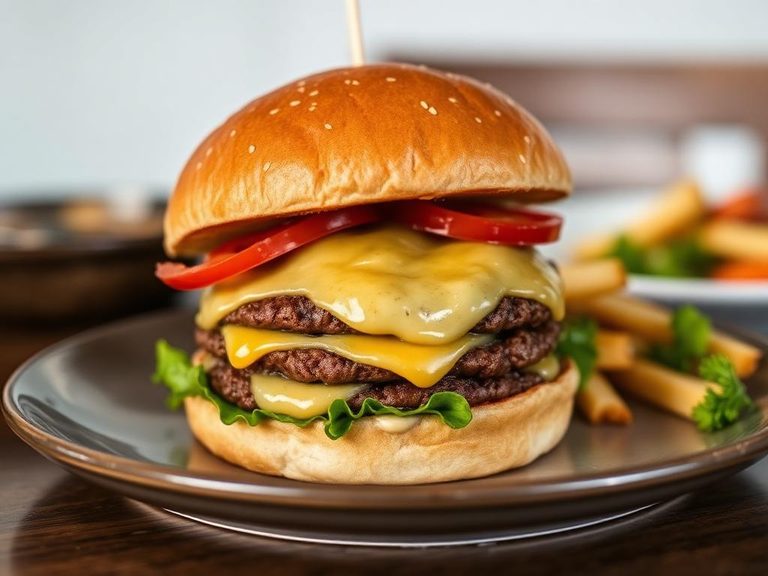
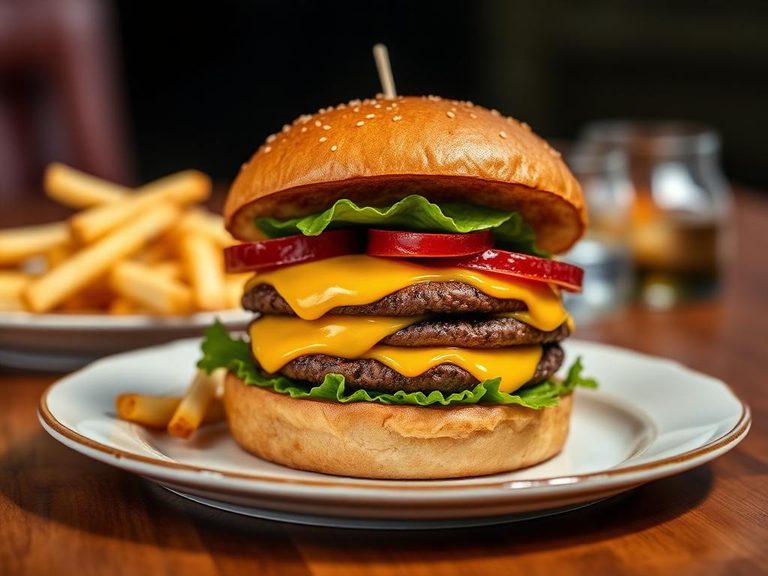
A Wendy's Double Stack with cheese is a compact, double-patty hamburger featuring two square beef patties, a slice of American cheese, and classic fixings like ketchup, mustard, pickles, and onions on a soft, toasted bun. Each bite delivers a savory, beefy flavor with a salty, creamy cheese note and a soft, slightly steamed bun texture. Nutritionally, it's a calorie-dense protein source, providing about 18.5g of protein per 100g, but it's also high in fat and sodium.
Calorie split: 26% protein · 22% carbs · 52% fat
↓ Full nutrition💚 Why it's loved
People love the Double Stack for its satisfying, classic fast-food taste—the savory beef, melted cheese, and tangy pickles create a familiar and craveable flavor profile. Its compact size makes it a quick, filling meal or snack that fits easily into a busy day.
⚠️ Watch-outs & how to enjoy it better
The high sodium and saturated fat content can be a concern for those managing blood pressure or heart health, and the refined bun may cause a blood-sugar spike. To counteract this, pair it with a side salad or apple slices for fiber, drink plenty of water, and consider it an occasional treat rather than a daily staple.
Key benefits
- High protein content for muscle maintenance
- Provides quick energy from carbohydrates
- Contains calcium from the cheese
- Offers iron from the beef patties
- Convenient and widely available fast-food option
🍽️ Popular dishes

🌍 Where it's eaten
💡 Did you know?
Wendy's signature square hamburger patties were chosen by founder Dave Thomas to symbolize that the company 'never cuts corners' on quality.
Full nutrition (USDA data · scales with serving)
| Water | 47.6 g |
| Energy | 285 kcal |
| Energy | 1192 kj |
| Protein | 18.5 g |
| Total lipid (fat) | 16.6 g |
| Ash | 1.9 g |
| Carbohydrate, by difference | 15.3 g |
| Total Sugars | 3.9 g |
| Sucrose | 0.00 g |
| Glucose | 1.5 g |
| Fructose | 1.6 g |
| Lactose | 0.33 g |
| Maltose | 0.40 g |
| Galactose | 0.00 g |
| Calcium, Ca | 73.0 mg |
| Iron, Fe | 2.8 mg |
| Magnesium, Mg | 21.0 mg |
| Phosphorus, P | 157 mg |
| Potassium, K | 258 mg |
| Sodium, Na | 477 mg |
| Zinc, Zn | 3.4 mg |
| Copper, Cu | 0.09 mg |
| Manganese, Mn | 0.17 mg |
Fat & fatty acid profile (per 100g)
| Fatty acids, total saturated | 6.9 g |
| SFA 4:0 | 0.05 g |
| SFA 6:0 | 0.04 g |
| SFA 8:0 | 0.03 g |
| SFA 10:0 | 0.07 g |
| SFA 12:0 | 0.07 g |
| SFA 14:0 | 0.59 g |
| SFA 15:0 | 0.09 g |
| SFA 16:0 | 3.6 g |
| SFA 17:0 | 0.18 g |
| SFA 18:0 | 2.1 g |
| SFA 20:0 | 0.02 g |
| SFA 22:0 | 0.01 g |
| SFA 24:0 | 0.01 g |
| Fatty acids, total monounsaturated | 7.3 g |
| MUFA 14:1 | 0.14 g |
| MUFA 15:1 | 0.00 g |
| MUFA 16:1 | 0.49 g |
| MUFA 16:1 c | 0.44 g |
| MUFA 17:1 | 0.13 g |
| MUFA 18:1 | 6.4 g |
| MUFA 18:1 c | 5.7 g |
| MUFA 20:1 | 0.06 g |
| MUFA 22:1 | 0.02 g |
| MUFA 22:1 c | 0.02 g |
| MUFA 24:1 c | 0.00 g |
| Fatty acids, total polyunsaturated | 1.3 g |
| PUFA 18:2 | 1.1 g |
| PUFA 18:2 n-6 c,c | 0.88 g |
| PUFA 18:2 CLAs | 0.09 g |
| PUFA 18:3 | 0.10 g |
| PUFA 18:3 n-3 c,c,c (ALA) | 0.09 g |
| PUFA 18:3 n-6 c,c,c | 0.01 g |
| PUFA 18:4 | 0.00 g |
| PUFA 20:2 n-6 c,c | 0.01 g |
| PUFA 20:3 | 0.02 g |
| PUFA 20:3 n-3 | 0.00 g |
| PUFA 20:3 n-6 | 0.02 g |
| PUFA 20:4 | 0.04 g |
| PUFA 20:5 n-3 (EPA) | 0.00 g |
| PUFA 22:4 | 0.01 g |
| PUFA 22:5 n-3 (DPA) | 0.01 g |
| PUFA 22:6 n-3 (DHA) | 0.00 g |
| Fatty acids, total trans | 0.92 g |
| Fatty acids, total trans-monoenoic | 0.82 g |
| TFA 16:1 t | 0.05 g |
| TFA 18:1 t | 0.77 g |
| TFA 22:1 t | 0.00 g |
| TFA 18:2 t not further defined | 0.10 g |
| Fatty acids, total trans-polyenoic | 0.10 g |
FAQ
How does the Double Stack differ from a regular Wendy's hamburger?
The Double Stack contains two beef patties and a slice of cheese, while a standard Wendy's hamburger has a single patty and may not include cheese by default.
Is the Double Stack a good source of protein?
Yes, it provides a substantial amount of protein (around 37g for the whole burger) which can help with satiety and muscle repair, though it comes with higher fat and sodium.
Can I customize the Double Stack to make it healthier?
You can request it without mayo or sauce, add extra lettuce and tomato, or pair it with a side of chili or a garden salad instead of fries to improve the nutritional balance.
Nutrient density (calculated · NRF9.3)
Nutrient Rich Foods index: beneficial nutrients (protein, fiber, vitamins, minerals) minus saturated fat, added sugar & sodium, per 100 kcal.
NRF9.3 index — Fulgoni, Keast & Drewnowski, 2009. Computed from USDA nutrients.
Weight-loss friendliness (composite index)
Energy density 2.85 kcal/g · 26% calories from protein · 0.0 g fiber · 3.9 g sugar per 100 g.
Composite of energy density (Rolls et al., 1999), protein & fiber satiety, minus sugar. A calculated heuristic — ranks satiety-per-calorie, not a clinical measure.
Dietary load (calculated from USDA values)
Potential renal acid load. Positive = acid-forming, negative = alkaline-forming.
Sodium-to-potassium ratio: 1.85 (lower is better — aim for ≤ 1)
Sodium:potassium per WHO potassium guidance. Computed from USDA nutrients.