

Turkey thigh, pre-basted, meat and skin, cooked, roasted
Whole food · Poultry Products
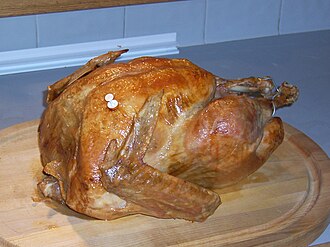
Photo: Wikipedia
Pre-basted turkey thigh, roasted with its skin, is a savory, succulent cut with a rich, meaty flavor and a tender yet firm texture. The skin crisps beautifully, adding a satisfying crunch and a layer of rendered fat that bastes the meat during cooking. Nutritionally, it's a powerhouse of protein with a notable fat content, offering a hearty, zero-carb option for low-carb or ketogenic diets.
Calorie split: 49% protein · 0% carbs · 51% fat
↓ Full nutrition💚 Why it's loved
People love it for its deep, savory flavor that's more pronounced than breast meat, and its forgiving texture that stays juicy when roasted. It's a versatile centerpiece for family meals, from holiday feasts to simple weeknight dinners, embodying comfort food across many cultures.
⚠️ Watch-outs & how to enjoy it better
The higher fat content, particularly from the skin, means it's calorie-dense and may not suit very low-fat diets. Pre-basting solutions often contain added sodium, which can be a concern for those monitoring salt intake. To mitigate, you can opt for a low-sodium baste, remove some skin before eating, and pair it with a potassium-rich side like roasted potatoes or a leafy green salad to help balance electrolytes.
Key benefits
- Excellent source of complete protein for muscle maintenance
- Rich in B vitamins, especially niacin and B6, for energy metabolism
- Contains minerals like selenium and phosphorus
- Naturally zero in carbohydrates and sugars
- Provides dietary fat for satiety and nutrient absorption
🍽️ Popular dishes
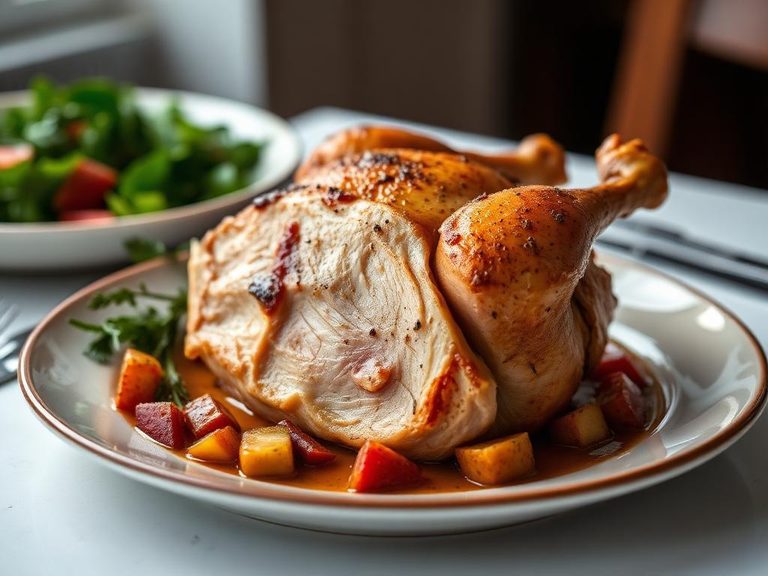


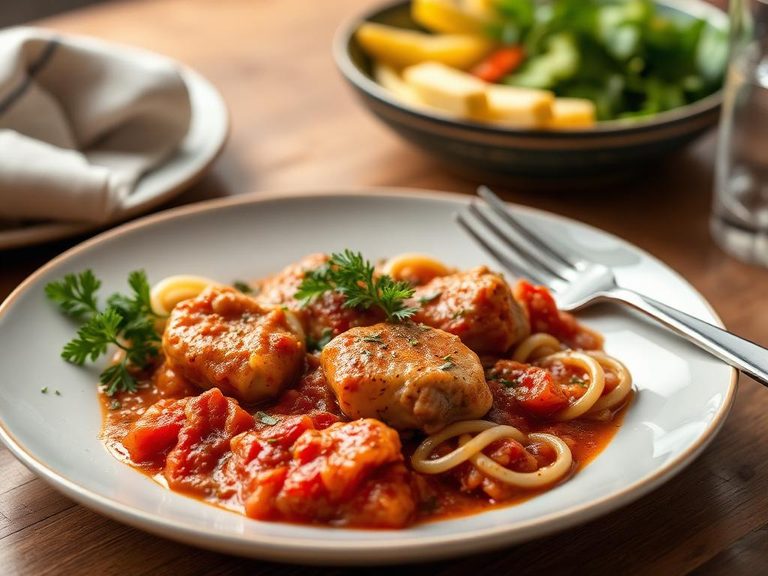

🌍 Where it's eaten
💡 Did you know?
A single pre-basted turkey thigh can contain nearly double the iron of the same serving of turkey breast, making it a surprisingly potent source of this essential mineral.
Full nutrition (USDA data · scales with serving)
| Water | 70.6 g |
| Energy | 157 kcal |
| Energy | 657 kj |
| Protein | 18.8 g |
| Total lipid (fat) | 8.5 g |
| Ash | 2.1 g |
| Carbohydrate, by difference | 0.00 g |
| Fiber, total dietary | 0.00 g |
| Calcium, Ca | 8.0 mg |
| Iron, Fe | 1.5 mg |
| Magnesium, Mg | 17.0 mg |
| Phosphorus, P | 171 mg |
| Potassium, K | 241 mg |
| Sodium, Na | 437 mg |
| Zinc, Zn | 4.1 mg |
| Copper, Cu | 0.14 mg |
| Manganese, Mn | 0.01 mg |
| Selenium, Se | 27.9 ug |
| Vitamin C, total ascorbic acid | 0.00 mg |
| Thiamin | 0.08 mg |
| Riboflavin | 0.26 mg |
| Niacin | 2.4 mg |
| Pantothenic acid | 0.81 mg |
| Vitamin B-6 | 0.23 mg |
| Folate, total | 6.0 ug |
| Folic acid | 0.00 ug |
| Folate, food | 6.0 ug |
| Folate, DFE | 6.0 ug |
| Vitamin B-12 | 0.24 ug |
| Vitamin A, RAE | 0.00 ug |
| Retinol | 0.00 ug |
| Vitamin A, IU | 0.00 iu |
Fat & fatty acid profile (per 100g)
| Fatty acids, total saturated | 2.6 g |
| SFA 10:0 | 0.00 g |
| SFA 12:0 | 0.01 g |
| SFA 14:0 | 0.06 g |
| SFA 16:0 | 1.6 g |
| SFA 18:0 | 0.71 g |
| Fatty acids, total monounsaturated | 2.5 g |
| MUFA 16:1 | 0.40 g |
| MUFA 18:1 | 2.1 g |
| MUFA 20:1 | 0.02 g |
| MUFA 22:1 | 0.01 g |
| Fatty acids, total polyunsaturated | 2.4 g |
| PUFA 18:2 | 2.0 g |
| PUFA 18:3 | 0.10 g |
| PUFA 20:4 | 0.21 g |
| PUFA 20:5 n-3 (EPA) | 0.00 g |
| PUFA 22:5 n-3 (DPA) | 0.03 g |
| PUFA 22:6 n-3 (DHA) | 0.04 g |
| Cholesterol | 62.0 mg |
Amino acid profile (per 100g)
| Tryptophan | 0.21 g |
| Threonine | 0.82 g |
| Isoleucine | 0.95 g |
| Leucine | 1.5 g |
| Lysine | 1.7 g |
| Methionine | 0.53 g |
| Cystine | 0.20 g |
| Phenylalanine | 0.74 g |
| Tyrosine | 0.72 g |
| Valine | 0.98 g |
| Arginine | 1.3 g |
| Histidine | 0.57 g |
| Alanine | 1.2 g |
| Aspartic acid | 1.8 g |
| Glutamic acid | 3.0 g |
| Glycine | 1.1 g |
| Proline | 0.84 g |
| Serine | 0.83 g |
FAQ
What does 'pre-basted' mean?
Pre-basting means the turkey was injected or soaked in a solution, typically containing water, salt, and flavorings like broth or butter, before packaging. This process helps ensure the meat stays moist during cooking.
Is it healthy to eat the skin?
The skin is where a significant portion of the fat and calories reside. It's delicious but calorie-dense. For a healthier option, you can remove the skin after cooking or limit your portion of it.
How do I prevent it from drying out?
Even though pre-basting helps, roasting at a moderate temperature (around 350°F/175°C) and using a meat thermometer to pull it out at 165°F (74°C) internal temperature are key. Letting it rest for 10-15 minutes after cooking allows juices to redistribute.
Nutrient density (calculated · NRF9.3)
Nutrient Rich Foods index: beneficial nutrients (protein, fiber, vitamins, minerals) minus saturated fat, added sugar & sodium, per 100 kcal.
NRF9.3 index — Fulgoni, Keast & Drewnowski, 2009. Computed from USDA nutrients.
Weight-loss friendliness (composite index)
Energy density 1.57 kcal/g · 48% calories from protein · 0.0 g fiber · 0.0 g sugar per 100 g.
Composite of energy density (Rolls et al., 1999), protein & fiber satiety, minus sugar. A calculated heuristic — ranks satiety-per-calorie, not a clinical measure.
Dietary load (calculated from USDA values)
Potential renal acid load. Positive = acid-forming, negative = alkaline-forming.
Sodium-to-potassium ratio: 1.81 (lower is better — aim for ≤ 1)
Sodium:potassium per WHO potassium guidance. Computed from USDA nutrients.