

Pancakes, plain, dry mix, complete, prepared
Whole food · Baked Products
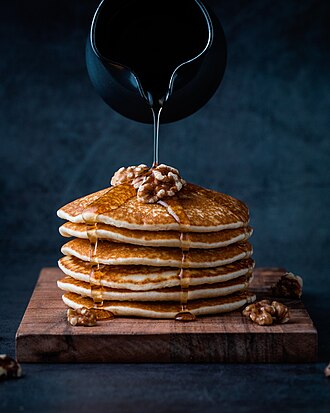
Photo: Wikipedia
This is a stack of classic American-style pancakes, cooked from a complete dry mix that requires only water. They have a soft, fluffy, and slightly spongy texture with a mild, sweet, and comforting flavor. Nutritionally, they are a high-carbohydrate, moderate-calorie food, providing quick energy with minimal fat and a modest amount of protein.
Calorie split: 11% protein · 77% carbs · 12% fat
↓ Full nutrition💚 Why it's loved
People love them for their nostalgic, comforting taste and the satisfying, fluffy texture that pairs perfectly with maple syrup, butter, or fruit. Their versatility makes them a beloved canvas for both sweet and savory toppings, from classic syrup to fried eggs and cheese.
⚠️ Watch-outs & how to enjoy it better
The primary downside is their high glycemic load, which can cause rapid blood-sugar spikes, and they are often low in satiating protein and fiber. To counteract this, pair them with a source of protein (like eggs, Greek yogurt, or nuts) and healthy fat (like avocado or nut butter) to slow digestion, and opt for a smaller portion topped with berries instead of sugary syrups.
Key benefits
- Quick and convenient source of energy
- Low in fat, especially saturated fat
- Contains some dietary fiber
- Easy to prepare for a fast meal
- Can be a vehicle for nutrient-rich toppings
🍽️ Popular dishes



🌍 Where it's eaten
💡 Did you know?
The word 'pancake' appears in English texts as early as the 15th century, and the ancient Romans made a similar dish called 'libuma' from wheat flour, cheese, and honey.
Full nutrition (USDA data · scales with serving)
| Water | 53.0 g |
| Energy | 194 kcal |
| Energy | 812 kj |
| Protein | 5.2 g |
| Total lipid (fat) | 2.5 g |
| Ash | 2.6 g |
| Carbohydrate, by difference | 36.7 g |
| Fiber, total dietary | 1.3 g |
| Calcium, Ca | 126 mg |
| Iron, Fe | 1.6 mg |
| Magnesium, Mg | 20.0 mg |
| Phosphorus, P | 334 mg |
| Potassium, K | 175 mg |
| Sodium, Na | 628 mg |
| Zinc, Zn | 0.39 mg |
| Copper, Cu | 0.09 mg |
| Manganese, Mn | 0.27 mg |
| Selenium, Se | 13.5 ug |
| Vitamin C, total ascorbic acid | 0.20 mg |
| Thiamin | 0.21 mg |
| Riboflavin | 0.22 mg |
| Niacin | 1.7 mg |
| Pantothenic acid | 0.24 mg |
| Vitamin B-6 | 0.09 mg |
| Folate, total | 37.0 ug |
| Folic acid | 28.0 ug |
| Folate, food | 9.0 ug |
| Folate, DFE | 57.0 ug |
| Choline, total | 19.2 mg |
| Vitamin B-12 | 0.20 ug |
| Vitamin A, RAE | 10.0 ug |
| Retinol | 10.0 ug |
| Vitamin A, IU | 32.0 iu |
Fat & fatty acid profile (per 100g)
| Fatty acids, total saturated | 0.51 g |
| SFA 4:0 | 0.01 g |
| SFA 6:0 | 0.00 g |
| SFA 8:0 | 0.00 g |
| SFA 10:0 | 0.00 g |
| SFA 12:0 | 0.01 g |
| SFA 14:0 | 0.02 g |
| SFA 16:0 | 0.34 g |
| SFA 18:0 | 0.13 g |
| Fatty acids, total monounsaturated | 0.88 g |
| MUFA 16:1 | 0.02 g |
| MUFA 18:1 | 0.86 g |
| MUFA 20:1 | 0.00 g |
| MUFA 22:1 | 0.00 g |
| Fatty acids, total polyunsaturated | 0.82 g |
| PUFA 18:2 | 0.76 g |
| PUFA 18:3 | 0.05 g |
| PUFA 20:4 | 0.01 g |
| PUFA 20:5 n-3 (EPA) | 0.00 g |
| PUFA 22:6 n-3 (DHA) | 0.00 g |
| Cholesterol | 12.0 mg |
Amino acid profile (per 100g)
| Tryptophan | 0.06 g |
| Threonine | 0.19 g |
| Isoleucine | 0.22 g |
| Leucine | 0.44 g |
| Lysine | 0.21 g |
| Methionine | 0.10 g |
| Cystine | 0.10 g |
| Phenylalanine | 0.26 g |
| Tyrosine | 0.18 g |
| Valine | 0.26 g |
| Arginine | 0.22 g |
| Histidine | 0.13 g |
| Alanine | 0.22 g |
| Aspartic acid | 0.32 g |
| Glutamic acid | 1.3 g |
| Glycine | 0.17 g |
| Proline | 0.50 g |
| Serine | 0.27 g |
FAQ
What makes 'complete' pancake mix different?
A 'complete' mix contains all the dry ingredients (flour, leavening, sugar, salt) and the powdered eggs and milk solids. You only need to add water to make the batter, unlike 'just-add-egg-and-milk' mixes.
Why are my pancakes flat and rubbery?
This is often from overmixing the batter, which develops too much gluten. Mix just until the dry ingredients are moistened; lumps are fine. Also, ensure your leavening agents (baking powder/soda) in the mix are fresh.
Can I make this mix healthier?
Absolutely. Stir in a scoop of protein powder, mix in ground flaxseed or wheat germ for fiber, or use the batter to make savory pancakes by adding herbs and vegetables. Always control the toppings.
Nutrient density (calculated · NRF9.3)
Nutrient Rich Foods index: beneficial nutrients (protein, fiber, vitamins, minerals) minus saturated fat, added sugar & sodium, per 100 kcal.
NRF9.3 index — Fulgoni, Keast & Drewnowski, 2009. Computed from USDA nutrients.
Weight-loss friendliness (composite index)
Energy density 1.94 kcal/g · 11% calories from protein · 1.3 g fiber · 0.0 g sugar per 100 g.
Composite of energy density (Rolls et al., 1999), protein & fiber satiety, minus sugar. A calculated heuristic — ranks satiety-per-calorie, not a clinical measure.
Dietary load (calculated from USDA values)
Potential renal acid load. Positive = acid-forming, negative = alkaline-forming.
Sodium-to-potassium ratio: 3.59 (lower is better — aim for ≤ 1)
Sodium:potassium per WHO potassium guidance. Computed from USDA nutrients.