

Mollusks, mussel, blue, cooked, moist heat
Whole food · Finfish and Shellfish Products

Photo: Wikipedia
The blue mussel, when cooked by moist heat like steaming or boiling, transforms from a shelled bivalve into a tender, briny morsel with a distinct oceanic flavor and a slightly chewy yet succulent texture. Nutritionally, it's a powerhouse, delivering an exceptional amount of high-quality protein for very few calories, making it one of the leanest and most nutrient-dense seafood options available.
Calorie split: 58% protein · 18% carbs · 24% fat
↓ Full nutrition💚 Why it's loved
People cherish mussels for their deep, sweet, and briny flavor that tastes like the pure essence of the sea. They are celebrated for their versatility, easily absorbing the flavors of garlic, white wine, herbs, and broth in classic dishes.
⚠️ Watch-outs & how to enjoy it better
Mussels are a common shellfish allergen and must be avoided by those with a mollusk allergy. They are also filter feeders, so there's a risk of ingesting toxins or pollutants if harvested from contaminated waters; always buy from reputable sources. To mitigate any potential metallic taste or grit, ensure they are debearded and scrubbed before cooking.
Key benefits
- Excellent source of complete, high-quality protein
- Very low in calories and total fat
- Rich in essential minerals like selenium, manganese, and zinc
- Good source of vitamin B12 and folate
- Naturally low in carbohydrates
🍽️ Popular dishes
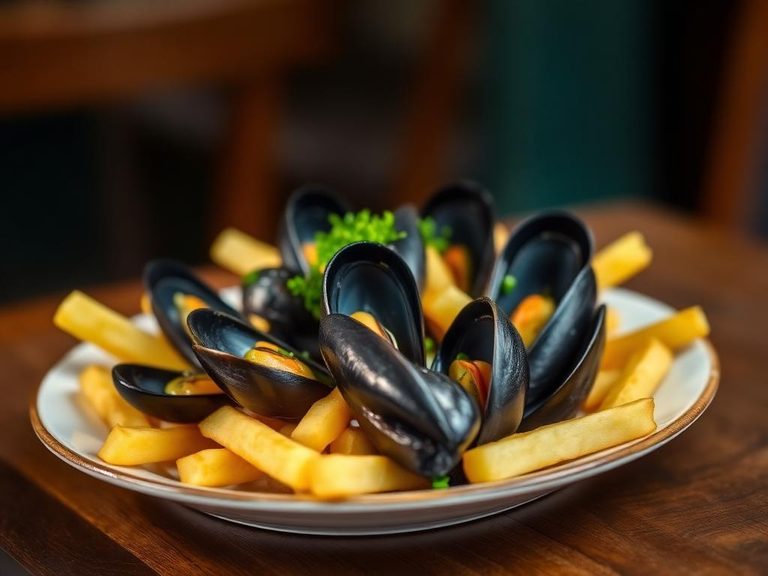
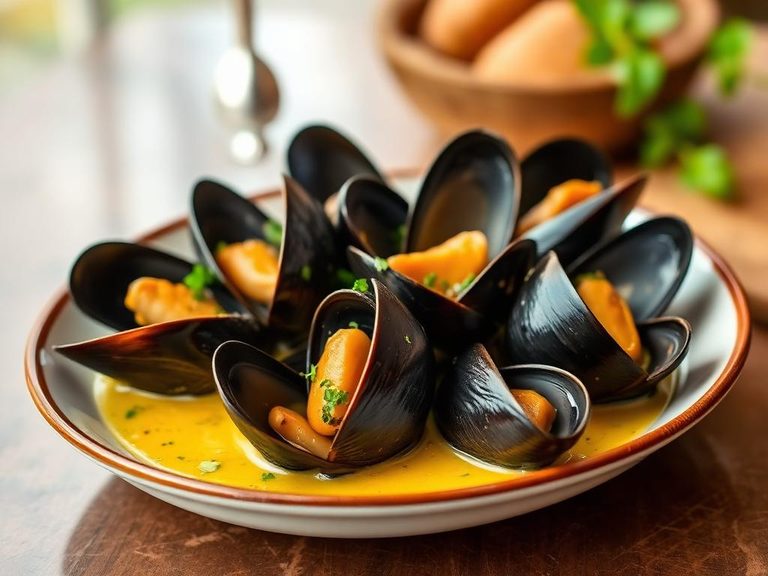
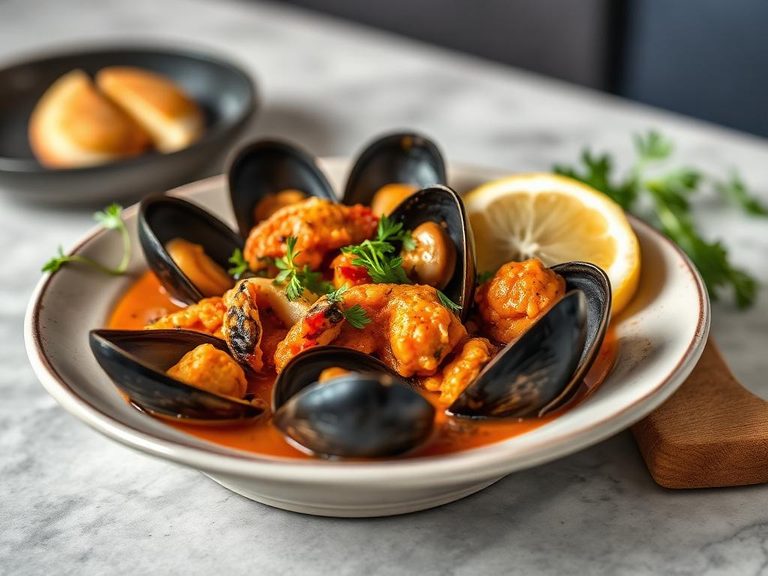
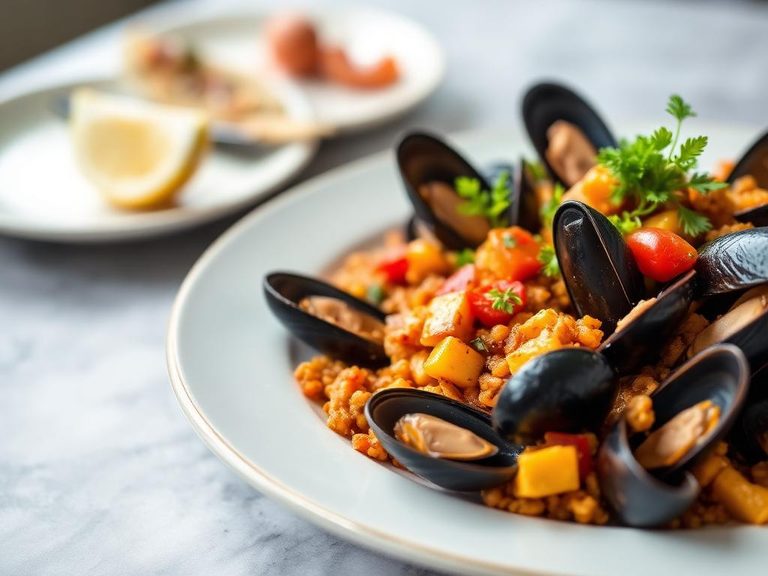
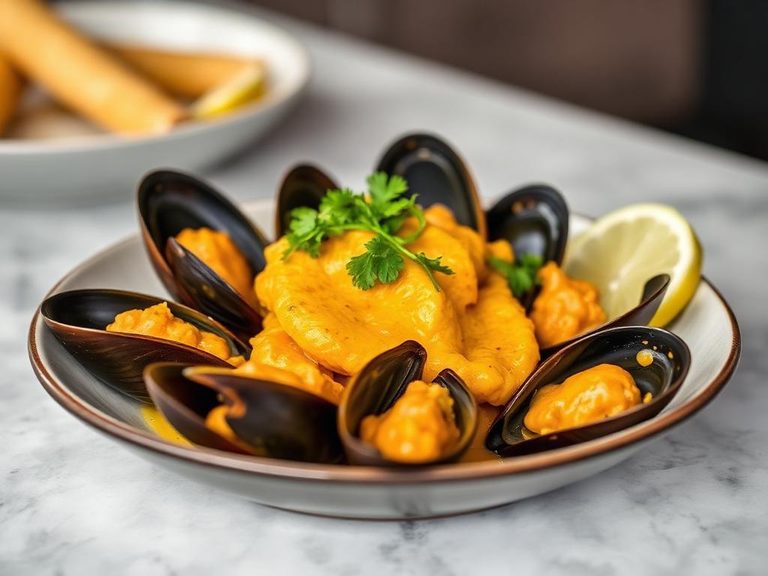
🌍 Where it's eaten
💡 Did you know?
Blue mussels can attach themselves to surfaces using strong, silky threads called byssal threads, which they produce from a gland in their foot, allowing them to anchor firmly in turbulent waters.
Full nutrition (USDA data · scales with serving)
| Water | 61.1 g |
| Energy | 172 kcal |
| Energy | 720 kj |
| Protein | 23.8 g |
| Total lipid (fat) | 4.5 g |
| Ash | 3.2 g |
| Carbohydrate, by difference | 7.4 g |
| Fiber, total dietary | 0.00 g |
| Calcium, Ca | 33.0 mg |
| Iron, Fe | 6.7 mg |
| Magnesium, Mg | 37.0 mg |
| Phosphorus, P | 285 mg |
| Potassium, K | 268 mg |
| Sodium, Na | 369 mg |
| Zinc, Zn | 2.7 mg |
| Copper, Cu | 0.15 mg |
| Manganese, Mn | 6.8 mg |
| Selenium, Se | 89.6 ug |
| Vitamin C, total ascorbic acid | 13.6 mg |
| Thiamin | 0.30 mg |
| Riboflavin | 0.42 mg |
| Niacin | 3.0 mg |
| Pantothenic acid | 0.95 mg |
| Vitamin B-6 | 0.10 mg |
| Folate, total | 76.0 ug |
| Folic acid | 0.00 ug |
| Folate, food | 76.0 ug |
| Folate, DFE | 76.0 ug |
| Vitamin B-12 | 24.0 ug |
| Vitamin A, RAE | 91.0 ug |
| Retinol | 91.0 ug |
| Vitamin A, IU | 304 iu |
Fat & fatty acid profile (per 100g)
| Fatty acids, total saturated | 0.85 g |
| SFA 14:0 | 0.12 g |
| SFA 16:0 | 0.59 g |
| SFA 18:0 | 0.14 g |
| Fatty acids, total monounsaturated | 1.0 g |
| MUFA 16:1 | 0.28 g |
| MUFA 18:1 | 0.41 g |
| MUFA 20:1 | 0.28 g |
| MUFA 22:1 | 0.05 g |
| Fatty acids, total polyunsaturated | 1.2 g |
| PUFA 18:2 | 0.04 g |
| PUFA 18:3 | 0.04 g |
| PUFA 18:4 | 0.07 g |
| PUFA 20:4 | 0.14 g |
| PUFA 20:5 n-3 (EPA) | 0.28 g |
| PUFA 22:5 n-3 (DPA) | 0.04 g |
| PUFA 22:6 n-3 (DHA) | 0.51 g |
| Cholesterol | 56.0 mg |
Amino acid profile (per 100g)
| Tryptophan | 0.27 g |
| Threonine | 1.0 g |
| Isoleucine | 1.0 g |
| Leucine | 1.7 g |
| Lysine | 1.8 g |
| Methionine | 0.54 g |
| Cystine | 0.31 g |
| Phenylalanine | 0.85 g |
| Tyrosine | 0.76 g |
| Valine | 1.0 g |
| Arginine | 1.7 g |
| Histidine | 0.46 g |
| Alanine | 1.4 g |
| Aspartic acid | 2.3 g |
| Glutamic acid | 3.2 g |
| Glycine | 1.5 g |
| Proline | 0.97 g |
| Serine | 1.1 g |
FAQ
How do I know if a mussel is safe to eat before cooking?
Only eat mussels with shells that are tightly closed or that close when tapped. Discard any that are already open and don't close when tapped, as this indicates they are dead.
What is the 'beard' on a mussel, and do I need to remove it?
The beard (byssal thread) is a fibrous tuft the mussel uses to anchor itself. Yes, it should be firmly pulled off towards the hinge before cooking for a better eating experience.
What is the best way to cook mussels to preserve their texture?
Quick, moist-heat methods like steaming are ideal. Cook them in a flavorful liquid (like wine or broth) in a covered pot just until the shells open, usually 5-7 minutes. Overcooking makes them rubbery.
Nutrient density (calculated · NRF9.3)
Nutrient Rich Foods index: beneficial nutrients (protein, fiber, vitamins, minerals) minus saturated fat, added sugar & sodium, per 100 kcal.
NRF9.3 index — Fulgoni, Keast & Drewnowski, 2009. Computed from USDA nutrients.
Weight-loss friendliness (composite index)
Energy density 1.72 kcal/g · 55% calories from protein · 0.0 g fiber · 0.0 g sugar per 100 g.
Composite of energy density (Rolls et al., 1999), protein & fiber satiety, minus sugar. A calculated heuristic — ranks satiety-per-calorie, not a clinical measure.
Dietary load (calculated from USDA values)
Potential renal acid load. Positive = acid-forming, negative = alkaline-forming.
Sodium-to-potassium ratio: 1.38 (lower is better — aim for ≤ 1)
Sodium:potassium per WHO potassium guidance. Computed from USDA nutrients.