

Fish, sablefish, cooked, dry heat
Whole food · Finfish and Shellfish Products

Photo: Wikipedia
Sablefish, often called black cod, is a luxurious deep-water fish prized for its velvety, buttery texture and rich, sweet flavor that melts in your mouth. With an exceptionally high fat content, it remains incredibly moist and succulent even when cooked with dry heat methods like grilling or broiling. Its nutrition profile is dominated by heart-healthy fats, making it a superb source of omega-3 fatty acids and a substantial protein source.
Calorie split: 28% protein · 0% carbs · 72% fat
↓ Full nutrition💚 Why it's loved
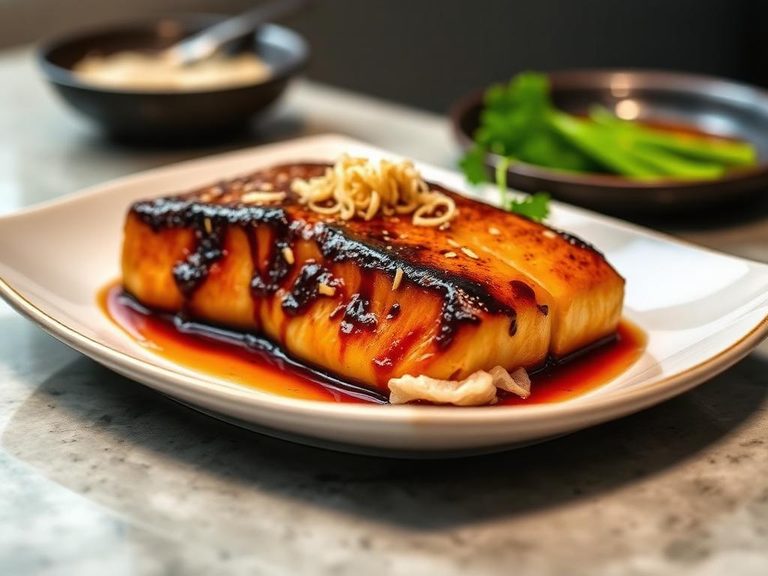
Chefs and home cooks adore sablefish for its forgiving nature and luxurious mouthfeel; it's nearly impossible to overcook due to its high fat content. Its mild, sweet flavor makes it a versatile canvas for bold glazes (like miso) or simple preparations that let the fish shine.
⚠️ Watch-outs & how to enjoy it better
Its high fat content, while nutritionally beneficial, means it is calorie-dense compared to leaner white fish, so portion awareness is key for those managing total calorie intake. As a top predator, it can contain trace environmental contaminants; choosing fish from well-managed fisheries (like those certified by the Marine Stewardship Council) is a concrete way to mitigate this concern.
Key benefits
- Excellent source of long-chain omega-3 fatty acids (EPA & DHA).
- High in high-quality, complete protein.
- Very low in carbohydrates and sugars.
- Rich in vitamin D and B12.
- Contains selenium, an important antioxidant mineral.
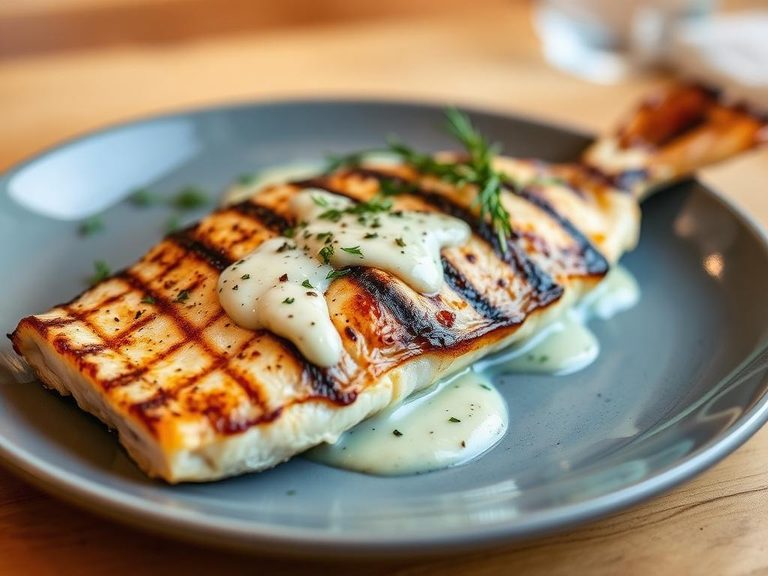
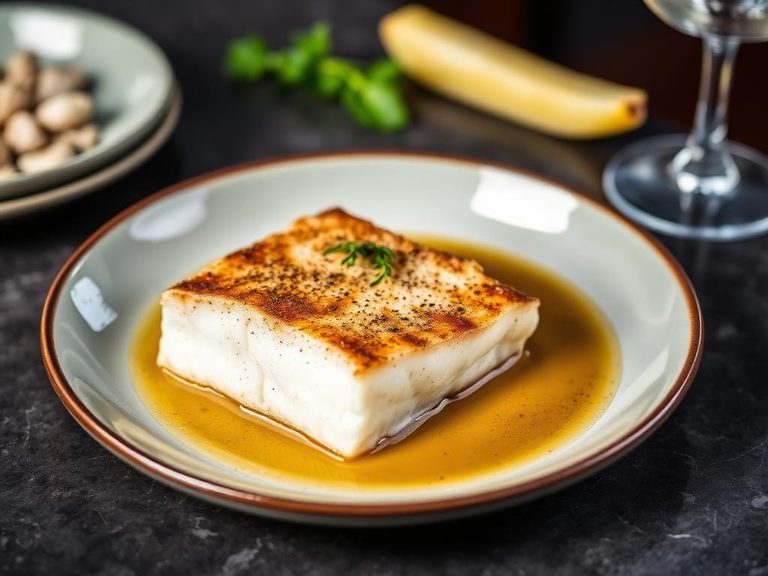
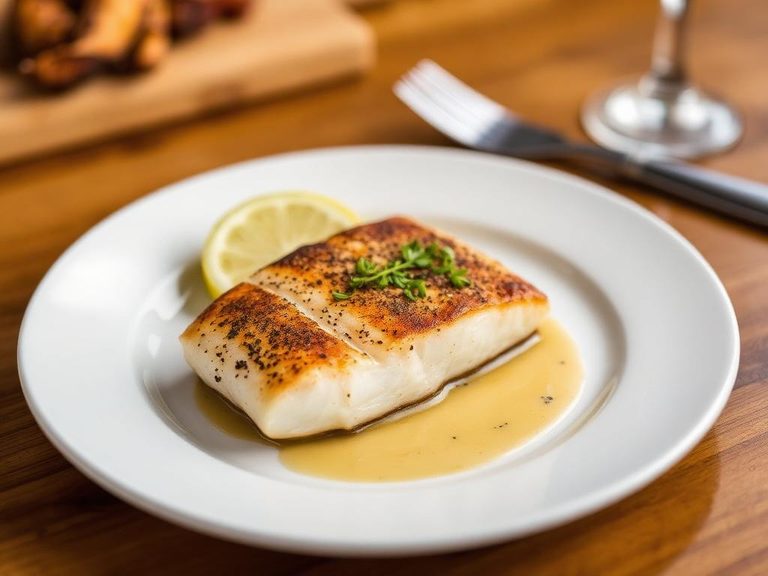
🍽️ Popular dishes

🌍 Where it's eaten
💡 Did you know?
Sablefish has an exceptionally long lifespan for a fish, with some individuals living to be over 90 years old.
Full nutrition (USDA data · scales with serving)
| Water | 62.9 g |
| Energy | 250 kcal |
| Energy | 1046 kj |
| Protein | 17.2 g |
| Total lipid (fat) | 19.6 g |
| Ash | 1.4 g |
| Carbohydrate, by difference | 0.00 g |
| Fiber, total dietary | 0.00 g |
| Calcium, Ca | 45.0 mg |
| Iron, Fe | 1.6 mg |
| Magnesium, Mg | 71.0 mg |
| Phosphorus, P | 215 mg |
| Potassium, K | 459 mg |
| Sodium, Na | 72.0 mg |
| Zinc, Zn | 0.41 mg |
| Copper, Cu | 0.03 mg |
| Manganese, Mn | 0.02 mg |
| Selenium, Se | 46.8 ug |
| Vitamin C, total ascorbic acid | 0.00 mg |
| Thiamin | 0.12 mg |
| Riboflavin | 0.12 mg |
| Niacin | 5.1 mg |
| Pantothenic acid | 0.86 mg |
| Vitamin B-6 | 0.35 mg |
| Folate, total | 17.0 ug |
| Folic acid | 0.00 ug |
| Folate, food | 17.0 ug |
| Folate, DFE | 17.0 ug |
| Vitamin B-12 | 1.4 ug |
| Vitamin A, RAE | 102 ug |
| Retinol | 102 ug |
| Vitamin A, IU | 338 iu |
Fat & fatty acid profile (per 100g)
| Fatty acids, total saturated | 4.1 g |
| SFA 12:0 | 0.01 g |
| SFA 14:0 | 0.92 g |
| SFA 16:0 | 2.6 g |
| SFA 18:0 | 0.52 g |
| Fatty acids, total monounsaturated | 10.3 g |
| MUFA 16:1 | 1.6 g |
| MUFA 18:1 | 5.2 g |
| MUFA 20:1 | 1.8 g |
| MUFA 22:1 | 1.7 g |
| Fatty acids, total polyunsaturated | 2.6 g |
| PUFA 18:2 | 0.21 g |
| PUFA 18:3 | 0.12 g |
| PUFA 18:4 | 0.15 g |
| PUFA 20:4 | 0.13 g |
| PUFA 20:5 n-3 (EPA) | 0.87 g |
| PUFA 22:5 n-3 (DPA) | 0.22 g |
| PUFA 22:6 n-3 (DHA) | 0.92 g |
| Cholesterol | 63.0 mg |
Amino acid profile (per 100g)
| Tryptophan | 0.19 g |
| Threonine | 0.75 g |
| Isoleucine | 0.79 g |
| Leucine | 1.4 g |
| Lysine | 1.6 g |
| Methionine | 0.51 g |
| Cystine | 0.18 g |
| Phenylalanine | 0.67 g |
| Tyrosine | 0.58 g |
| Valine | 0.89 g |
| Arginine | 1.0 g |
| Histidine | 0.51 g |
| Alanine | 1.0 g |
| Aspartic acid | 1.8 g |
| Glutamic acid | 2.6 g |
| Glycine | 0.82 g |
| Proline | 0.61 g |
| Serine | 0.70 g |
FAQ
What is the difference between sablefish and black cod?
They are the same fish (scientific name: *Anoplopoma fimbria*). 'Sablefish' is the official name used by fisheries and chefs, while 'black cod' is a common market name, though it is not a true cod.
Is sablefish sustainable?
Sustainability varies by fishery. The Alaska and British Columbia fisheries are generally well-managed and often carry certifications like the Marine Stewardship Council (MSC). Always look for sourcing information.
Why is sablefish so expensive?
Its price reflects its status as a luxury item, its slow growth and long lifespan, high demand in high-end restaurants (especially for dishes like miso-glazed black cod), and the costs associated with deep-sea fishing.
Nutrient density (calculated · NRF9.3)
Nutrient Rich Foods index: beneficial nutrients (protein, fiber, vitamins, minerals) minus saturated fat, added sugar & sodium, per 100 kcal.
NRF9.3 index — Fulgoni, Keast & Drewnowski, 2009. Computed from USDA nutrients.
Weight-loss friendliness (composite index)
Energy density 2.50 kcal/g · 28% calories from protein · 0.0 g fiber · 0.0 g sugar per 100 g.
Composite of energy density (Rolls et al., 1999), protein & fiber satiety, minus sugar. A calculated heuristic — ranks satiety-per-calorie, not a clinical measure.
Dietary load (calculated from USDA values)
Potential renal acid load. Positive = acid-forming, negative = alkaline-forming.
Sodium-to-potassium ratio: 0.16 (lower is better — aim for ≤ 1)
Sodium:potassium per WHO potassium guidance. Computed from USDA nutrients.