

Chicken, broilers or fryers, leg, meat and skin, cooked, fried, batter
Whole food · Poultry Products

Photo: Wikipedia
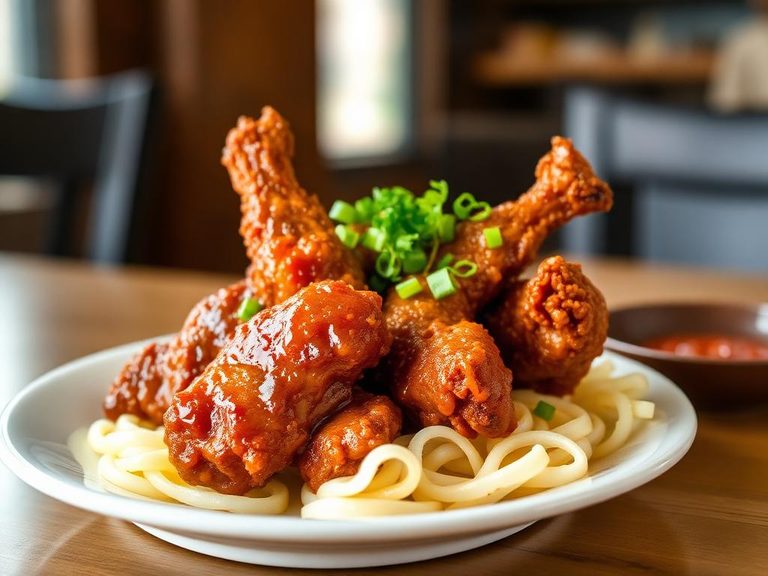
This is a golden, crispy-coated chicken leg, where the meat and skin have been deep-fried to a satisfying crunch. The batter forms a savory, textured shell that gives way to juicy, flavorful dark meat underneath. It delivers a substantial protein punch (21.77g) alongside a notable fat content (16.17g) from the skin and frying process.
Calorie split: 33% protein · 13% carbs · 54% fat
↓ Full nutrition💚 Why it's loved
People adore the irresistible contrast between the shatteringly crisp, seasoned batter and the tender, succulent dark meat. It's a universal comfort food, evoking everything from Southern U.S. soul food to Japanese karaage, making it a crowd-pleasing centerpiece for casual meals and celebrations alike.
⚠️ Watch-outs & how to enjoy it better
The high fat and calorie density from the skin and frying method can be a concern for those monitoring intake. The batter may also contain gluten (a common allergen) and the cooking process can elevate sodium levels. To counteract, pair a smaller portion with a large, vinegar-dressed salad to add fiber and volume, or opt for an air-fried version at home to reduce added fats.
Key benefits
- High-quality complete protein source
- Excellent source of B vitamins, especially niacin and B6
- Provides essential minerals like selenium and phosphorus
- Energy-dense, making it a satisfying meal component
- The skin and batter contribute to a rich mouthfeel
🍽️ Popular dishes



🌍 Where it's eaten
💡 Did you know?
The crispy coating on fried chicken isn't just for texture; it acts as a protective barrier, sealing in the juices of the dark meat and preventing it from drying out during the high-heat cooking process.
Full nutrition (USDA data · scales with serving)
| Water | 52.1 g |
| Energy | 273 kcal |
| Energy | 1142 kj |
| Protein | 21.8 g |
| Total lipid (fat) | 16.2 g |
| Ash | 1.3 g |
| Carbohydrate, by difference | 8.7 g |
| Fiber, total dietary | 0.30 g |
| Calcium, Ca | 18.0 mg |
| Iron, Fe | 1.4 mg |
| Magnesium, Mg | 20.0 mg |
| Phosphorus, P | 152 mg |
| Potassium, K | 189 mg |
| Sodium, Na | 279 mg |
| Zinc, Zn | 2.2 mg |
| Copper, Cu | 0.08 mg |
| Manganese, Mn | 0.05 mg |
| Selenium, Se | 26.6 ug |
| Vitamin C, total ascorbic acid | 0.00 mg |
| Thiamin | 0.12 mg |
| Riboflavin | 0.22 mg |
| Niacin | 5.4 mg |
| Pantothenic acid | 0.99 mg |
| Vitamin B-6 | 0.27 mg |
| Folate, total | 18.0 ug |
| Folic acid | 9.0 ug |
| Folate, food | 9.0 ug |
| Folate, DFE | 24.0 ug |
| Vitamin B-12 | 0.28 ug |
| Vitamin A, RAE | 27.0 ug |
| Retinol | 27.0 ug |
| Vitamin A, IU | 91.0 iu |
Fat & fatty acid profile (per 100g)
| Fatty acids, total saturated | 4.3 g |
| SFA 10:0 | 0.00 g |
| SFA 12:0 | 0.02 g |
| SFA 14:0 | 0.09 g |
| SFA 16:0 | 2.8 g |
| SFA 18:0 | 1.3 g |
| Fatty acids, total monounsaturated | 6.6 g |
| MUFA 16:1 | 0.51 g |
| MUFA 18:1 | 6.0 g |
| MUFA 20:1 | 0.08 g |
| MUFA 22:1 | 0.00 g |
| Fatty acids, total polyunsaturated | 3.9 g |
| PUFA 18:2 | 3.5 g |
| PUFA 18:3 | 0.19 g |
| PUFA 20:4 | 0.10 g |
| PUFA 20:5 n-3 (EPA) | 0.01 g |
| PUFA 22:5 n-3 (DPA) | 0.02 g |
| PUFA 22:6 n-3 (DHA) | 0.04 g |
| Cholesterol | 90.0 mg |
Amino acid profile (per 100g)
| Tryptophan | 0.25 g |
| Threonine | 0.89 g |
| Isoleucine | 1.1 g |
| Leucine | 1.6 g |
| Lysine | 1.7 g |
| Methionine | 0.57 g |
| Cystine | 0.30 g |
| Phenylalanine | 0.87 g |
| Tyrosine | 0.71 g |
| Valine | 1.1 g |
| Arginine | 1.3 g |
| Histidine | 0.64 g |
| Alanine | 1.2 g |
| Aspartic acid | 1.9 g |
| Glutamic acid | 3.5 g |
| Glycine | 1.3 g |
| Proline | 1.1 g |
| Serine | 0.80 g |
FAQ
Is the batter on fried chicken typically high in carbs?
Yes, the batter is primarily made from flour (wheat), which is a carbohydrate source. A 100g serving contains about 8.72g of carbs, mostly from this coating.
How does the nutrition differ between the meat and the skin?
The skin and the attached fat layer are where the majority of the fat (and thus calories) reside. The meat itself is leaner and is the primary source of the protein.
Can I get a similar taste and texture with a healthier cooking method?
Yes, using an air fryer or oven-baking with a light coating of oil can achieve a crispy exterior with significantly less added fat. Marinating the chicken first ensures the meat stays flavorful and moist.
Nutrient density (calculated · NRF9.3)
Nutrient Rich Foods index: beneficial nutrients (protein, fiber, vitamins, minerals) minus saturated fat, added sugar & sodium, per 100 kcal.
NRF9.3 index — Fulgoni, Keast & Drewnowski, 2009. Computed from USDA nutrients.
Weight-loss friendliness (composite index)
Energy density 2.73 kcal/g · 32% calories from protein · 0.3 g fiber · 0.0 g sugar per 100 g.
Composite of energy density (Rolls et al., 1999), protein & fiber satiety, minus sugar. A calculated heuristic — ranks satiety-per-calorie, not a clinical measure.
Dietary load (calculated from USDA values)
Potential renal acid load. Positive = acid-forming, negative = alkaline-forming.
Sodium-to-potassium ratio: 1.48 (lower is better — aim for ≤ 1)
Sodium:potassium per WHO potassium guidance. Computed from USDA nutrients.