

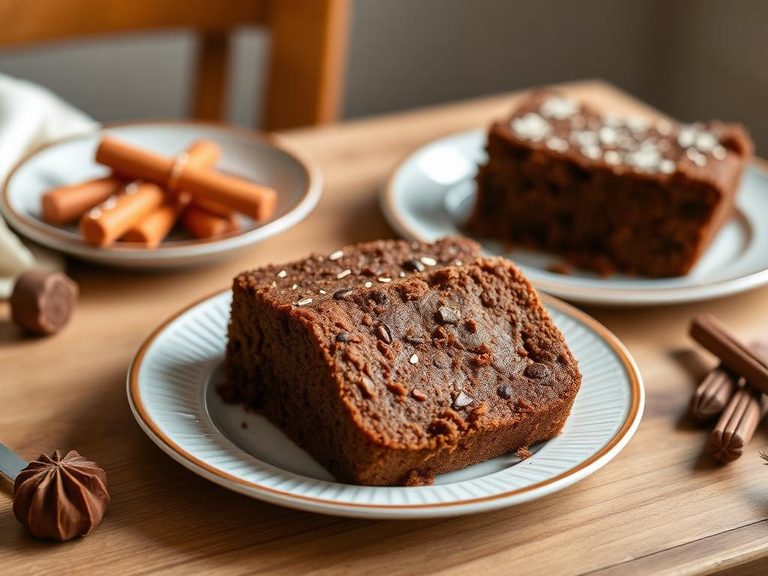
Cake, gingerbread, prepared from recipe
Whole food · Baked Products

Photo: Wikipedia
A spiced, molasses-rich cake with a dense, moist crumb and a warm, aromatic flavor profile. Its deep brown color and soft, slightly chewy texture come from the generous use of ginger, cinnamon, and dark syrup. Nutritionally, it's a calorie-dense treat, with carbohydrates and fats providing most of its energy.
Calorie split: 4% protein · 55% carbs · 41% fat
↓ Full nutrition💚 Why it's loved
People love gingerbread for its iconic, nostalgic flavor that evokes holiday seasons and cozy gatherings. Its versatility allows it to be shaped into houses, cookies, or enjoyed as a simple, spiced loaf.
⚠️ Watch-outs & how to enjoy it better
Its high carbohydrate and calorie content can lead to blood-sugar spikes, making it a concern for those managing diabetes or watching their intake. To counteract this, enjoy a small portion alongside a source of protein or healthy fat (like nuts or yogurt) to slow digestion. Be mindful of portion sizes, especially if it's a pre-made, commercially produced version which may have added sodium.
Key benefits
- Provides quick energy from carbohydrates.
- Contains minerals like iron and manganese from molasses.
- Offers a comforting, warming sensation from spices.
- Can be a source of dietary fats for satiety.
🍽️ Popular dishes




🌍 Where it's eaten
💡 Did you know?
The tradition of building elaborate gingerbread houses is believed to have been popularized in Germany in the 19th century, inspired by the Brothers Grimm fairy tale 'Hansel and Gretel.'
Full nutrition (USDA data · scales with serving)
| Water | 28.0 g |
| Energy | 356 kcal |
| Energy | 1490 kj |
| Protein | 3.9 g |
| Total lipid (fat) | 16.4 g |
| Ash | 1.8 g |
| Carbohydrate, by difference | 49.2 g |
| Calcium, Ca | 71.0 mg |
| Iron, Fe | 2.9 mg |
| Magnesium, Mg | 70.0 mg |
| Phosphorus, P | 54.0 mg |
| Potassium, K | 439 mg |
| Sodium, Na | 327 mg |
| Zinc, Zn | 0.39 mg |
| Copper, Cu | 0.20 mg |
| Manganese, Mn | 0.68 mg |
| Selenium, Se | 16.3 ug |
| Vitamin C, total ascorbic acid | 0.10 mg |
| Thiamin | 0.19 mg |
| Riboflavin | 0.16 mg |
| Niacin | 1.7 mg |
| Pantothenic acid | 0.38 mg |
| Vitamin B-6 | 0.19 mg |
| Folate, total | 33.0 ug |
| Folic acid | 25.0 ug |
| Folate, food | 8.0 ug |
| Folate, DFE | 51.0 ug |
| Vitamin B-12 | 0.06 ug |
| Vitamin A, RAE | 14.0 ug |
| Retinol | 14.0 ug |
| Vitamin A, IU | 48.0 iu |
Fat & fatty acid profile (per 100g)
| Fatty acids, total saturated | 4.1 g |
| SFA 4:0 | 0.00 g |
| SFA 6:0 | 0.00 g |
| SFA 8:0 | 0.00 g |
| SFA 10:0 | 0.00 g |
| SFA 12:0 | 0.00 g |
| SFA 14:0 | 0.06 g |
| SFA 16:0 | 2.4 g |
| SFA 18:0 | 1.7 g |
| Fatty acids, total monounsaturated | 7.1 g |
| MUFA 16:1 | 0.02 g |
| MUFA 18:1 | 7.1 g |
| MUFA 20:1 | 0.00 g |
| MUFA 22:1 | 0.00 g |
| Fatty acids, total polyunsaturated | 4.2 g |
| PUFA 18:2 | 3.9 g |
| PUFA 18:3 | 0.25 g |
| PUFA 18:4 | 0.00 g |
| PUFA 20:4 | 0.01 g |
| PUFA 20:5 n-3 (EPA) | 0.00 g |
| PUFA 22:5 n-3 (DPA) | 0.00 g |
| PUFA 22:6 n-3 (DHA) | 0.00 g |
| Cholesterol | 32.0 mg |
Amino acid profile (per 100g)
| Tryptophan | 0.05 g |
| Threonine | 0.12 g |
| Isoleucine | 0.15 g |
| Leucine | 0.28 g |
| Lysine | 0.13 g |
| Methionine | 0.08 g |
| Cystine | 0.08 g |
| Phenylalanine | 0.20 g |
| Tyrosine | 0.13 g |
| Valine | 0.17 g |
| Arginine | 0.17 g |
| Histidine | 0.09 g |
| Alanine | 0.14 g |
| Aspartic acid | 0.22 g |
| Glutamic acid | 1.1 g |
| Glycine | 0.14 g |
| Proline | 0.37 g |
| Serine | 0.21 g |
FAQ
Is gingerbread healthy?
While it contains some beneficial spices and minerals from molasses, gingerbread is primarily a treat high in calories, sugar, and fat. It's best enjoyed in moderation as part of a balanced diet.
Why is my gingerbread cake so hard?
Overbaking is the most common cause. Use a toothpick to test for doneness—it should come out with a few moist crumbs, not clean. Also, ensure your molasses and other wet ingredients are at room temperature.
Can I make gingerbread without molasses?
Molasses is key to the classic flavor, color, and moisture. You can substitute it with dark corn syrup or honey, but the taste will be noticeably different—less robust and complex.
Nutrient density (calculated · NRF9.3)
Nutrient Rich Foods index: beneficial nutrients (protein, fiber, vitamins, minerals) minus saturated fat, added sugar & sodium, per 100 kcal.
NRF9.3 index — Fulgoni, Keast & Drewnowski, 2009. Computed from USDA nutrients.
Weight-loss friendliness (composite index)
Energy density 3.56 kcal/g · 4% calories from protein · 0.0 g fiber · 0.0 g sugar per 100 g.
Composite of energy density (Rolls et al., 1999), protein & fiber satiety, minus sugar. A calculated heuristic — ranks satiety-per-calorie, not a clinical measure.
Dietary load (calculated from USDA values)
Potential renal acid load. Positive = acid-forming, negative = alkaline-forming.
Sodium-to-potassium ratio: 0.74 (lower is better — aim for ≤ 1)
Sodium:potassium per WHO potassium guidance. Computed from USDA nutrients.