Gingerbread house

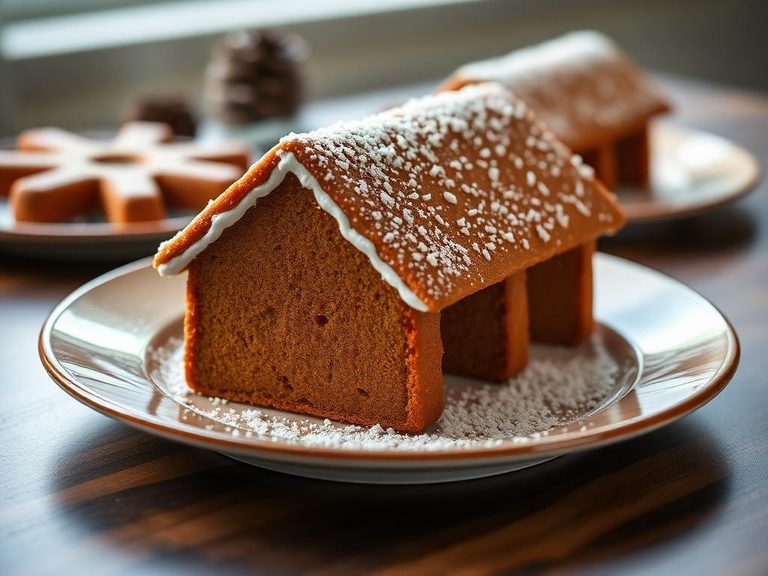
A gingerbread house is a decorative confection made from baked gingerbread dough, assembled into a structure and elaborately decorated with icing, candy, and other sweets. Its primary ingredients include flour, ginger, cinnamon, molasses, and sugar. This festive creation is a traditional holiday craft and edible centerpiece, originating from Germany and popularized across Europe and North America.
🍽️ Nutrition at a glance
This dish is extremely high in carbohydrates and sugar, with a significant amount of fat from butter and icing. It provides minimal protein and its key nutrients are primarily simple sugars for quick energy, with a rough calorie ballpark of 200-300 kcal per small, decorative piece.
Nutrition breakdown
| Calories | 350 kcal |
| Protein | 3.5 g |
| Carbs | 70 g |
| Fat | 7 g |
| Fiber | 1 g |
| Sugar | 45 g |
| Sodium | 250 mg |
| Calcium | 40 mg |
| Iron | 2 mg |
| Potassium | 120 mg |
| Vitamin A | 10 µg |
| Vitamin B1 (Thiamine) | 0.1 mg |
| Vitamin B2 (Riboflavin) | 0.05 mg |
| Niacin (B3) | 0.8 mg |
| Phosphorus | 50 mg |
Per 1 piece (approx. 100 g) · estimated, varies by recipe
💡 What's interesting
Culturally, the gingerbread house is an iconic symbol of Christmas and winter holidays, famously linked to the Brothers Grimm fairy tale 'Hansel and Gretel.' Nutritionally, it is a unique example of food used primarily as an artistic medium rather than for sustenance.