

Pancakes, plain, dry mix, incomplete, prepared
Whole food · Baked Products
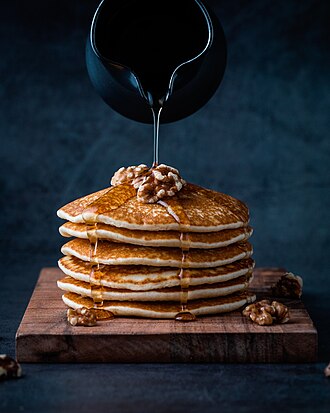
Photo: Wikipedia
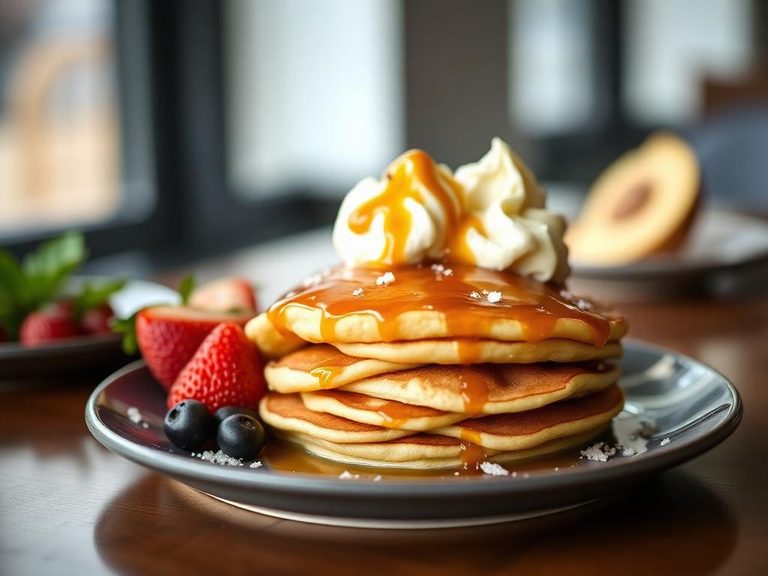
This is the classic American pancake made from a dry mix where you just add water or milk. It has a soft, spongy texture with a mild, slightly sweet flavor that acts as a perfect canvas for toppings. Nutritionally, it provides a moderate energy boost from carbohydrates with a decent amount of protein for a breakfast item.
Calorie split: 14% protein · 53% carbs · 32% fat
↓ Full nutrition💚 Why it's loved
People love them for their comforting, mild flavor and fluffy texture, which perfectly absorbs maple syrup, butter, or fruit compotes. They are deeply embedded in American breakfast culture, evoking a sense of home and weekend leisure.
⚠️ Watch-outs & how to enjoy it better
The refined carbohydrate content can lead to a quick blood-sugar spike and subsequent crash, especially without added protein or fat. They are also often made with wheat flour, a common allergen. To counteract this, top with Greek yogurt or nuts for protein, use a sugar-free syrup, or opt for a whole-grain mix.
Key benefits
- Quick and convenient to prepare from a mix
- Good source of energy from complex carbohydrates
- Contains a moderate amount of protein
- Versatile base for both sweet and savory toppings
- Familiar, comforting breakfast staple
🍽️ Popular dishes
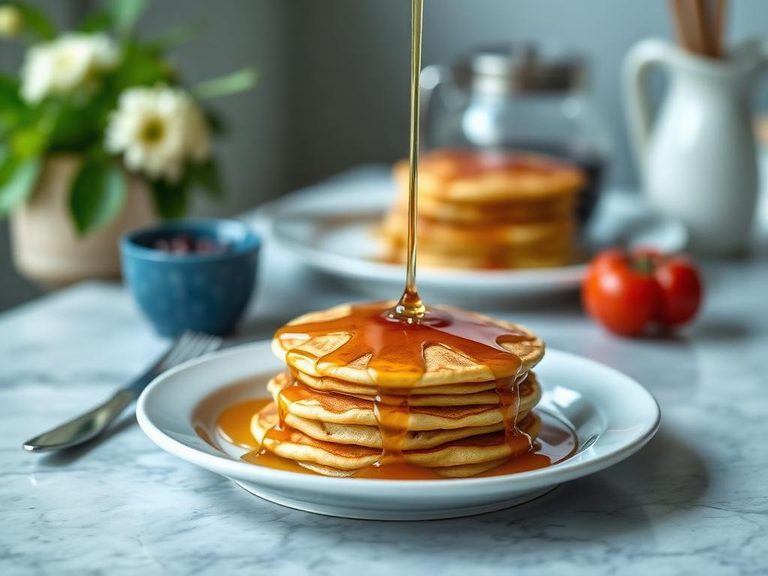
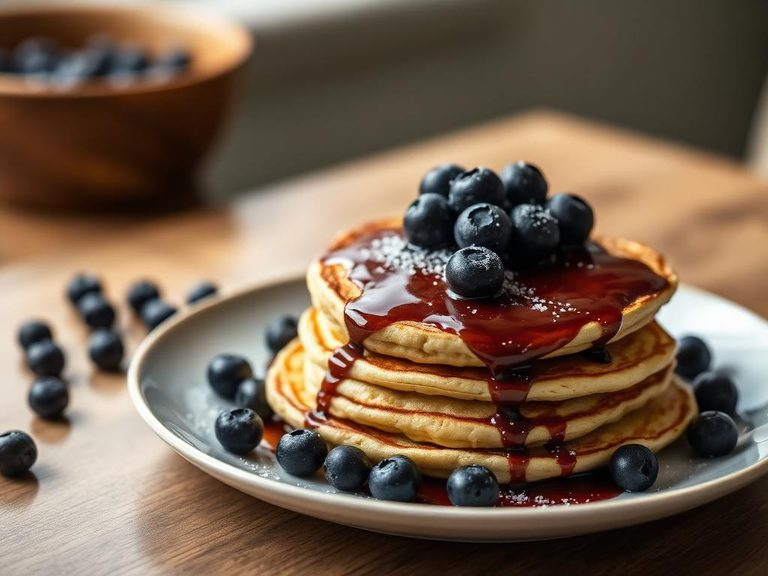
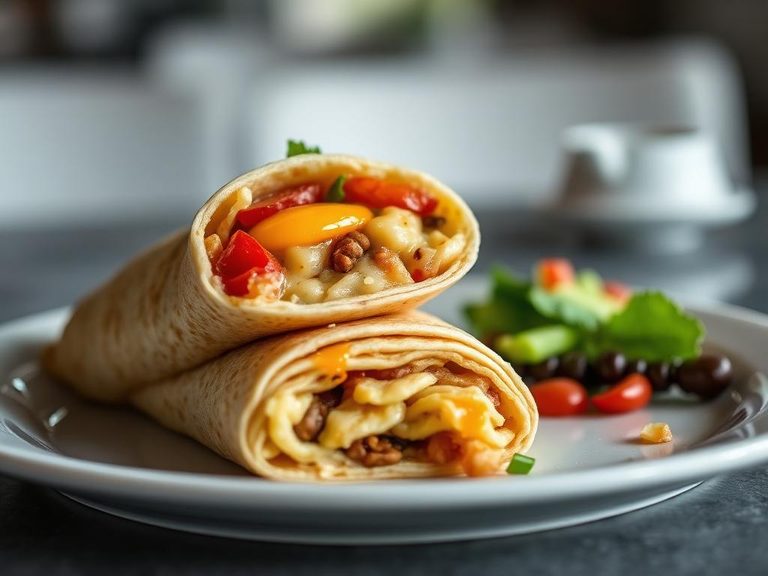

🌍 Where it's eaten
💡 Did you know?
The first commercially successful pancake mix, Aunt Jemima, was introduced in 1889 and was the first ready-mix food ever sold in the US.
Full nutrition (USDA data · scales with serving)
| Water | 52.9 g |
| Energy | 218 kcal |
| Energy | 912 kj |
| Protein | 7.8 g |
| Total lipid (fat) | 7.7 g |
| Ash | 2.6 g |
| Carbohydrate, by difference | 28.9 g |
| Fiber, total dietary | 1.9 g |
| Calcium, Ca | 215 mg |
| Iron, Fe | 1.3 mg |
| Magnesium, Mg | 22.0 mg |
| Phosphorus, P | 313 mg |
| Potassium, K | 199 mg |
| Sodium, Na | 505 mg |
| Zinc, Zn | 0.75 mg |
| Copper, Cu | 0.05 mg |
| Manganese, Mn | 0.14 mg |
| Selenium, Se | 9.8 ug |
| Vitamin C, total ascorbic acid | 0.60 mg |
| Thiamin | 0.20 mg |
| Riboflavin | 0.31 mg |
| Niacin | 1.2 mg |
| Pantothenic acid | 0.51 mg |
| Vitamin B-6 | 0.10 mg |
| Folate, total | 36.0 ug |
| Folic acid | 25.0 ug |
| Folate, food | 11.0 ug |
| Folate, DFE | 54.0 ug |
| Vitamin B-12 | 0.34 ug |
| Vitamin A, RAE | 71.0 ug |
| Retinol | 70.0 ug |
| Vitamin A, IU | 250 iu |
Fat & fatty acid profile (per 100g)
| Fatty acids, total saturated | 2.0 g |
| SFA 4:0 | 0.05 g |
| SFA 6:0 | 0.03 g |
| SFA 8:0 | 0.02 g |
| SFA 10:0 | 0.04 g |
| SFA 12:0 | 0.04 g |
| SFA 14:0 | 0.16 g |
| SFA 16:0 | 1.2 g |
| SFA 18:0 | 0.46 g |
| Fatty acids, total monounsaturated | 2.1 g |
| MUFA 16:1 | 0.09 g |
| MUFA 18:1 | 2.0 g |
| MUFA 20:1 | 0.01 g |
| MUFA 22:1 | 0.00 g |
| Fatty acids, total polyunsaturated | 2.9 g |
| PUFA 18:2 | 2.6 g |
| PUFA 18:3 | 0.32 g |
| PUFA 18:4 | 0.00 g |
| PUFA 20:4 | 0.02 g |
| PUFA 20:5 n-3 (EPA) | 0.00 g |
| PUFA 22:5 n-3 (DPA) | 0.00 g |
| PUFA 22:6 n-3 (DHA) | 0.01 g |
| Cholesterol | 71.0 mg |
Amino acid profile (per 100g)
| Tryptophan | 0.10 g |
| Threonine | 0.30 g |
| Isoleucine | 0.38 g |
| Leucine | 0.66 g |
| Lysine | 0.41 g |
| Methionine | 0.18 g |
| Cystine | 0.14 g |
| Phenylalanine | 0.38 g |
| Tyrosine | 0.29 g |
| Valine | 0.43 g |
| Arginine | 0.34 g |
| Histidine | 0.19 g |
| Alanine | 0.32 g |
| Aspartic acid | 0.54 g |
| Glutamic acid | 1.8 g |
| Glycine | 0.24 g |
| Proline | 0.67 g |
| Serine | 0.43 g |
FAQ
How is this different from a pancake made from scratch?
A dry mix pre-combines flour, leavening agents, sugar, and salt. Scratch recipes allow you to control ingredients like flour type, sugar, and fat content more precisely.
Can I make these without eggs or milk?
Yes, the 'incomplete' mix is designed to be prepared with just water, but you can also substitute plant-based milk or use a flax egg for added nutrition and binding.
Why are they called 'incomplete' mix?
The term indicates that the mix requires the addition of wet ingredients (like water, milk, and/or eggs) to become a complete batter and be ready for cooking.
Nutrient density (calculated · NRF9.3)
Nutrient Rich Foods index: beneficial nutrients (protein, fiber, vitamins, minerals) minus saturated fat, added sugar & sodium, per 100 kcal.
NRF9.3 index — Fulgoni, Keast & Drewnowski, 2009. Computed from USDA nutrients.
Weight-loss friendliness (composite index)
Energy density 2.18 kcal/g · 14% calories from protein · 1.9 g fiber · 0.0 g sugar per 100 g.
Composite of energy density (Rolls et al., 1999), protein & fiber satiety, minus sugar. A calculated heuristic — ranks satiety-per-calorie, not a clinical measure.
Dietary load (calculated from USDA values)
Potential renal acid load. Positive = acid-forming, negative = alkaline-forming.
Sodium-to-potassium ratio: 2.54 (lower is better — aim for ≤ 1)
Sodium:potassium per WHO potassium guidance. Computed from USDA nutrients.